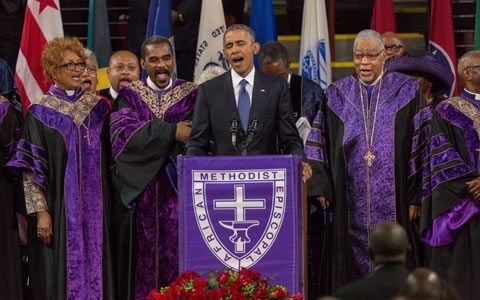
“This eulogy delivered by Barack Obama at the funeral for Rev. Clementa Pinckney, one of the victims of the shootings at Emanuel African Methodist Episcopal Church in Charleston, South Carolina, is the best example of a Christian message I have ever heard delivered by any political leader – ever! How inspiring to hear a public figure talk so openly and confidently about God and church and grace. Regardless of one’s vocation, or circumstance, or politics, or worldview, we would all do well to study this speech, live by its message, and speak it out clearly in our own families and communities”
Glyn Carpenter, NZCN National Director
Remarks by the President in Eulogy for the Honorable Reverend Clementa Pinckney
College of Charleston Charleston, South Carolina 2:49 P.M. EDT
THE PRESIDENT: Giving all praise and honour to God.
The Bible calls us to hope. To persevere, and have faith in things not seen.
“They were still living by faith when they died,” Scripture tells us. “They did not receive the things promised; they only saw them and welcomed them from a distance, admitting that they were foreigners and strangers on Earth.”
We are here today to remember a man of God who lived by faith. A man who believed in things not seen. A man who believed there were better days ahead, off in the distance. A man of service who persevered, knowing full well he would not receive all those things he was promised, because he believed his efforts would deliver a better life for those who followed.
To Jennifer, his beloved wife; to Eliana and Malana, his beautiful, wonderful daughters; to the Mother Emanuel family and the people of Charleston, the people of South Carolina.
I cannot claim to have the good fortune to know Reverend Pinckney well. But I did have the pleasure of knowing him and meeting him here in South Carolina, back when we were both a little bit younger. (Laughter.) Back when I didn’t have visible grey hair. (Laughter.) The first thing I noticed was his graciousness, his smile, his reassuring baritone, his deceptive sense of humour — all qualities that helped him wear so effortlessly a heavy burden of expectation.
Friends of his remarked this week that when Clementa Pinckney entered a room, it was like the future arrived; that even from a young age, folks knew he was special. Anointed. He was the progeny of a long line of the faithful — a family of preachers who spread God’s word, a family of protesters who sowed change to expand voting rights and desegregate the South. Clem heard their instruction, and he did not forsake their teaching.
He was in the pulpit by 13, pastor by 18, public servant by 23. He did not exhibit any of the cockiness of youth, nor youth’s insecurities; instead, he set an example worthy of his position, wise beyond his years, in his speech, in his conduct, in his love, faith, and purity.
As a senator, he represented a sprawling swath of the Lowcountry, a place that has long been one of the most neglected in America. A place still wracked by poverty and inadequate schools; a place where children can still go hungry and the sick can go without treatment. A place that needed somebody like Clem.
His position in the minority party meant the odds of winning more resources for his constituents were often long. His calls for greater equity were too often unheeded, the votes he cast were sometimes lonely. But he never gave up. He stayed true to his convictions. He would not grow discouraged. After a full day at the capitol, he’d climb into his car and head to the church to draw sustenance from his family, from his ministry, from the community that loved and needed him. There he would fortify his faith, and imagine what might be.
Reverend Pinckney embodied a politics that was neither mean, nor small. He conducted himself quietly, and kindly, and diligently. He encouraged progress not by pushing his ideas alone, but by seeking out your ideas, partnering with you to make things happen. He was full of empathy and fellow feeling, able to walk in somebody else’s shoes and see through their eyes. No wonder one of his senate colleagues remembered Senator Pinckney as “the most gentle of the 46 of us — the best of the 46 of us.”
Clem was often asked why he chose to be a pastor and a public servant. But the person who asked probably didn’t know the history of the AME church. As our brothers and sisters in the AME church know, we don’t make those distinctions. “Our calling,” Clem once said, “is not just within the walls of the congregation, but…the life and community in which our congregation resides.”
He embodied the idea that our Christian faith demands deeds and not just words; that the “sweet hour of prayer” actually lasts the whole week long, that to put our faith in action is more than individual salvation, it’s about our collective salvation; that to feed the hungry and clothe the naked and house the homeless is not just a call for isolated charity but the imperative of a just society.
What a good man. Sometimes I think that’s the best thing to hope for when you’re eulogized — after all the words and recitations and resumes are read, to just say someone was a good man.
You don’t have to be of high station to be a good man. Preacher by 13. Pastor by 18. Public servant by 23. What a life Clementa Pinckney lived. What an example he set. What a model for his faith. And then to lose him at 41 — slain in his sanctuary with eight wonderful members of his flock, each at different stages in life but bound together by a common commitment to God.
Cynthia Hurd. Susie Jackson. Ethel Lance. DePayne Middleton-Doctor. Tywanza Sanders. Daniel L. Simmons. Sharonda Coleman-Singleton. Myra Thompson. Good people. Decent people. God-fearing people. People so full of life and so full of kindness. People who ran the race, who persevered. People of great faith.
To the families of the fallen, the nation shares in your grief. Our pain cuts that much deeper because it happened in a church. The church is and always has been the centre of African-American life, a place to call our own in a too often hostile world, a sanctuary from so many hardships.
Over the course of centuries, black churches served as “hush harbours” where slaves could worship in safety; praise houses where their free descendants could gather and shout hallelujah, rest stops for the weary along the Underground Railroad; bunkers for the foot soldiers of the Civil Rights Movement. They have been, and continue to be, community centres where we organize for jobs and justice; places of scholarship and network; places where children are loved and fed and kept out of harm’s way, and told that they are beautiful and smart, and taught that they matter. That’s what happens in church.
That’s what the black church means. Our beating heart. The place where our dignity as a people is inviolate. When there’s no better example of this tradition than Mother Emanuel, a church built by blacks seeking liberty, burned to the ground because its founder sought to end slavery, only to rise up again, a Phoenix from these ashes.
When there were laws banning all-black church gatherings, services happened here anyway, in defiance of unjust laws. When there was a righteous movement to dismantle Jim Crow, Dr. Martin Luther King, Jr. preached from its pulpit, and marches began from its steps. A sacred place, this church. Not just for blacks, not just for Christians, but for every American who cares about the steady expansion of human rights and human dignity in this country; a foundation stone for liberty and justice for all. That’s what the church meant.
We do not know whether the killer of Reverend Pinckney and eight others knew all of this history. But he surely sensed the meaning of his violent act. It was an act that drew on a long history of bombs and arson and shots fired at churches, not random, but as a means of control, a way to terrorize and oppress. An act that he imagined would incite fear and recrimination; violence and suspicion. An act that he presumed would deepen divisions that trace back to our nation’s original sin.
Oh, but God works in mysterious ways. God has different ideas.
He didn’t know he was being used by God. Blinded by hatred, the alleged killer could not see the grace surrounding Reverend Pinckney and that Bible study group — the light of love that shone as they opened the church doors and invited a stranger to join in their prayer circle. The alleged killer could have never anticipated the way the families of the fallen would respond when they saw him in court — in the midst of unspeakable grief, with words of forgiveness. He couldn’t imagine that.
The alleged killer could not imagine how the city of Charleston, under the good and wise leadership of Mayor Riley, how the state of South Carolina, how the United States of America would respond — not merely with revulsion at his evil act, but with big-hearted generosity and, more importantly, with a thoughtful introspection and self-examination that we so rarely see in public life.
Blinded by hatred, he failed to comprehend what Reverend Pinckney so well understood — the power of God’s grace.
This whole week, I’ve been reflecting on this idea of grace. The grace of the families who lost loved ones. The grace that Reverend Pinckney would preach about in his sermons. The grace described in one of my favourite hymnals — the one we all know: Amazing grace, how sweet the sound that saved a wretch like me. I once was lost, but now I’m found; was blind but now I see.
According to the Christian tradition, grace is not earned. Grace is not merited. It’s not something we deserve. Rather, grace is the free and benevolent favour of God, as manifested in the salvation of sinners and the bestowal of blessings. Grace.
As a nation, out of this terrible tragedy, God has visited grace upon us, for he has allowed us to see where we’ve been blind. He has given us the chance, where we’ve been lost, to find our best selves. We may not have earned it, this grace, with our rancour and complacency, and short-sightedness and fear of each other — but we got it all the same. He gave it to us anyway. He’s once more given us grace. But it is up to us now to make the most of it, to receive it with gratitude, and to prove ourselves worthy of this gift.
For too long, we were blind to the pain that the Confederate flag stirred in too many of our citizens. It’s true, a flag did not cause these murders. But as people from all walks of life, Republicans and Democrats, now acknowledge — including Governor Haley, whose recent eloquence on the subject is worthy of praise, as we all have to acknowledge, the flag has always represented more than just ancestral pride. For many, black and white, that flag was a reminder of systemic oppression and racial subjugation. We see that now.
Removing the flag from this state’s capitol would not be an act of political correctness; it would not be an insult to the valour of Confederate soldiers. It would simply be an acknowledgement that the cause for which they fought — the cause of slavery — was wrong — the imposition of Jim Crow after the Civil War, the resistance to civil rights for all people was wrong. It would be one step in an honest accounting of America’s history; a modest but meaningful balm for so many unhealed wounds. It would be an expression of the amazing changes that have transformed this state and this country for the better, because of the work of so many people of goodwill, people of all races striving to form a more perfect union. By taking down that flag, we express God’s grace.
But I don’t think God wants us to stop there. For too long, we’ve been blind to the way past injustices continue to shape the present. Perhaps we see that now. Perhaps this tragedy causes us to ask some tough questions about how we can permit so many of our children to languish in poverty, or attend dilapidated schools, or grow up without prospects for a job or for a career.
Perhaps it causes us to examine what we’re doing to cause some of our children to hate. Perhaps it softens hearts towards those lost young men, tens and tens of thousands caught up in the criminal justice system, and leads us to make sure that that system is not infected with bias; that we embrace changes in how we train and equip our police so that the bonds of trust between law enforcement and the communities they serve make us all safer and more secure.
Maybe we now realize the way racial bias can infect us even when we don’t realize it, so that we’re guarding against not just racial slurs, but we’re also guarding against the subtle impulse to call Johnny back for a job interview but not Jamal. So that we search our hearts when we consider laws to make it harder for some of our fellow citizens to vote. By recognizing our common humanity by treating every child as important, regardless of the colour of their skin or the station into which they were born, and to do what’s necessary to make opportunity real for every American — by doing that, we express God’s grace.
For too long —
AUDIENCE: For too long!
THE PRESIDENT: For too long, we’ve been blind to the unique mayhem that gun violence inflicts upon this nation. Sporadically, our eyes are open: When eight of our brothers and sisters are cut down in a church basement, 12 in a movie theatre, 26 in an elementary school. But I hope we also see the 30 precious lives cut short by gun violence in this country every single day; the countless more whose lives are forever changed — the survivors crippled, the children traumatized and fearful every day as they walk to school, the husband who will never feel his wife’s warm touch, the entire communities whose grief overflows every time they have to watch what happened to them happen to some other place.
The vast majority of Americans — the majority of gun owners — want to do something about this. We see that now. And I’m convinced that by acknowledging the pain and loss of others, even as we respect the traditions and ways of life that make up this beloved country — by making the moral choice to change, we express God’s grace.
We don’t earn grace. We’re all sinners. We don’t deserve it. But God gives it to us anyway. And we choose how to receive it. It’s our decision how to honour it.
None of us can or should expect a transformation in race relations overnight. Every time something like this happens, somebody says we have to have a conversation about race. We talk a lot about race. There’s no shortcut. And we don’t need more talk. None of us should believe that a handful of gun safety measures will prevent every tragedy. It will not. People of goodwill will continue to debate the merits of various policies, as our democracy requires — this is a big, raucous place, America is. And there are good people on both sides of these debates. Whatever solutions we find will necessarily be incomplete.
But it would be a betrayal of everything Reverend Pinckney stood for, I believe, if we allowed ourselves to slip into a comfortable silence again. Once the eulogies have been delivered, once the TV cameras move on, to go back to business as usual — that’s what we so often do to avoid uncomfortable truths about the prejudice that still infects our society. To settle for symbolic gestures without following up with the hard work of more lasting change — that’s how we lose our way again.
It would be a refutation of the forgiveness expressed by those families if we merely slipped into old habits, whereby those who disagree with us are not merely wrong but bad; where we shout instead of listen; where we barricade ourselves behind preconceived notions or well-practised cynicism.
Reverend Pinckney once said, “Across the South, we have a deep appreciation of history — we haven’t always had a deep appreciation of each other’s history.” What is true in the South is true for America. Clem understood that justice grows out of recognition of ourselves in each other. That my liberty depends on you being free, too. That history can’t be a sword to justify injustice, or a shield against progress, but must be a manual for how to avoid repeating the mistakes of the past — how to break the cycle. A roadway toward a better world. He knew that the path of grace involves an open mind — but, more importantly, an open heart.
That’s what I’ve felt this week — an open heart. That, more than any particular policy or analysis, is what’s called upon right now, I think — what a friend of mine, the writer Marilyn Robinson, calls “that reservoir of goodness, beyond, and of another kind, that we are able to do each other in the ordinary cause of things.”
That reservoir of goodness. If we can find that grace, anything is possible. If we can tap that grace, everything can change.
Amazing grace. Amazing grace.
(Begins to sing) — Amazing grace, how sweet the sound, that saved a wretch like me; I once was lost, but now I’m found; was blind but now I see.
Clementa Pinckney found that grace.
Cynthia Hurd found that grace.
Susie Jackson found that grace.
Ethel Lance found that grace.
DePayne Middleton-Doctor found that grace.
Tywanza Sanders found that grace.
Daniel L. Simmons, Sr. found that grace.
Sharonda Coleman-Singleton found that grace.
Myra Thompson found that grace.
Through the example of their lives, they’ve now passed it on to us. May we find ourselves worthy of that precious and extraordinary gift, as long as our lives endure. May grace now lead them home. May God continue to shed His grace on the United States of America.
by Kirsty Anderson, Elevate Christian Disability Trust
24% of people in NZ live with some form of disability. When you consider this number, there is little doubt that in most churches there are people who either have a disability themselves or have a family member with a disability.
What is disability?
Disability is a term used to cover a wide range of long-term impairments, physical limitations and restrictions. These impairments generally fit into the following categories:
blind and low vision
deaf and hard of hearing
intellectual
developmental
physical
mental health
Ways to look at disability
There are two main ‘models’ used commonly to view and frame disability. The medical model views disability as an abnormality, with diagnosis and treatment focussed on defects and dysfunction. The emphasis is to fix the abnormality or defect.
The social model views disability as the result of barriers (attitudinal, physical and organisational), not a person’s impairment. The emphasis is on removing barriers.
The various views and beliefs about disability within society have been shaped by history and by what society considers important. Who society recognizes and admires is an indicator of what is important and valued in that society. We see those who have accomplished much labelled successful, people whose actions or work contribute greatly to society are highly regarded, and those who are attractive or talented are admired.
From a biblical perspective, our value is because of who designed us and the price paid for us. We are all made in the image of God. All of us were ‘knit together’ and formed by God. Jesus’ death on a cross was the price paid for each of us, which includes people who experience disability. Our physical appearance, our intelligence, or what we have done, cannot lessen or add to our value.
Our society places great significance on independence and views those who rely on others, or need more support, as weak. In contrast, from a biblical perspective every person is dependent on God and this dependence is immense and endless. God also made us to be interdependent, to do life together and to support each other. We are called the Body of Christ and no one part of a body can function on its own. It can only function as a part of the whole body, each part dependent to varying degrees on the rest.
God looks at the heart. Our appearance and our level of intelligence are not important to Him. In Proverbs we are told to trust God and not lean on our own understanding. In 1 Corinthians we are told that knowledge will pass away.
What is it that we are focusing on? Is it the disability? Or do we focus on what is eternal?
Why is there disability?
There are no easy answers and around certain aspects there are differing views. In saying this, there are some key truths. Disability can result from illness, disease, genetics, accidents or injuries. There has been degeneration of the gene pool since sin entered the world, so our physical bodies are not as perfect as Adam and Eve’s. Sometimes, God allows people to have disability. Some people also assign responsibility to God for not only allowing but causing their disability.
Understand first and foremost that a person is a person; they may also happen to have a disability but this is not who they are.
Become aware of the beliefs and attitudes you have around disability.
Talk about the value of life – how our value was determined by Christ’s death and by being made in His image. As such, intelligence, appearance, independence and achievements do not determine our worth
Recognise that disability affects the physical body and not the spirit; therefore disability does not hinder a person having a relationship with God.
Consider the following passages: Exodus 4:10-12; 2 Corinthians 4:16-18; Luke 14 and 1 Corinthians 12.
Kirsty oversees the relationships Elevate has with Churches, making sure they are supported in their efforts of inclusion for people with disabilities in the church.
The Christian message Samuel Marsden introduced 200 years ago has been positive for this country and is one which must be repeated with optimism and conviction year in and year out.
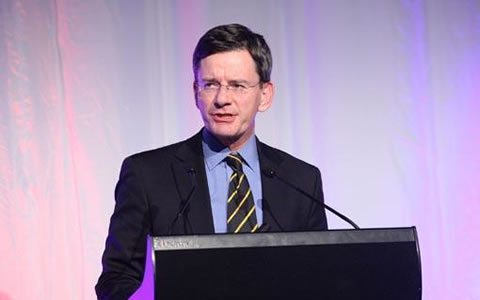
The following speech was delivered by Hon Christopher Finlayson QC, Attorney-General, during the Gospel Bicentenary commemorations held at Oihi in the Bay of Islands, Christmas Week 2014. It should be an encouragement to Christians in all walks of life to know and tell our Christian story.
1814 was a very interesting year. The most noteworthy event was the abdication of Napoleon as Emperor of the French on 11 April, preceded a few days earlier by the Bourbon restoration. George Stephenson tested his first locomotive, Blucher, successfully in England. Pius VII re-established the Society of Jesus all over the world. Some here may say that was a very bad move by His Holiness; others, including me, say it paved the way for the election of Francis, the first Jesuit pope.
The British continued to have a bad time in the United States. On September 13, their failure at the Battle of Baltimore was a critical turning-point in their war with the Americans. The American defence of Fort McHenry inspired Francis Scott Key to compose the poem later set to music as The Star Spangled Banner.
The year ended with the Congress of Vienna, which sought to settle many issues arising out of French Revolutionary Wars and the Napoleonic Wars. Schubert’s First Mass and Beethoven’s Eighth Symphony had their premieres and, on 25 December, just down the path from here, Samuel Marsden brought Christianity to New Zealand.
As we all know, Marsden introduced to New Zealand what is arguably the gentlest form of Christianity: Anglicanism. Shortly thereafter, the Catholics arrived bringing French Catholicism and, some years later, Irish Catholicism.
With settlement came the dour Scots and Presbyterianism. Then the social justice advocates, unimpressed with establishment Christianity, who brought first Methodism and then the Salvation Army.
And this introduction of various forms of Christianity continued into the twentieth century. Orthodoxy came with our first Greek immigrants and in due course the Serbs, Romanians and Russians. Most recently, the Assyrian Christians, uprooted from their homelands by extremism, have brought their religion and liturgy spoken in the language of Christ.
This [the Christian heritage of New Zealand] is a rich and interesting story and it is not recounted enough.
Despite the odd outbreak of sectarian hostility, the churches have worked pretty well together over the years. I think of the first parish priest of Saint Mary of the Angels in Wellington, who conducted funeral services for the Presbyterians at St John’s in Willis Street when their minister was absent. Today, St John’s gives its church to St Mary of the Angels’ parishioners so they can celebrate Mass while their church in Boulcott Street is repaired.
All these churches continue today. Many appear to have fallen on hard times. They seem lost and perplexed by the modern world. They try to adapt, not always successfully. For me, the Judeo-Christian tradition, which Marsden inaugurated on Christmas Day 1814, and which has continued to this day, is underscored by four main points:
First, that the individual is made in the image of God and that, accordingly, everyone has worth.
Secondly, that one should respect individual effort and creativity, a key idea, particularly following the Reformation and the Enlightenment. In medieval times, and even in some corners of Christianity today, independence of thought is not cherished.
Thirdly, that a successful society is one governed by laws, not men and women – that we are all subject to the rule of law no matter how powerful or how rich. An ancient value, admittedly, but one reinforced by the Reformation and the American Revolution.
Finally, above all, the Christian message is a very optimistic one. It is a story of reconciliation and forgiveness.
As Pope Francis recently told the Council of Europe, in order to progress towards the future, we need the past, we need profound roots. We either preserve a country’s foundational being or it dies.
I am pleased to be here today and, to use an overused word, ‘celebrate’ the arrival of Marsden and Christianity into New Zealand because the Christian message he introduced 200 years ago has been positive for this country and is one which must be repeated with optimism and conviction year in and year out.
The Christian churches should be proud of these traditions and their message; they do not worry about reinventing themselves and trying to be relevant. Of course they have to adapt to changing times, but they can and must hold fast to unchanging principles and have the same gritty determination of Samuel Marsden.
On my recent and first trip to Nepal I saw the blind see, the deaf hear and the lame walk. I saw dozens of work weary women receive restored knees and backs; I saw healing touch a boy with cerebral palsy, movement restored to a stroke victim, gastric problems healed and demonic oppression lifted. I asked myself why we did not see this level of healing in New Zealand even as I rejoiced to see more than 80% of those we prayed for receive healing in the name of Jesus. We also saw approximately 1300 people commit to belief in Jesus and receive salvation.
My journey to Nepal and beyond started some two years ago. As Pastor at New Plymouth Central Baptist I received news that one of our women in the congregation had received a diagnosis for a life threatening cancer. Of course we would pray and organise pastoral support and care. A week later I heard of another woman under similar diagnosis. And in the next few weeks the number grew to four. My reaction moved from just care and compassion to a growing anger at the impact of Genesis 3 sin on good people amongst us and our own sense of helplessness in the face of it.
I was reading in John 11 at that time. In the story of the death and raising of Lazarus I realised, with the help of a good commentator, that the words “moved with compassion” barely began to describe how Jesus felt. What the original language conveyed was ‘moved with anger’ at Satan and sin. I knew that feeling. Only Jesus was not helpless in the face of it. I shared it with the church and declared that we would and should seek the Lord to know more of his healing power.
To that end we invited John Fergusson to bring to us his School of Healing, both in January and again in March of 2014. We dared to believe that we would see more of God’s healing power. John had more experience of this than we did and we asked him to share of his experience and insight. He also invited any that would like to do so to join him on a missions trip to Nepal where he went twice each year and had done so for the last eight years. He described a much wider experience of God’s healing in Nepal than he was seeing in New Zealand.
We saw some more healing during the year that followed the schools but not enough. Of the four women diagnosed with cancer and one other condition three were successfully treated medically and one went to be with the Lord. For the three healed we could not say that God had intervened because we saw no evidence of that directly other than through medical processes. We praised God for those successful treatments. But we so wanted to also to see the direct miraculous hand of God. Six congregation members signed up to go with John to Nepal in November of 2014 to make up a missions team of 12 persons. The focus of the mission was a partnership with the local churches in evangelism and healing…
Nepal is one of the poorer countries of the world. Nepal’s citizens experience a full range of diseases and injury that comes from poverty, minimal infrastructure and back breaking subsistence labour. In a traditional three day crusade meeting context amongst villages in Western Nepal we saw attendance grow each day from 2500 to 9000 as word spread that Jesus was present to save and to heal. Some 1300, mostly Hindus, responded to the invitation for salvation. The invitation for healing in Jesus name also produced immense interest.
And they came. Men and women with gastro problems evidenced by continued pain and excruciatingly tight abdominal muscles, lumps of various causes, migraines, limb injuries, blindness, deafness, demonic oppression…
God was faithful. The same scenarios can be told over and over so allow me to recount some unusual ones both from the crusade meetings and from the schools of healing that we held in two other centres.
We also ran into a lot of overt demonic oppression. In the presence of an active Holy Spirit they manifested. We were able to deal with these by the Holy Spirit. One particular incident taught me a lot.*
These are extracts from my diary of that mission
“Back and knees…”
The first person to approach me seeking healing was an old-looking woman who pointed to her back and her knees. The young teenage translator explained she could no longer crouch to work as years of this kind of labour had ruined her knees and her back.
My mind raced in true strategic western reasoning. The problem was the nature of her work, which was what needed fixing. Why would I pray for her back and knees when the nature of her working life could be and should be changed? On and on went my mind seeking solutions for this woman and others like her.
Then the Lord spoke so clearly into my spirit. “Martien, that’s all well and good, but what are you going to do for this woman standing in front of you?” Gently but firmly he brought me back on track. So with the authority He grants us I said to the woman “Jesus is the only healer and in his name I now command your back to be healed and made whole, to your knees also I now say be healed.”
She looked at me quite blankly as the interpretation was made. Even after that she just looked puzzled. Taking her by the hands I asked her to crouch with me. She did. Going down had never really been the problem. Then we rose using only those knee and back muscles and as we did a huge smile broke out on her face.
God had healed and restored both back and knees. Immediately there was a line of about 20-30 women all with worn bodies, broken knees and broken backs. Expectation was suddenly very high, faith unquestionable and God was faithful.
They were all healed. They could go back to those rice fields, they could again provide for their families. Me, I was awed and stopped analysing – it was just too busy to think too much as people pressed around seeking the Lord’s touch.
“Deafness…”
A young man came with one deaf ear, his right ear. We commanded the ear to hear again in Jesus name. We tested it. His ear was healed.
I was asked to come and pray for a woman who had no hearing in her left ear. I first tested her by blocking off the good right ear and proved she could not hear in her left ear. I commanded healing of the ear and the healing and clearing of the infection.
We stood for about a minute with my hands on her ear. Then covering her good right ear firmly asked whether she could hear me. Yes; but still a little muffled.
Covering her right ear again I spoke the name of Jesus into her left ear. Saying several times, “Hear this – Jesus is the healer.” She did hear and was fully healed. We tested it and her husband tested it and with a big smile she said “Jesus has healed me.” Amen to that!
“Pain and tightness…”
A young man with pains and tightness across his stomach. Assuming the pain symptomatic of a problem I took authority over the cause and commanded the symptomatic pain to go in Jesus name as evidence of the healing. On one side the pain disappeared completely and the other it remained in a lesser state. So we prayed again and it continued to diminish. We gave thanks for a complete healing.
Probably two dozen more young men with the same complaint and God healed them. God is good.
“Mentrual issues and pain…”
A very moving, poignant moment when a woman, probably in her early 20s, stood in front of me with her face set in sadness. She explained that her menstrual cycle was completely inconsistent in timing and she had constant related pain. She had been like this for 5 years. This meant no children (she was married).
I was awed that she had pushed past her sense of shame (based on community values) and the cultural inappropriateness of talking to a man of intimate woman’s problems.
So urgent was her need that she had come to talk to me. She reminded me of a woman who pursued Jesus just to touch his garment. I felt so privileged to stand in Jesus place, with his authority, to meet her need.
I commanded in Jesus name that wholeness and normality be restored to her body and that she be freed from pain as immediate evidence of God’s hand on her body.
The pain cleared and she knew it. The proof of her full healing would come in the next few weeks.
“Sight…”
A woman came with problems with no short-sightedness in her eyes. Difficult if you are harvesting with a very sharp sickle. We commanded her eyes to see again properly and she said “I see” and she did and could see and focus on the short distance.
A young boy was presented by his father because his eyes would not work together to focus and both eyes moved at random when he tried to look at something. They came right with a command to heal and I had the joy of looking him in the eye and holding his gaze as he held mine.
“Stroke…”
There was a man who three years before had had a stroke. He had pain in his head and all down the left hand side of his body. He could walk dragging his left foot and his left arm hung limply.
I spoke healing to the brain and to the pain in Jesus name. The pain left his body, his foot was released to walk again although he needed to practice that. He began to move his arm and gradually lifted it over his head and moved it into increased circles and flexing as full use was restored to it.
“Small miracles are still miracles…”
A woman came with a painful growth on one toe and under authority in Jesus name if faded from sight in front of our eyes – she was healed.*
“More than meets the eye…”
A woman approached me asking for prayer for a lump on the side of her throat and a pain down her right side of her body. We sought to minister to this but nothing changed and we had to let her go.
There was sadness on her face. I went afterwards again to where she sat at the back of the church and again sought to minister healing to her to no avail. I then sensed by the Holy Spirit that this was a spiritual issue and when I raised that point she began to shake and to wail.
A clear manifestation of a demonic spirit. In Jesus name I ordered the Spirit to be silent and it settled down. From other women around we found out that she had been a believer for only one month, that she was not married but the child with her was hers.
I discerned that the physical and spiritual were linked in some way. The Holy Spirit said to me “Look at her dress” I did and realised that this woman was a lot less modestly dressed in a community of woman who were very modest in their attire.
All the pointers were that the woman still worked in the sex industry and she was not yet able to let go of her livelihood which supported her and her child. This proved to be so and we had to leave her in the care of her church community to address this question so that she would feel able to embrace the Lord’s offer to be free.
The rest of the team had similar experiences. The question of why this doesn’t happen like this in New Zealand became a real one for me. I have come to a conclusion about this
Only God is omnipresent. The devil is not. He has to roam backward and forward across the face of the earth. This means he rules as “prince of this world” through other fallen angels (demons / evil spirits). We saw this overtly in Nepal.
Satan is evil but he is not stupid. In Nepal the demons do not hesitate to reveal themselves, scaring people into the hands of witch doctors/shamans and Hindu priests creating a deeper bondage.
In the West the demonic serves Satan better by acting covertly and denying the existence of the spiritual. This does not mean that the demonic is less present. These powers just have different names and strategies.
I come back from Nepal prepared to name powerful demonic forces over our land. They are Rationalism, Individualism, Secularism and Intellectualism amongst others. We are all far more subject to them than we are prepared to acknowledge. Our need to analyse, understand, diagnose and know, are symptomatic of this submission to reason (rationalism) that prevails in our society.
Naming them as demons is itself a first step to breaking their hold on us. I believe it is these demons that undermine faith, encourage doubt, and means we see less healing and less of the miraculous. You will feel foolish in New Zealand even speaking of demons because “rational” people do not do so.
Remember Jesus didn’t hesitate and he dealt to them. I listened in to a fellow believer seeking to pray for healing for a sick friend. There were endless questions about the condition, help that had been sourced so far, medications and treatments ordered. On and on it went.
Why? It is our need to diagnose, analyse, research. Yet none of this makes one jot of difference to God’s capacity or willingness to heal. It is rationalism again. God knows already and he is the only one that needs to know, we should just obey and trust.
This article by Marcus Roberts (MercatorNet, 29 April) picks up on an NZ Herald article about the 2014 Report on the Positive Ageing Strategy, and highlights the very real risk that a change to NZ’s euthanasia laws would bring.
According to this article in the NZHerald, the Age Concern charity estimates that “between 17,000 and 25,000 older Kiwis [New Zealanders] experience some sort of abuse each year” … even worse is that about 75% of all alleged abusers are family members … predicted that rate would increase.
It’s not clear what point the author is making about NZ’s Labour Party forcing an MP to withdraw a private member bill on euthanasia before the last election. In saying it didn’t help the party at the election, he seems to be saying it doesn’t matter whether they’d kept the bill or not. In our view, the two issues are quite separate, and regardless of whether it helps a party of not, we hope that all parties refuse to support a bill which could seriously escalate the current problem of elder abuse.
However, the main point of the article is an important one, namely that if euthanasia is legalised, the abuse that elderly folk experience now, could become fatal. Well worth a read.