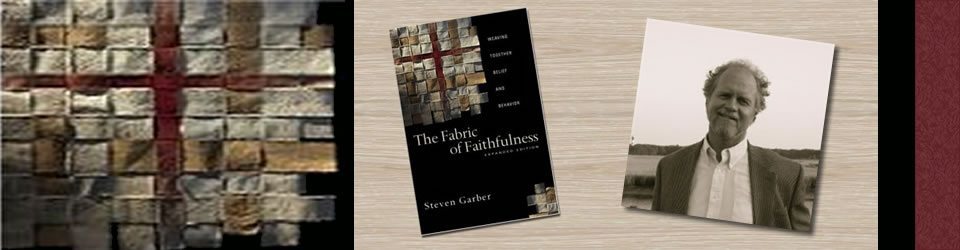
It’s a big question and it’s one that many young Christians really start to wrestle with as they transition out of home and into study and the workforce. One person who has done a lot of thinking about that question is Steve Garber. He has written a fascinating book entitled The Fabric of Faithfulness. In the book he discusses issues of moral meaning, integrity, consistency and connecting what we believe with how we live.
Having lectured for decades on university campuses and interacted with thousands of under-graduate and post-graduate students, Garber has identified three reasons that they become and stay faithful into their adult lives. They are:
1. Convictions – They were taught a worldview which was sufficient for the questions and crises of life, especially the ones implicit in our culture’s secularization and pluralization.
2. Character – They met at least one teacher or mentor who incarnated the worldview which they were coming to consciously identify as their own. That person passionately lived what they believed and was willing to share why and how.
3. Community – They made choices over the years to live out their worldview in the company of mutually committed folk who provided a network of stimulation and support which showed that the ideas could be coherent across the whole of life.
One organization that is trying to foster the development of these three factors in the lives of young adults is the Compass Foundation. The tag-line at Compass is “Know the Gospel; Know Culture; Translate” and at their annual summer conference approximately one hundred 18 – 30 year-olds gather together at Lifeway Campus in Snells Beach to explore those themes with a group of local and international speakers. It is a great place to explore the richness of a gospel that impacts all of life – our working, worshiping, studying, relating, imagining, lamenting, and creating in a thoughtful, open and safe forum. Many of them are profoundly shaped by the week and the ongoing connections and conversations that result.
Philosopher and theologian Jacques Ellul in his Meditation on Ecclesiastes writes: “Remember the Creator during your youth: when all possibilities lie open before you and you can offer all your strength intact for His service. The time to remember is not after you become senile and paralyzed! Then it is not too late for your salvation, but too late for you to serve as the presence of God in the midst of the world and the creation. You must take sides earlier – when you can actually make choices, when you have many paths opening at your feet, before the weight of necessity overwhelms you.”
Driving home today listening to a National Radio Worldwatch item about discussions in Belgium about euthanasia for children. Who said we don’t need to worry about a slippery slope?
We can be thankful for the time being that Maryan Street’s euthanasia bill for New Zealand has been withdrawn, but we should also remember that it is “only for the time being”. When advocates think the time is right, the bill will be reintroduced and Kiwis need to be ready and informed.
Having dinner recently with a friend in Wellington who I regard as very clued up in matters of church and public issues, I was surprised to hear him talk about switching off life-support machines as euthanasia. It’s not!
And if people are not well-informed on the issue, there’s a real danger that when a bill to legalise euthanasia is re-introduced, misinformation will determine the outcome rather than facts and the public good.
One group that I have met has set up a website called euthanasiadebate.org.nz which gives some pretty simple facts and arguments against legalising euthanasia. In a one page flyer called “8 dangers of legal euthanasia” they talk about difficulties with so-called legal safeguards, elder abuse, and other reasons why legalising euthanasia is not a good idea. The back page of the flyer provides answers to common FAQs.
A student doctor I know changed his view on this issue after reading the information and meeting with Professor David Richmond, chair of HOPE Foundation, who supports this initiative and is a specialist in this field.
I recommend having a look at the flyer, and if you think it’s useful forward this post to others. If it’s easier, you can even use the Facebook / Twitter buttons below to share it with your friends.
Many readers will be familiar with the name Keith Newman, author of Bible and Treaty – a book we’ve been encouraging people to read in the lead up to 2014 – the year we mark 200 years since Samuel Marsden first preached the gospel in Aotearoa New Zealand.
Keith has recently released a new book called Beyond Betrayal, and was interviewed by Chris Laidlaw on Radio New Zealand, Sunday 29 September.
As Keith talked about the important role played by the missionaries in New Zealand, and especially by Maori believers, Chris Laidlaw asked “Has NZ history sold Christianity a bit short?”.
Keith’s answer will not be a surprise to most readers but the examples he gives and the stories he shares are well worth listening to.
Chris Laidlaw challenged Keith about claims over the years that evangelical Christianity had undermined the very essence of Maori culture and that in effect the decision to send missionaries to countries like NZ was a form of spiritual assimilation?
Keith’s reply was that the role of the missionaries had been quite misunderstood. He said that the missionaries had to learn and speak the language, to live among the people, learn their customs, “and of course they were working very hard to undermine some of the nastier elements of [the culture] cannibalism, utu, and bring ideas of forgiveness. But once Maori got this they realised that this was a very important change for them”. He went on to talk about how the constant utu, battles, and so on, were decimating the tribes and undermining their ability to survive and trade.
The October edition of the North and South magazine has just been published here in New Zealand, and it contains a nine page article on abortion law in New Zealand.
Not only is the article little more than a one-sided attempt to try and sell the extreme ideology and legislative proposals of the Abortion Law Reform Association of NZ (ALRANZ), but it is riddled with factual and logical flaws.
These flaws start with the title of the article ‘The Meaning of Life‘, a rather odd choice considering the fact that the article doesn’t even really come close to asking the fundamental ethical question at the heart of the abortion debate: ‘is a fetus a living human being entitled to the right to life?’
Before I explore various statements made in the article, I just want to point out some stats so you can get an idea of how one-sided this article is.
The article is 9 pages long, yet approximately just 1/2 to 3/4 of one page, in total, is dedicated to pro-life comment.
Approximately 21 people were interviewed in this article, only 3 are pro-life, the other 18 are pro-choice – and of that other 18, by my count, 13 are either committed pro-choice activists, or abortion industry personal.
Having said that, Amy Blowers, one of the three pro-lifers interviewed, does an awesome job, in the very brief column space she was given, of presenting the important fact that the abortion debate is about ethics, NOT about religion.
If I was to pull this article to pieces line-by-line we’d be here all week, so I have decided to just focus on the aspects of it that caught my attention, and are, I think, worthy of discussion here.
It’s NOT about religion!
Much of this article attempts to frame the abortion debate as a debate about religious beliefs, and it paints the very clear, but totally erroneous picture that this is a debate between one group who want to force a religious dogma on the entire population (the pro-lifers), and another group that is committed to women’s empowerment and autonomy.
This is a classic straw man on the part of the pro-choice movement, because the actual debate about abortion ethics has nothing to do with religion. Instead this is a debate about human ethics, human rights and whether it is right to kill human beings while they are in a womb.
Yes, pro-lifers do come from various religious backgrounds, but then a lot of them also come from no religious background whatsoever (there are at least 6 million non religious pro-lifers in the US alone!) – more importantly; pro-lifers don’t think that abortion is wrong because ‘God told us so’, instead we oppose it because we believe that unborn human beings are people too, and because we embrace the radical idea that it is wrong to deliberately kill innocent human persons.
Sadly this article doesn’t even come close to attempting to engage the fundamental ethical questions at the heart of this debate, instead it just scrapes the bottom of the barrel, and regurgitates the tired old pro-choice sophistry which falsely claims that opposition to abortion is purely a religious matter.
Enough of the one-sided rewriting of NZ history!
There is a reasonable amount of so-called ‘history’ presented in this article. There’s just one problem, the retelling is VERY one-sided, and it digs up old incidents in such a distorted way as to create a false impression of the real history of this debate.
Yes, some anti-abortionists from decades past did engage in extreme activities, however the VAST majority of pro-lifers did NOT – they did nothing more than peacefully protest abortion in New Zealand.
Not only that, but the article tries to impute guilt to pro-lifers for things that almost certainly have NOTHING to do with us – like the recent cutting of fuel lines on the car of an Auckland abortion clinic employee. There is ZERO evidence to link this event with any pro-lifer, and in all likelihood it was actually a case of someone stealing fuel from the car. However that doesn’t stop this studious journo from including comment about it in her article – comment which implies, without ANY justification whatsoever, that it still could have been pro-lifers.
If you want to talk about scary tactics, ones that have actually happened in the past few years, let’s explore in detail the attempts to disaffiliate a pro-life club from Auckland University for peacefully handing out a pamphlet which simply questioned whether women were truly being offered informed consent about abortion in NZ. Or maybe we could discuss pro-life medical professionals being refused jobs simply because they don’t endorse abortion (which is supposed to be illegal in NZ, by the way).
Once again, this is little more the pro-choice smoke and mirrors aimed at discrediting the pro-life movement before a single question can even be asked of the glaring logical flaws in the pro-choice ideology which endorses the killing of human beings in utero.
No, post-abortion trauma is NOT caused by opposition to abortion
I once interviewed a woman who had had two abortions before carrying her third child to term. I still vividly remember the moment when she looked at the camera and stated that when the doctors handed her third child to her after the delivery that she suddenly realized that her previous two children had been murdered (yes, she really did use the word ‘murdered’). As far as I was aware, this woman had no faith background at all, and she certainly wasn’t some timid creature – she was, in fact, a pretty ordinary Kiwi woman who managed her own successful small business.
Yet, if one is to take the claims made in this North and South article seriously, then that woman was actually deluded or lying about her post-abortion grief. According to the ludicrous comments in this article, the only reason she feels pain about her abortions is because someone else tricked or guilted her into feeling pain about it.
Try telling that to the many, many women who told their post-abortion grief stories to Melinda Tankard Reist in her book Giving Sorrow Words.
Yes, I get annoyed at the blatant unwillingness of the pro-choice ideologues to enter into honest debate and have the serious logical flaws of their ideology exposed, but the one thing that really angers me is their continual attempts to pour insult and scorn up women suffering from post-abortion grief by refusing to acknowledge the reality of their suffering. Here you have one of the greatest hypocrisies of this debate: a movement which claims to be pro-woman, while at the same time insinuating that women who are psychologically wounded by abortion are either mentally unwell, or liars.
The current NZ abortion laws costs the healthcare sector money
This was one of the more laughable attempts to justify loosening the current NZ abortion laws (page 62 of the North and South article). If we’re going to talk about saving money for the NZ healthcare sector, then let’s start by having a discussion about removing ALL taxpayer funding for social and preference abortions (non-life saving). Requiring people to fund their own ethically problematic procedures would certainly free up millions of dollars that could be spent on actual life-saving treatments.
And while we’re at it, let’s stop giving millions of dollars to the International Planned Parenthood Federation and instead keep that money in NZ to be used for real healthcare in this country.
You would do WHAT to women who don’t want to have an abortionist kill their unborn child?!
Just listen to this rather disturbing comment from Auckland abortion clinic manager Lesley Wood (page 63 of the article):
“If it were up to her [Wood], she’d put women choosing to keep their baby in front of a panel. “You don’t have two doctors asking them how they’re going to look after this precious little thing and make sure it’s loved and fed for the rest of their lives. The decision to have and parent a child, that’s lifelong and it’s a lot bigger than deciding to have an abortion.”
The truly troubling nature of this comment should give you a good indication of the extremism that is on offer from the pro-choice ideologues right here in good old NZ, and why the last thing this country needs is to start listening to their calls for further loosening of our current abortion laws.
As they say in the rural sector ‘this is totally arse about face’.
This is a drug that has caused multiple female deaths all over the globe, and yet pro-choice activists still try and defend it as ‘safe’ – yet more reason to doubt their claims of being a pro-woman movement.
Actually Simon, conscientious objection is still a right
On page 64 of the article abortionist Simon Snook refers to conscientious objection (you know, that important human right that even medical professionals are allowed to exercise) on the part of medical professionals as “doctors being deliberately obstructive”.
This is just another example of the many hypocrisies that riddle the movement which claims to be all about ‘choice’ – what they really mean, if their actual statements and actions are to be believed, is: ‘choice for only SOME’.
I’m sorry Simon, but your claims about abortion law are not supported by the facts
Staying with abortionist Simon Snook, on page 64 of the article he states that:
“the abortion rates in countries where [abortion is] illegal or restricted is the same as in those with more liberal laws. “You just have more women dying through illegal abortions.”
Yeah, I’m gonna have to go ahead and call you on that one Simon, because it’s just not true.
Ireland has one of the most restrictive abortion laws in the world, yet they also have one of the lowest rates of maternal mortality in the world – their maternal mortality rate is FAR lower than the US where most states allow abortion-on-demand, and often right up to birth.
How’s this for a classic case of woeful ethical logic, once again from abortionist Simon Snook (page 64 of the article):
“I don’t view an embryo or fetus as having the same rights as the person potentially having to raise it in the world.”
Just stop and consider what Snook is suggesting here – he’s giving the right to terminate a human being to the person who has to raise that human being, and he’s basing his refusal to give rights to the fetus based on the impact it will have on the person who will have to care for it as it grows.
How does this not invite the obvious question: what about the person who has to raise an infant, or even a teenager in the world? Shouldn’t they also get more rights, including the right to have that child terminated, because of the fact that they have to potentially keep raising it in the world?
Yes Professor Fergusson, ideology, not truth, is certainly king of the abortion debate at the moment
One of the most telling statements in this article comes from Professor David Fergusson, a researcher who describes himself as a pro-choice atheist. On page 65 he states:
“Colleagues have told him they won’t do work on abortion “because they know they’ll be attacked and vilified unless they produce the right answer”
I can tell you right now that these attacks are not coming from opponents of abortion – they simply don’t don’t hold enough power in the academic halls of power to do such a thing.
Sadly even Fergusson falls prey to this refusal to follow the facts where they clearly point. His own research shows that there is an increased risk of anxiety, alcohol and drug abuse, and suicidal behavior in women who have had abortions, yet he still states that one of his fears is that his “research could be used to stop women having access to abortion”. The tractor beam pull of ideology is strong indeed, even for an honest researcher like Professor Fergusson.
You do realise that Wendy Davis supported an extreme abortion law, right?!
Page 65 of the article refers to Texas senator Wendy Davis, calling her a “new hero” of “the women’s movement in America” because she filibustered a law, introducing abortion restrictions, by standing and saying nothing of any real consequence for almost 13 hours (yes, I do see the irony).
Does the author of this article realize that what Wendy Davis was fighting so hard to stop was a law that banned abortions AFTER 20 weeks?!
Yep, that’s right, she’s a hero because she supports late term abortions. Even the majority of people who call themselves pro-choice would not support such an extreme position on the issue of abortion.
I’m sorry, but when did the President of Planned Parenthood become a NZ citizen?
Page 65 of the article features an interview with Cecile Richards, President of Planned Parenthood in America.
Now I’m confused, exactly what does the President of America’s largest for-profit abortion business have to do with New Zealand abortion laws? Let me give you a hint: nothing. Unless of course you are someone who wants to see the extreme pro-abortion politics of the USA, and all of the truly frightening realities that go along with it, introduced in this country as well.
So you’ll excuse me for not wanting to take advice from an extreme US abortion ideologue who runs an organisation that makes millions of dollars every year from selling abortions to vulnerable women.
Does Steve Chadwick realise that she’s just provided a justification for killing any dependent child?
On page 66 of the article former Labour MP, and architect of the last failed attempt to liberalize NZ abortion laws states the following:
“There’s this picture of a young, at-risk mother [being the woman must likely to need access to abortion] but often it’s the women who are already struggling with three or four children and know they’ll be on their own and can’t give another little one quality of life.”
Any thinking person can see that this line of reasoning wouldn’t just justify abortion, but also the killing of ANY dependent child, no matter what their age. What if a pregnant mother decided that she couldn’t give a good quality of life to her teenage daughter, but she could provide it for her unborn child? What would happen if she went to her local MP and asked them to lobby for a law change that allowed parents to have any dependent child terminated if they felt that their quality of life wasn’t going to be good?
See what I mean about the serious logical flaws of the pro-choice ideology?
What Chadwick is proposing here is truly insane: that a child who couldn’t be guaranteed a good quality of life is better off being killed when they are young.
What makes this position even more insane is the fact that it could actually be solved by providing better support services to women in need, but then that’s far more complex and costly than the cheap and easy option of abortion – so NZ women in need will instead be left with little to no choice, and then they’ll be told that this lack of choice is actually in their best interest.
We want control!
Alison McCulloch is quoted on page 66 of the article:
“If you can’t control whether you have children, you can’t control your own life fully”
Sure, but isn’t this a control that should be exercized BEFORE you actually engage in the most effective act for making children? Does no one else think that it’s totally irresponsible and ethically reprehensible for a couple to freely enter into the very act which biology has given us to make new vulnerable and dependent human beings, and then to have the lives of those vulnerable human beings terminated because they then decided, after the fact, that they didn’t actually want the new vulnerable and dependent human being they are responsible for creating?
And, once again, we have a pro-choice ideologue who is proposing a line of reasoning which actually justifies the killing of ANY child, not just those in utero. What about the mother of a 6 month old baby girl who suddenly changes her mind and decides that she wants to control whether or not she has children, so she smothers her daughter with a pillow? Would that be acceptable to Alison McCulloch?
I am assuming it wouldn’t be, but then why not?
If it can be shown that a fetus is actually a personal moral subject, just like a 6 month old child is, then what, apart from a totally arbitrary standard, could actually stop the same argument she presents in this article from being used to justify killing the 6 month old baby girl in the name of personal freedom?
The state made me do it!
On page 67 of the North and South article Alison McCulloch offers one of the most ridiculous arguments for her ardent pro-abortion activism:
“What does it mean if women are told they can’t have an abortion? If you look at it from the other side, where the agency of the state is being used to force pregnancy onto an unwilling person, there’s a bit more clarity around that.”
Despite the absolute absurdity of this position, it is NEVER even questioned in this article.
By restricting or outlawing abortion the state would not be forcing motherhood on anyone (that’s something the couple freely opened the door to when they chose to engage in the very act which makes persons into mothers or fathers), instead the state is saying that no one has the right to kill an innocent human person.
This same principle applies in the state’s refusal to legalize infanticide, or the killing of older children – the state is NOT forcing motherhood on women of older children by refusing to legalize child killing after birth, instead it is simply upholding the hugely important ethical norm that homicide is such a gravely unjust and unethical act that it can never be tolerated by the state.
No, fetal pain is NOT relevant to the central ethical question about abortion
On the last page of the article the author makes a reference to fetal pain as if the lack of fetal pain would somehow justify the killing of an unborn human being. Killing an innocent human person does not suddenly become acceptable if they don’t feel any pain in the killing process. If I give someone anesthetic BEFORE decapitating them, I haven’t suddenly made my act of homicide ethical.
Enough of the arbitrary inventions for justifying abortion please
How’s this for an arbitrary statement attempting to justify abortion (page 67 of the article):
“I believe that at 40 weeks’ gestation, a baby has equal rights to the mother, and on the day of conception, it has zero rights,” says one doctor. “It’s a continuum of where you sit on that line.”
Let me introduce my own equally arbitrary statement: ‘I believe that at puberty a child has equal rights to it’s parents, and on the day of conception, it has zero rights. It’s a continuum of where you sit on that line’.
Saying something is NOT the same thing as it being true.
Not only is this statement confused, but it is based on nothing more than whim – making it extremely dangerous and completely unsound. Surely we owe it to ourselves as a species to ensure that the justifications we are basing major ethical decisions and laws on are actually true, and not just inventions plucked from the air?
Amy Blowers – Prolife NZ
Let me finish by again highlighting the awesome contribution of Amy Blowers, of Prolife NZ, to this article, and also by reminding you that many of the pro-choice views presented in this article are clearly NOT supported by the majority of Kiwis. How else can one explain the open display of fear at the end of the article from pro-abortion activist Nikki Whyte, who laments the growing opposition to abortion, and the fact that more and more young people are joining the ranks of that opposition.
Senior Lib Dem MP Sir Alan Beith says Christians feel forced to hide their faith
Christians feel that they are being forced to hide their religion because of “silly” interpretations of equality laws, a senior MP has said.
Sir Alan Beith, the former deputy leader of the Liberal Democrats and chair of the Commons Justice Select Committee, has likened the misunderstandings to those surrounding health and safety regulation, where the rules can be overzealously applied for the wrong reasons.
Referring to recent high profile cases involving people being told not to wear religious symbols in the workplace, Sir Alan said that many Christians feel that they have to keep their faith “under wraps”.
But rather than being an issue of the law, the 70-year-old MP for Berwick-upon-Tweed said that an ill-informed sense of what it means for the state to be secular often led officials to try and hide anything relating to religious views while in “civil society”.
Sir Alan is the longest-serving Lib Dem since David Lloyd George, and has announced that he will step down at the next general election. He is also a Methodist lay preacher, and runs a group known as the Liberal Democrat Christian Forum.
Speaking at the party’s conference in Glasgow, where he is also launching a book of essays called Liberal Democrats Do God, Sir Alan said: “I think that what a lot of people feel now is that they are being asked to hide their religion, that secularism requires not wearing religious symbols.
“I think that what has arisen is that people feeling that not only does the State have to separate itself from religion under secularism, but they are being asked really to hide and keep under wraps their religious views in civil society.
“Sometimes the completely false interpretation of laws, regulations and changes leads to that happening, when it wasn’t even the intention in the first place – a bit like health and safety. You get silly things happening, which were not the intention of any legislative change.”
The MP’s comments come after the case of Nadia Eweida, a British Airways check-in attendant who was sent home from work for wearing a crucifix.
In January, the European Court of Human Rights (ECHR) upheld her complaint, ruling that the 60-year-old’s religious rights had been violated by the airline.
The ECHR has ruled that Ms Eweida, a Coptic Christian, was discriminated against under freedom of religion laws.
What do you think? Do we have a similar situation here? Please share your comments below.
Roger Harrington speaking to the Council of Assembly about St Andrews, Invercargill
What I have to say I trust will encourage other churches to look outside of the church, seek ways to involve yourself in the community, build a relationship with people so that they may see Jesus Christ in what you do.
Paul said . “I will not boast about anything but what God has done.”
Joshua said “consecrate yourselves, for tomorrow the Lord we do wonders among you.”
3 years ago the church was on its knees, unsure whether we should close the doors or amalgamate with another church as the congregation’s age was 70 plus. Some said lets keep praying and re commit ourselves to God and ask Him to lead us into the future.
St Andrews had been a church that was inward thinking for many years, always Bible based and was content within itself, but numbers were falling rapidly.
Easter Buns:
3 years ago, to show the people in the neighborhood that we were still alive, we delivered, 400 packets of hot cross buns in the area with a simple message. ” The time of Easter is a special time for us that Jesus died on the cross for you and me. This is a gift from the church.” The people at St Andrews have given out over 1200 buns at Easter. This outreach was much appreciated by all. A number of people from the Elston Lea flats were given this gift. Some men living in the flats were invited to a men’s breakfast and 4 men came. Some had marriage, gambling and alcohol problems. Two of these men gave their lives to God, both of these men have joined the church, they attend prayer and study groups, one is Clerk of Deacons Court, a change only God can make.
Art Course:
I read in a Christian magazine about an artist, Graham Bradock, who was teaching young people how to paint and draw. We obtained some material and ran a class with the help of a gifted artist. This reached children from all over the city but not many from the South of the city attended. Later we approached two schools nearby and asked if they would put a notice in their newsletter about running an art course, one school did not want to know us, the other said yes . When at the school with Nyalle (our ministry Intern), we asked the principal if there was any other way that the church could help the school.
Garden:
She said that they had funding to build a school garden 20m x 10 with a high fence, shed and tunnel house but no parents would help. I asked her for a plan, Being a bit like Peter I said we would build it for the school. We took it to the courts and they said they would help. This involved us with the children and teachers at New River School.
This was the turning point for the church.
This year Environment Southland invited the men involved in the project to an evening when awards were given out for environment projects carried out from farming, forestry, water ways etc and for community work. St Andrews was awarded the Community award for Southland for our work with the school, plus $1000 from the Aluminum Smelter . This will be given back as a gift voucher of $250 to a senior pupil every year for the next four years. This person would have shown leadership and good achievements during the year. This award was on local TV, newspapers etc, great advertising for the church.
Reading Programme:
After finishing the garden we asked if there was something else we could do for the school. She said they have we have 6 & 7 children who have little understanding what they are reading, if one or two people would help these kids it would be great. 10 adults go to school weekly read to these kids. A marvelous opportunity to build a relationship with these young people, many of these kids go to the Inconz group. To think that a 76 year old man would go back to school and read and talk to them, unheard off.
When we go to school kids greet you, give you a hug, call out your name, even some teachers give you a hug , and I don’t mind.
The school holds its end of the year breakup , Anzac services and concerts at St Andrews. 90% of these children would have never entered a church with their parents. This year we gave out at Easter buns to all the children with a simple message about Easter. 10 Bible in School teachers go to that school, the highest number in the city. Why has this happened ? because God lead us out of our comfort zone and we took a step of faith.
Chaplain:
18 months ago Teina Marie, a Cook Island lady with some Bible training was asked to join the Ministry team, and with 3 year support from Synod she accepted this challenge. Teina has completed a school Chaplaincy course, meets regularly with the school and works along side the teachers. A large percentage of families are Maori or Island people and she has wonderful skills and understanding of these people. Teina is a very important person in the ministry team.
Valoa Jack:
A year ago Nyalle and I attended a Cook Island funeral held at St Andrews and a young man spoke how he had lead this man to Christ on his death bed. Nyalle and I approached this young man after the service and told him that God could use him at St Andrews. A week later he rang Nyalle and said, “Do you really mean what you said?”, Nyalle said, “yes.” This man is a social worker at a secondary school and a gifted musician. With the generous support from Synod for a year we employed Valoa for 3 years to work with youth.
We started a Inconz programme last year with 15 kids. When Valoa started the numbers grew and to date we have 60 young people attending every Wed & Thursday after school. The group has become too big so we have split it into year 1 to 4 and 5 year upwards. We believe that this time next year there will be 100 young people attending. But we can only do this with the help from Synod.
12 young people have given their lives to God and attend a weekly study group , and a leadership group, which Valoa and Nyalle take.
A youth service is held monthly and last time 27 young people sang , read the Bible and prayed with guidance from the leaders. This has not been seen at St Andrews for the last 25 years.
We believe that with these young people we can build a base for St Andrews.
Countdown:
A few months ago my wife was shopping at a Supermarket and overheard 2 staff people saying how sad it was that all that unsold baking was thrown out every day, she came home and told me, I saw the Manager and asked if we could have those goods to help struggling familes in the South of the City and he said “Yes.”
Marie and I pick up about 40 large boxes of food every week. We approached the school and asked them whether they would say in their newsletter, that St Andrews Church had access to bread etc and the Church would like to help families. Working though the school means that we are not Bible bashing families, but giving to them with love. Every day people from church deliver baking to these homes. We meet these people, this is a marvelous way to have contact with those outside of the church. A big number of children from these homes come to Inconz. There are always opportunities awaiting us, if we will take a step in faith and walk with God along the way.
This year we invited Mike Hawke, an Anglican Vicar from Christchurch to hold a Gospel Country and Western service in the Community Hall, the place was packed, next year we are looking at a City wide mission with this man.
We have become a multi cultural church, a family of 8 Samoan people have already joined the church, a family from the Marshall Is attends. Every week new people can be seen in Church.
The Future:
Teina Marie could be encouraged into Ministry training.
Valoa Jack has the ability to become a Youth Director for the Presbyterian Church’s in Invercargill..
A contemporary service will be started next year by Valoa. Jack
What has happened at St Andrews is beyond belief.
The Tois Toi parish approached other church’s to see if they could join with them, they said no, they approached St Andrews, we said yes. We will try and help this church with our Ministry team, it will be hard work, but we will try.
Many opportunities are there, Café group for parents bringing their children to Inconz. Teenage youth group,
With the support of Synod we believe that we can build a viable church in the South of Invercargill.
The steps we have taken are.
Commit yourselves to God. It might be only a few, look outside of the church for the lost and lonely.
Work through a school with practical work
Don’t preach to them at school, build a caring relationship with the teachers and pupils.
Make the church facilities available to the school and community.
Work the opposite way the church used to do. (a) Through school children to parents, Inconz is a good start.
Be a keen listener for opportunities.
Be bold, don’t be put off by doubters in the courts and church, they will change when they see the results.
The ministry team is a key part in growing the church. Using different giftsand fostering cultural understanding has been the gretest benfit to St Andrews.
Under funded church’s should be encouraged to join with another church, release funds and grow a Ministry based church.








 Countdown: