NZ Christian Network is advising everyone who is concerned about the proposed Abortion Legislation Bill to make sure that they send a submission to the Abortion Legislation Committee. This matter is now very time-sensitive: Submissions close at midnight Thursday 19 September 2019.
Dr Stuart Lange wrote the following submission to the Abortion Legislation Committee in opposition to the “Abortion Legislation Bill” on behalf of New Zealand Christian Network.
The New Zealand Christian Network was established in 2002 to help churches in New Zealand to work together and to represent a reasoned Christian voice on public issues. We are a widely inter-denominational movement. We reflect a moderate orthodox/biblical Christian faith and seek to express the perspectives of at least half a million of New Zealand’s Christian people and their churches.
NZCN is OPPOSED to the “Abortion Legislation Bill”
1. We first acknowledge this is a painful issue
For many people, abortion is a very painful and divisive issue. Convictions and feelings run deep. Many find abortion tragic. Others, finding themselves unexpectedly pregnant, have been thrown into a life crisis. In anguish and fear, they have agonised over whether or not to seek an abortion, and have had to live with that decision ever since. Some grieve for family members who were never born. Many people alive today are aware that they could have been aborted, but are pleased they were not. We acknowledge that all those who proceed with unwelcome pregnancies need strong support from others, and those who have undergone an abortion need compassionate understanding.
2. Society needs good and balanced legislation
The health of pregnant women and the protection of the unborn are both matters where society needs excellent and balanced legislation. We are far from convinced that the Abortion Legislation Bill now before Parliament is adequate in either respect. If retained, this Bill would need very serious amendment.
3. The core problem with the Abortion Legislation Bill
The core problem with the Abortion Legislation Bill is that it has no regard for the rights or protection of unborn children, and treats abortion as solely a women’s health issue. This is a radical and unwarranted change, and one we profoundly oppose. The bill allows no rights whatsoever to unborn children, and effectively removes all protection for them. The human life growing within a pregnant woman is ignored, and treated as of no significance.
If passed, the Bill will cement into New Zealand law the principle that unborn children have no legal or human rights. This will likely pave the way in the future for an unrestricted right to abortion in New Zealand, at any stage of gestational development, and for any reason.
The Bill abandons the approach of the existing legislation, which seeks to balance the rights and needs of a pregnant woman with the rights of an unborn child. Current legislation does not give unborn children the full status and human rights of a human being, but recognises the duty of the State to give a measure of protection to unborn human lives. It provides for lawful abortions only in circumstances such as a serious risk to the life, and/or the physical or mental health of the pregnant woman. This Bill would sweep all that away.
4. The humane State and its respect for the sanctity of life
A respect for the sanctity of human life has long been a key principle governing the laws in enlightened and democratic modern states. The State’s general respect for the intrinsic value of every human life, and including the status and rights of unborn children, has in large measure reflected biblical understandings that all people are made in the image of God, are to be treasured, that we must love others as much as we love ourselves, and that compassion and the protection of the vulnerable are non-negotiable values. In the Bible, unborn humans are seen as being exquisitely formed by God within their mother’s womb (Psalm 139:15-16). Pagan pre-Christian societies had little regard for the value of human life, and widely practised abortion, infanticide, and many other forms of cruelty, but the Christianising of society generally led to a more humane outlook. Christians rejected abortion and infanticide, and society eventually followed.
5. Respect for the sanctity of life matters to us all
Respect for the sanctity of human life is not just some religious scruple or philosophical ideal which may lightly be discarded. It is a powerful public good, and a key element of a compassionate, and safe society. It makes everyone safer. The incremental erosion of respect for the sanctity of human life makes everyone less safe. The abandoning of any protection for unborn human lives is a dangerous step for society. In the twentieth century, various oppressive States deemed successive groups as less than human, stripped them of rights, and many millions subsequently died.
6. Respect for the sanctity of life needs to be widely debated
This Bill is not a “reform” or “updating”, as claimed, but represents a major shift in public policy with massive ethical implications. The bill is drawn up in such a way as to exclude the obvious ethical issue that abortion involves the taking of unborn life, and that society has a legitimate interest in the protection of unborn human lives.
The arbitrary legal extinguishing of all human rights for unborn children (contrary to previous law) is a matter of major ethical and societal importance. It should be studied and debated fully. The 1977 provision in New Zealand law for abortions in some circumstances followed two years of deliberations by a Royal Commission of Enquiry, with extensive study, discussion and public consultation. No comparable process has preceded the Abortion Legislation Bill.
7. The claimed justification for the bill is spurious
Supporters of the Bill allege that women need to have abortion “decriminalised”. But there is no basis for that. There has been provision for lawful abortion in New Zealand since 1977. Under the current legislation, no woman has ever been criminalised by having an abortion, lawful or otherwise.
The current inclusion of parts of the existing legislation under the Crimes Act reflects the inescapable reality that abortion involves ending the life of an unborn child, which remains a very serious thing.
We have no objection to abortion legislation being domiciled outside the framework of the Crimes Act. That is not the key issue. What really matters is that society and the state should give appropriate protection to the unborn child, along with allowing abortion where it is genuinely necessary for the health of the mother.
The call for decriminalisation appears to be primarily a means to securing abortion on demand, with absolutely no regard for any rights of the unborn child.
8. The argument that a pregnant woman’s autonomy over “her own body”
It is asserted that a woman should have autonomy over her “own” body, and that therefore abortion should be an absolute right. But such an argument overlooks the inescapable reality that pregnancy is about “having a baby”, and that abortion is about ending the life of that unborn baby.
It is argued an unborn child is part of a woman’s body. That is an unsustainable claim, and clearly contrary to biological science. Certainly an unborn child is intimately connected to the mother, and utterly dependent on her body, and nourished by her body. But the baby is never part of her body.
From the outset, a human embryo is a distinct human organism, with its own genetic code, and its own body and developing brain and organs. It is not yet a developed foetus, or a viable “human being”. But it is programmed to be born, and to live a human life beyond the womb, potentially for another hundred years. It is clearly not part of the woman’s body.
9. The claim that abortion is “just a health procedure”
Abortion may well be seen as a health procedure for a woman who does not wish to continue her pregnancy. But it is the very opposite of a “health procedure” for the unborn child.
10. The Royal Commission of Inquiry had it about right
We endorse the part of the 1977 report of the Royal Commission on Contraception, Sterilisation, and Abortion which declared it ethically wrong, except for good reason, to terminate unborn life. It asserted that, regardless of whether an unborn child can be seen as full human being, abortion “extinguishes the potentiality of life” and is thus “a most serious step”. Abortion on demand “would be to deny to the unborn child any status whatsoever”, and that it would be immoral to allow abortion “for reasons of convenience”. Protection of the unborn, it said, should only give way in the face of serious danger to the mother’s life or health.
11. The existing abortion legislation strikes a reasonable balance
The existing abortion legislation reflects the continuing desire of many in society (then and now) to extend some protection to unborn children, along with the needs of women who desire an abortion. The present law states that abortion is only lawful where there is a “serious danger to the woman’s life, physical or mental health”. We believe that is a reasonable balance (but are not happy with how the existing law has been so liberally interpreted).
12. We oppose abortion on demand, as proposed in the bill
What is proposed in the Bill is abortion on demand, especially in the first twenty weeks of gestation. But a great many people in New Zealand society do not agree with abortion on demand, and continue to believe abortion is ethically justifiable only in certain circumstances.
We understand the moral distinction often made between embryos in the first twenty weeks and those unborn who have reached the stage where they could be viable if born. But an embryo of any age is still a human life in the making, and in our view still deserves protection. It ultimately makes no difference to the outcome of abortion whether an unborn child is aborted early or late in pregnancy. The end result is still death. Those destroyed in the womb will never live the life they are programmed to live: they will never know love, feel the breeze on their face, see a sunset, express their individuality, work, form relationships, have children, or experience sorrow and joy. Do we truly have the right to deny them their life?
13. No legal protection for unborn babies after twenty weeks’ gestation
What the Bill proposes for pregnancies of over twenty weeks of gestation leaves late-term unborn children with no legal protection, and vulnerable to abortion on demand.
The proposed statutory test is a very weak and vague criterion that a “health practitioner” (not even necessarily a doctor) must “reasonably believe” the abortion is “appropriate” with regard to the woman’s physical and mental health. There is no provision in the Bill for the health professional to have any regard for the rights of the unborn child. Indeed, any regard for protecting the unborn baby may be seen as beyond the scope of the new law.
We much prefer the way the existing law is worded, that after 20 weeks’ gestation lawful abortions are only allowed “when it is necessary to save the woman’s life, or prevent serious permanent injury to her physical or mental health”.
The change of law regarding abortions after 20 weeks of gestation will very likely increase the number of late-term abortions.
The proposed legislation will inevitably lead to the abortion of many more babies with disabilities, and to abortions on the grounds of sex-selection. There is nothing in the proposed legislation to prevent either of those outcomes.
Any abortion involves the death of the unborn, but – except in circumstances where it is truly necessary – the abortion of babies who would be capable of living if born alive is especially repugnant. Morally, it is very similar to infanticide.
14. The passing of the Bill would increase overall abortion rates
Legislation helps shape public attitudes. The availability of abortion on demand, in effect both before and after twenty weeks’ gestation, and the deliberate jettisoning of any legal protection for unborn human life, will almost certainly lead to an increase in the number of abortions in New Zealand. That is tragic, not least because the number of abortions has been declining.
We accept that abortion is sometimes ethically justified. We agree that abortion should be “safe, legal and rare”. This Bill look set to achieve the very opposite of “rare”.
15. A major blind spot
The promotion of abortion on demand, without any regard for the life of the unborn child, is deeply inconsistent with all the commendable rhetoric in our society about the wellbeing of children, care for the vulnerable, and compassion. Unborn babies are not sub-human nothings. Biologically, they are us.
16. The language of the bill is de-humanising
We believe the change of language used by the bill is insidious in the way it de-humanises unborn children. The Crimes Act rightly refers to foetuses as an “unborn child”. But the proposed Bill only uses the term “foetus”. By and large the Bill ignores the existence of the unborn, or that any abortion “health procedure” always involves a death. The Bill also refers to the lethal drug(s) used in injections to kill foetuses as “medicine”.
17. If the Bill is retained, it should have many amendments, e.g.
The reinstatement of protection for the life of the unborn, at least after 20 weeks, making abortion after that point unlawful except for genuinely serious risk to the life of the mother and/or her physical or mental health, with explicit mention of the need to protect unborn life, and processes to ensure that provision for abortion in exceptional circumstances is not being abused by being too liberally interpreted.
Mandatory counselling prior to any decision about abortion to ensure informed choice and consent, with objective and non-coercive information about the current stage of development of the unborn child, what abortion involves for both mother and child, the risks, alternatives to abortion, and the availability of support.
A requirement for a short period of reflection before a decision is finalised
Safeguards against coercion (e.g. from partner, family, school, health practitioner etc.)
An amendment to prevent abortions on the basis of gender
Safeguards against abortion on the grounds of minor disability
Changing “health practitioner” to “medical practitioner”
Strengthening freedom of conscience provision, especially in relation to employment rights of health practitioners
Removing provision for “safe areas”, which compromises freedoms of belief, assembly, and expression
To be evangelical means to believe and live for Christ in the spirit of the New Testament Gospel, celebrating God’s great love and grace, through faith in Christ as Lord and Saviour.
Evangelical Christianity is about spiritual conversion, and Christian consecration and discipleship.
It is about believing that salvation is found in Christ alone, and that believers should share the good news of Christ both in word and in action.
It places much emphasis on the saving work of Christ on the Cross, and the critical importance of Christ’s resurrection.
Being evangelical is about devotion to Christ, and prayerfulness.
It involves a high level of commitment to Christian fellowship and the church.
To be evangelical means to recognise the divine inspiration and authority of the Bible, and to make much use of it in preaching, teaching, study and devotion.
Evangelical Christianity is about holding to historic biblical Christianity, and to safeguard that many evangelical churches and organisations have a statement of faith.
Evangelical Christianity varies greatly in its practices and tone.
At its best, evangelical Christianity transcends denominational distinctives, and cultural divides, and many differences over secondary matters. Evangelical Christianity shares many of its characteristics with various other Christian streams, especially with regard to the basics of Christian faith and life, but nevertheless it has its own distinctive flavour. At its core, evangelical Christianity has a spiritual Gospel dynamic which transforms individual lives, and then flows over into relationships, family, churches, and society.
At its core, evangelical Christianity has a spiritual Gospel dynamic which transforms individual lives, and then flows over into relationships, family, churches, and society.
The word “evangelical” points us to the heart of the New Testament message. The word is derived from the New Testament Greek word for “Gospel” (euangelion), which means “good news”: the good news that the living God has sent his Son into the world, to reveal God, to die for our sins, and to rise from the dead, and that when people place their faith in Christ they receive forgiveness, newness of life, the presence of the Holy Spirit, and confidence for eternity.
The word “evangelical” was used during the Reformation, to indicate an emphasis on the Gospel of grace and on the authority and use of the Bible. It was very much associated with the eighteenth century revivals in Britain and America, and the nineteenth century humanitarian improvements in British society, and the nineteenth and twentieth century global expansion of Protestant Christianity – and not least the background to New Zealand’s Treaty of the Waitangi.
Within the church, the word “evangelical” serves primarily an in-house theological term. Outside the church, the word “evangelical” is less useful, because it is so often misunderstood. It is often best to express its meaning using other words.
The New Zealand Christian Network is associated with the World Evangelical Alliance, which seeks to express the faith of about some 600 million evangelical Christians worldwide, across a vast diversity of different nations, cultures and denominations. In some 130 countries, there is a national evangelical alliance affiliated to the WEA. From time to time, the WEA calls a General Assembly. The last one was in 2008. The next one is in November 2019, and it will be attended by several representatives from New Zealand.
Dr Stuart Lange – National Director, New Zealand Christian Network
The Prime Minister of New Zealand has recently expressed the laudable view that we need a world which celebrates the diversity of its citizens and migrants. Absolutely so. People of all sorts of beliefs and worldviews want a society which is compassionate, respectful, just and free. We are right to resist any erosion of those values, and to consider very carefully what laws and behaviour best protects them.
The Christchurch events have raised concerns over on-line “hate speech”, which among other things helped incite appalling racist violence. The Folau controversy in Australia has opened up other important issues, in New Zealand as well, around freedoms of belief and expression, and whether people should lose their job for expressing (even when they are not at work) beliefs which some find offensive. At the same time, there is currently discussion in Government circles about legislation to prohibit “hate speech”. It is unclear yet what legislative changes may be proposed.
Protection of “minorities”
It is right that society welcome, respect and protect minorities. That is an expression of a just and humane society. It is unhelpful, though, to give any groups more rights than any other groups. All people should be treated equally, with the same rights and restraints.
The laws of this land need to be neutral, equally respecting the rights of belief and expression for people of all faiths, and of none.
In a changing society, it is increasingly problematical to assume which group is a majority, and which group is a minority, and what may happen later. Muslims and Buddhists, for instance, are both currently minorities. Christianity is often assumed to be the “majority” religion. But recent censuses have put Christian adherence at less than 50%. So are Christians now a minority too? The “secular” view is assumed by many to be the only view which should prevail. But is it a majority or a minority? The laws of this land need to be neutral, equally respecting the rights of belief and expression for people of all faiths, and of none.
Prejudice and “hate”
Discussion around possible legislative change often includes rhetoric about “hate”. Nobody doubts that true “hate” is destructive, both for those who are hated and those who hate. In terms of public policy and law, however, the word “hate” is not a useful word. It is too broad in meaning to be of any use. Human beings can say they “hate it” when something very trivial happens, or that they “hate” instant coffee. They can hate evil and injustice. They can harbour in their hearts prejudice or hate against other ethnicities and cultures. Occasionally, human beings can hate others with such vicious, demonic hatred that they actually want to hurt or kill people (as with murderers, terrorists, and genocidal despots such as Hitler). The last of those categories of hate – that which incites or commits violence – is clearly abhorrent and evil, and should always be unlawful.
Mild prejudice is not hate. All human beings have at least a little prejudice in them, influencing our views on politics, religion, sports, and many other things. Deep prejudice, however, can be associated with real hate. Racist hatred is especially repugnant, and needs to be actively discouraged. It is irrational, unjust, and cruel. But even the expression of racist views should be unlawful only when it is deliberately seeking to foster contempt and/or to incite racial violence.
Strongly prejudiced opinions can be irritating and offensive. We hear and read them every day, on public and social media. But the risk of being offended is the unavoidable price of freedom of belief and freedom of expression. It would be nice if many people were to tone down their opinions, especially those we disagree with. But there needs to be a high threshold before expressed opinions are deemed either “hateful” or unlawful. Society must strenuously protect freedom of belief and expression. Our liberty, our life, our society depend on those freedoms, and when they are curtailed we are letting go far too much.
Society must strenuously protect freedom of belief and expression. Our liberty, our life, our society depend on those freedoms, and when they are curtailed we are letting go far too much.
Politicised language
The word “hate” has become unhelpfully politicised. For instance, in many circles the meaning of “hate” appears to have become extended to include the expression of views that do not align with those of a particular community. Clearly, society must defend the right of that community to express and promote their beliefs. Equally, though, society must defend the right of other people to hold and express contrary views, including those beliefs some disagree with or find offensive, such as the belief (which is very widely held, and not just by Christians) that God intended marriage as the union of a man and woman.
To speak against beliefs we disagree with is everyone’s democratic right, and – unless we want tyranny – that right to freedom of belief and expression must cut both ways. To label as “hate speech” those views we disagree with, and to denigrate those who hold them, looks like vilification. To push for someone to lose their job for expressing their religious beliefs, as has happened with Folau, is a very disturbing encroachment on freedom of belief and expression.
A level playing field
In our multi-cultural, multi-faith society, most Christians do not want or require special privileges for themselves. All they really need is what everyone else needs: a society where there are equal freedoms of belief and expression, and freedom from discrimination, for people of all faiths, and for people of no faith. A society where any person, whether religious or secular, is free to believe and express and live by the tenets of their faith, without fear of censure, or of losing their job, or of public vilification. A society where believing in your creed (Christian, Muslim, or whatever) or publicly quoting your holy book will not lead to getting into trouble with the law, your educational provider, your employer, your professional body, or being censured by the media. A society where everyone remains perfectly free to promote both secular views and religious views, without discrimination. A society where anyone may express and advocate any belief about culture, religion, morality, or marriage, without any fear of being labelled as “unsafe”, just because someone might be offended. What do we need to ensure a free society? Freedom of belief and expression for all: a level playing field.
What do we need to ensure a free society?
Freedom of belief and expression for all: a level playing field.
Respect and restraint
Regardless of the laws around public discourse, and how they might be shaped, both secular people and people of faith do well to speak and act with goodwill and respect for all others, out of a sense of common humanity, and a desire to preserve the peace of our free and diverse society. We should speak the truth as we see it, but do so with kindness and respect. Being deliberately offensive has never been good behaviour. Christians, who believe that Jesus is the perfect revelation and embodiment of God, have a superb example to follow: he spoke enduring truth, with infinite grace and compassion.
Dr Stuart Lange National Director, New Zealand Christian Network
God favours boys! This is the message girls and women receive throughout their lives and sadly, the church most often simply reinforces this.
From conception to birth the common rhetoric is that there is the hope for a boy instead of a girl. Some communities even blame the mother for not producing a girl! Female infanticide continues to be a real problem – why? Because there is still a perception that women are less valuable, and men have greater earning power. One father who had three girls was overjoyed that the fourth child was to be a boy and shared that at last he had someone to carry on the family name and inheritance.
Families exacerbate messaging in subtle ways; whether through allocation of time, funds, inheritance and even affection, or through assigning authority – the son to be “in charge”, for example. The message is clear – girls are less valuable and less capable.
Schools reinforce stereotypical roles through enforced subject selection – girls do cookery and sewing, and boys do woodwork and design. Worse still, in some communities girls are forced to offer sexual favours to get through their schooling!
Churches can further megaphone this messaging overtly with patronising statements such as “men and women have different roles, women are there to care for the home, men are there to provide,” or simply by there being no women in leadership or authority, beyond Sunday School. I know from my own experience – my church leaders told me that women are not allowed to teach and that was how God ordained it to be. Men are to lead, teach and be the head. I remember when a colleague in Kenya announced he was to marry, he shared with me that he now had a greater responsibility as he was tasked with pastoring his wife and ensuring she behaved and followed Jesus! A woman being abused by her husband sought help from the pastor who said she was to submit and ask what had she done to antagonise her husband and force him to act in such away?
Is it true – does God prefer boys? Has he saved up all the gifts of leadership and teaching for just boys? Does he really want women to be seen and treated as less than men, even less than human?
Everything I read about God, his love, his justice, his redeeming and reconciling aims, his creative equality in making both men and women in his image – the way Jesus treated women and the way in Christ we are all equal – tells me that God does not have favourites and gives gifts to both men and women.
But how do we enable all to see and understand this? How does one tackle the deeply held beliefs that people and communities hold that leads to this inequality that permeates all aspects of life? Romans 12:1 says we need to be transformed through the renewal of our mind.
We believe this starts with a commitment to love and desire equality for all. We encourage all our Micah family to take a stand today, and every day, for gender equality and freedom. Let it impact your homes, your community, your workplace and your church. Become advocates and examples for equality in and through all you do and say. The impact of this will be immeasurable.
Promote shared responsibilities for home and family – see Salt Initiatives
Promote equal opportunities in the workplace, in leadership, in ministry and in all aspects of life – see as an example Quality and Human Rights Commission
Reform legal processes that discriminate against women in access to inheritance, ownership, finance, land and resources controls – see example from IJM on Land theft
Promote and reform the use of media so as to ensure equality messaging that supports empowerment of women – see UN paper on equality of women in the media.
What is the Christian stance on the terrible events of 15 March, in which 50 Muslim people were murdered in Christchurch?
Within hours of this tragedy, the New Zealand Christian Network put out the following statement….
The New Zealand Christian Network has expressed horror and great sadness about the violent attacks today on Muslim people and mosques in Christchurch. A spokesperson for the network, Dr Stuart Lange, said the attacks are “utterly appalling” and will be deplored by all New Zealand people of all faiths or none. The network urges people to pray for all the families and communities which will be deeply affected and to offer them support in every way possible.
On Tuesday, the National Church Leaders meeting (which includes the heads of many Christian church denominations) unanimously declared…
The National Church Leaders gathered in Wellington today (Tuesday 19th March 2019) to express their profound horror at the terrible violence towards Muslim people in Christchurch mosques last Friday. We are deeply saddened by these tragic events and we strongly condemn these acts of racial hatred and murder. We feel very deeply for our fellow New Zealand faith community, which was so cruelly attacked as worshippers peacefully gathered for prayer.
We extend our prayerful and heartfelt sympathy to the Muslim community here in New Zealand, and around the world. The whole Christian church community in New Zealand is praying for the Muslim community: praying for the healing of the wounded, comfort for the bereaved, and for God’s peace upon all who have been traumatised.
At this time of deep shock, grief, and anxiety, we ask and pray for all New Zealanders to stand united, to have great love and compassion, and to show unfailing respect and kindness for all people who live in this society of Aotearoa New Zealand, regardless of ethnicity or religious affiliation. We believe there is absolutely no room for racial hatred in our land, and we are determined that we must stand together as one people, united as human beings created by God, and as fellow New Zealanders. May goodness overcome evil, and peace and goodwill prevail.
All over the country, Christian churches and Christian people have been praying for our New Zealand Muslim community, and showing them love and support through messages, visits, gifts, and participation in vigils.
This remains the overwhelming Christian response: sorrow, prayer, and compassion.
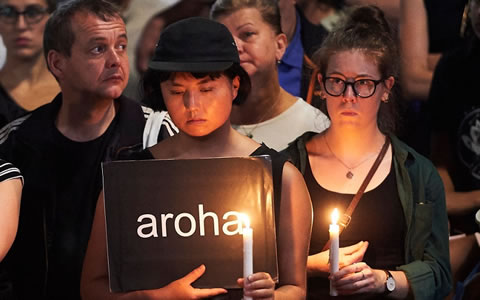
We join with all New Zealanders in showing aroha and support. We are all fellow human beings, God’s creatures. And we are fellow New Zealanders. We live in a multi-cultural, multi-faith New Zealand, and we should relate to one another with love and respect while faithfully holding to our own Christian and biblical beliefs.
We encourage all Christians to join in the 2 minutes of silence, and to join in prayer for those who grieve and to pray for peace in our nation.
We do not need to see today’s public broadcasting of the Muslim call for prayer as a national endorsement of distinctive Muslim beliefs. We assume its use today has only been intended as a special mark of respect to a grieving community at this time. Let us all pray with integrity to God whom we worship and trust; as Christians, we pray to God who is Father, Son, and Holy Spirit. In God’s name we pray today, and must continue to pray for our whole nation.
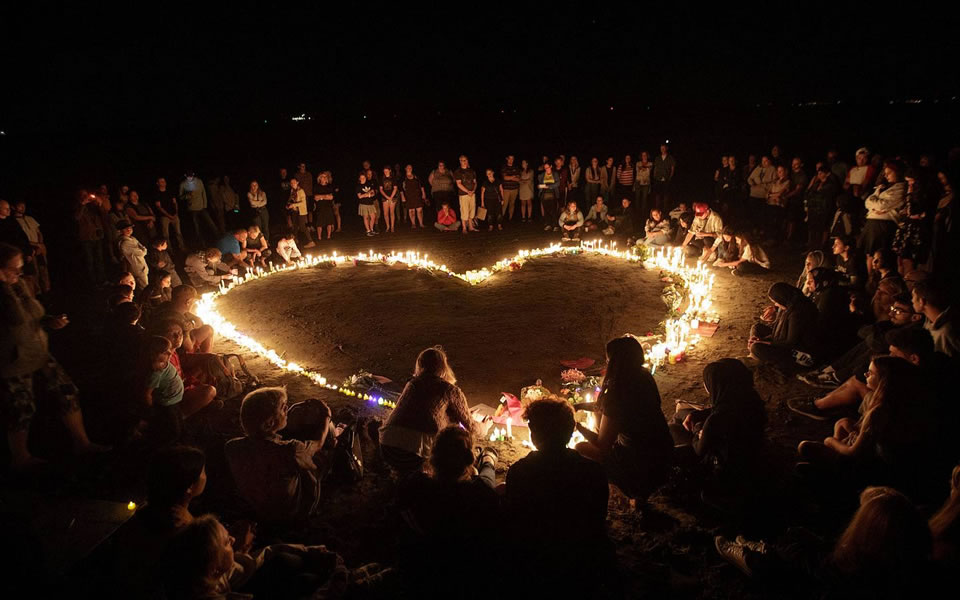
A vigil on Takapuna Beach in memory of the victims of the Christchurch Mosque shootings. Photo / Chris Loufte
AUCKLAND CHURCH LEADERS AOTEAROA NEW ZEALAND (ACL)
Joint Statement by Auckland Church Leaders
The recent massacre at the mosques in Christchurch has brought deep grief to New Zealand. As Auckland church leaders we condemn this evil attack and are shocked and horrified that such an atrocity should take place in our nation. We are equally horrified that it should be perpetrated in a place of prayer and worship, when freedom to worship is cherished in New Zealand. How shocking this violence should happen in a city called “Christchurch” as this act goes against everything that Jesus Christ stood for and that the church stands for.
As a Christian community we welcome, support and embrace all who live peaceably in Aotearoa New Zealand. We remember that Jesus Christ spent his early years as a migrant/refugee in Egypt and so we celebrate all who have come to New Zealand looking for freedom, safety and greater opportunities for their families. Our national anthem says it so well:
God of Nations, at Thy feet, In the bonds of love we meet….
Men of every creed and race, Gather here before Thy face….
From dissension, envy, hate And corruption guard our State, Make our country good and great God defend New Zealand
These words take on fresh and deeper meaning as we stand in solidarity with those who grieve the loss of their loved ones.
To the Muslim community in New Zealand we say that you are welcomed and loved as we share life in this great nation. This is your home too.
We pray for healing in the midst of deep sorrow. We pray for all families and friends impacted by such hate and intolerance. We pray this horrible tragedy will not divide us, but rather bring us together in strength, compassion and common humanity.
Prepared by Auckland Church Leaders:
Rt Rev Ross Bay, Anglican Bishop of Auckland ♦ Pastor Tak Bhana, Senior Pastor, Church Unlimited ♦ Pastor Paul de Jong, Senior Pastor, LIFE ♦ Pastor Jonathan Dove, Senior Pastor, Greenlane Christian Centre ♦ Most Rev Patrick Dunn, Catholic Bishop of Auckland ♦ Majors Ian & Liz Gainsford, Divisional Leaders, The Salvation Army ♦ Mr David Goold, on behalf of the Christian Community Churches of NZ (serving the Open Brethren) ♦ Pastor Ken Harrison, Senior Pastor, Harvest Christian Church , Papakura AOGNZ ♦ Pastor Dr Brian Hughes, Senior Pastor, Calvary Chapel ♦ Rev Dr Stuart Lange, Interim National Director, NZ Christian Network ♦ Rev Kok Soon Lee, Auckland Chinese Churches Association ♦ Rev Andrew Marshall, National Director, Alliance Churches of New Zealand ♦ Very Rev Anne Mills, Dean, Auckland Cathedral of the Holy Trinity ♦ Rev Steve Millward, Moderator, Northern Presbytery, Presbyterian Church ♦ Pastor Bruce Monk, International Overseer for Acts Churches & Equippers ♦ Pastor Sam Monk, Senior Pastor, Equippers Church & Acts National Leader ♦ Pastor Peter Mortlock, Senior Pastor, City Impact Church ♦ Pastor Lloyd Rankin, National Director, Vineyard Churches ♦ Pastor Boyd Ratnaraja, National Leader, Elim Church of New Zealand ♦ Pastor Dean Rush, Senior Leader, C3 Church Auckland ♦ Pastor Jim Shaw, New Life Churches Executive team ♦ Rev Paul Talluri, on behalf of the Church of the Nazarene ♦ Bishop Brian Tamaki, Destiny Churches New Zealand ♦ Pastor Allan Taylor, Northern Baptist Association ♦ Pastor Ben Timothy, President, North New Zealand Conference, Seventh-day Adventist Church ♦ Rev Dr Richard Waugh, National Superintendent, Wesleyan Methodist Church of New Zealand ♦ Rev Graeme White, Auckland Synod Superintendent, Methodist Church of New Zealand