One of the biggest obstacles to the biblical call to unity is the shallow or superficial reading of scripture. There’s still plenty of scope for disagreement even among specialists who are adept at plumbing the depths of a text in the original languages.
But many disagreements are not at that level. They occur because verses are plucked out of context and used to mean something they were not intended to.
Tim Bulkeley is not only a member of NZ Christian Network’s discussion group on marriage. He is also an Old Testament scholar, and one of the small number of bloggers I follow. I particularly like his 5 minute Bible series
I recently used two of his podcasts to shed some light in a group where discussion had got quite prickly over the topic of women in the church.
Quoting from Tim’s text introducing Part 1 ….
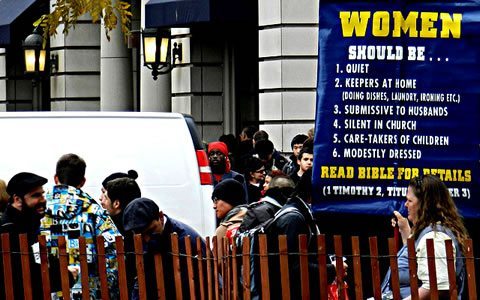
Perhaps no Bible text illustrates the dangers of a simplistic reading of Scripture than 1 Cor 14:34.
If we tear this verse from its cotext,1 and then read it as if the Bible were “God’s instruction manual for life” and even worse read it also literally then we are in trouble! The verse (in the fairly literal NET)2 reads:
the women should be silent in the churches, for they are not permitted to speak. Rather, let them be in submission, as in fact the law says.
The verse is full of oddities.3 Not the least of which is that in 1 Cor 11:4-6 Paul assumes that both women and men will pray and prophesy, and in this same chapter 1 Cor 14:4-5 suggests the same thing, and that this is indeed in the public meeting (cf. v.4). Paul seems to be contradicting himself!
What is going on, and how should we interpret such passages?
Click on the links following to hear Tim’s two 5 minute messages
In 2011 I spoke at the national interfaith forum on State and Church. Four years on, these comments seem even more relevant today than they were back then.
Part 1 is a response to a paper presented by Professor Paul Morris from Victoria University. (It should be clear what points are being rebutted).
Part 2 is a response to the 5 key questions being addressed at the forum:
Should the state observe religious rituals?
Should parliament open with a Christian prayer, other prayer, or any prayer at all?
Should public events acknowledge the diversity of religion and belief?
Should the state recognise and support religious activities?
Should the state promote interfaith dialogue?
But for those who just want the ‘bottom line’, let me open with my conclusion:
I do not say there should be Christian prayer in parliament because
Christianity is the largest religious group, even though this is true
And not because it’s unfair that secularists have already squeezed Christianity out of 99.9% of the public square
Not because of tradition, although tradition is important and should not be changed lightly
Nor because of our history, although Christianity has played an important role and it’s reasonable that it should be reflected
Nor because of its symbolism, although this is not insignificant
And certainly not because the church needs it. The church has seen many political leaders and regimes come and go over 2,000 years
I say there should be Christian prayer because it’s right that parliament should begin its work each day by acknowledging the sovereignty of God
Part 1
I want to thank Professor Paul Morris for the work which went into preparing his paper. The survey of nation states and their religions, and the summary of history and trends in this issue, are useful in themselves. And I am sure the paper overall will achieve well its purpose of provoking debate and discussion.
Before I share some thoughts of my own on state and church, I would just like to touch briefly on a few points in Paul’s paper:
It’s good to have you record that there are no exclusively secular states, because there are many in New Zealand who try to maintain that New Zealand is totally secular as a basis for various other arguments.
You make the point that in the various ways that states interact with religions “it is the majority faith that benefits from these arrangements”. I think the picture is actually more complex than that.The fact that in NZ three statutory holidays are based on the Christian calendar, or that a state funeral is held in a Christian cathedral, is probably not as significant as the fact that minority religions are free to practise their beliefs including building places of worship. This is sadly not true in some regimes around the world. As this discussion progresses, it would be useful to have some research into what combination of state and religion offers the greatest level of protection and freedom for minorities.
The three new political models you outline are very useful. Church leaders are continually looking at how churches can engage more effectively and positively in their communities and this section will help in those discussions.With possibly a very small number of exceptions, no church leader wants to see a return to a Christendom model where the church ruled the state. At the same time, few if any church leaders probably think that a state ruled by secularists will be ultimately beneficial for society.As you say in your closing “the failure of liberalism to sustain values is a growing concern”. What we need is a discussion about what sort of model will be in NZ’s best interests long-term, and that’s what today is all about.
Your fourth factor regarding the growing concern with social cohesion is especially pertinent, and possibly the real starting point for this whole discussion.Numerous incidents including the London riots, the global financial crisis, the News Corp phone hacking, the growing gaps between rich and poor, and the inability of western governments to balance their budgets, highlight this problem.
When you move to New Zealand the description of Christianity as a “minority religion” because it might fall below 50% will certainly raise a few eyebrows. People think of Christianity in Turkey as a minority religion, or Buddhism in New Zealand. But to describe the largest religious group in a country as a “minority religion” is unusual to say the least.
You point out that the church’s influence has been declining since the 1950s which is true. It’s also true that NZ has seen a corresponding and dramatic increase in many negative social indicators over that same time period. Although direct causation is hard to prove, this is something that people should seriously reflect on.
Singling out churches for failing to honour the Treaty is a bit harsh. While their record is not perfect, the fact is that church leaders spoke out often against the government and others for treaty abuses for nearly 20 years after the treaty – as they continue to do today. And to a large extent it was the work of Christian missionaries, and the high regard in which they were held by Maori that almost certainly led to the Treaty even being signed.
What I appreciate most about this paper is that it is descriptive of what is happening, which leaves the discussion wide open as to what should happen.
Part 2
The brochure for this forum asked 5 questions:
Should the state observe religious rituals?
Should parliament open with a Christian prayer, other prayer, or any prayer at all?
Should public events acknowledge the diversity of religion and belief?
Should the state recognise and support religious activities?
Should the state promote interfaith dialogue?
I don’t have time to address all of these questions in detail, so let me say my answer to all questions is ‘yes’, and on question 2, I believe parliament should open specifically with Christian prayer.
“It was the Christian foundation of social and cultural life in Europe that made possible the emergence first of capitalism, then of democratic politics.”
This is not something I said. It is a quotation in a book called Civilisation by historian Nial Ferguson, from a member of the Chinese Academy of Sciences, who was part of a team tasked with discovering why it was that Europe having lagged behind China until the 17th century, overtook it, rising to prominence & dominance.
“At first, [the scientist] said, we thought it was your guns. You had better weapons. Then we delved deeper and thought it was your political system. Then we searched deeper still, and concluded that it was your economic system. But for the past 20 years we have realised that it was in fact your religion, Christianity. It was the Christian foundation of social and cultural life in Europe that made possible the emergence first of capitalism, then of democratic politics.
What is even more interesting is that this story was told in an article by Lord Jonathan Sachs, Chief Rabbi to the Commonwealth in The Times 12 May 2011.
Sachs went on to say “While Christianity is in decline in Britain and most of Europe it is growing and thriving in China where the number of people in church on Sunday is greater than the total membership of the Communist Party – and this in the land that in 1958 Chairman Mao had declared ‘religion-free’.
“As a non-Christian” he says,” I find this fascinating. Europe is losing the very thing that once made it great, while China the world’s fastest-growing economy, is discovering it. China – the home of Confucianism, Taoism and its own brand of communism. That is something no one could have foreseen.
What has China realised that the West is rapidly forgetting? That a civilisation is as strong as its faith … Societies start growing old when they lose faith in the transcendent. They then lose faith in an objective moral order and end by losing faith in themselves”.
Sounds vaguely like a description of Western liberal democracies.
//
God created the Church and God created government. Each has a different function. Each is accountable to God. Apart from anything else, opening parliament each day with prayer is a reminder that politicians do not have ultimate power.
Governments which make no reference to God fall into two errors: they miss out on the provision and guidance which come from God, and they begin to think and act as if they were God. A former NZ Prime Minister is on record saying that government can do anything it wants to.
But this is not true. States are not the final arbiter of right and wrong. As one example, we expect governments everywhere to uphold human rights. These rights transcend governments. In fact it’s easy to show they even transcend the United Nations. Where do they come from?
Christians say they are visible in many belief systems but they are most clearly displayed in the person of Jesus Christ.
Cardinal George Pell in the 2009 Sir John Graham lecture said “Concern for the weak and unfortunate was considered foolishness in the Roman world. It was Christianity which made it a virtue. While freedom was greatly extolled in the ancient world, it was only for the aristocratic and powerful few and was explicitly linked to domination of the many, including the many slaves; sometimes 40% of the population. It was Christianity which eventually set the slaves free, which taught that freedom is not just a privilege of the strong …”
//
I do not say there should be Christian prayer in parliament because
Christianity is the largest religious group, even though this is true
And not because it’s unfair that secularists have already squeezed Christianity out of 99.9% of the public square
Not because of tradition, although tradition is important and should not be changed lightly
Nor because of our history, although Christianity has played an important role and it’s reasonable that it should be reflected
Nor because of its symbolism, although this is not insignificant
And certainly not because the church needs it. The church has seen many political leaders and regimes come and go over 2,000 years
I say there should be Christian prayer because it’s right that parliament should begin its work each day by acknowledging the sovereignty of God
NZ Christian Network’s sister organisation in UK has just published the results of a research project described as the “first of its kind”. The research was conducted by Barna Group on behalf of the EAUK (Evangelical Alliance UK), the Church of England, and HOPE.
When I was with EAUK director Steve Clifford in June, the research project called “Talking Jesus – Perceptions of Jesus, Christians, and evangelism in England”, was still underway, but there was already a strong sense of excitement building.
Click on the link button below to access the report, Powerpoints, and video presentations of the results.
This week I received a copy of the findings in the post, and when I checked on EAUK’s website I found that everything I’d received – AND MORE – is available online.
And it’s well worth a look!
It’s possible that the similarities between UK and NZ will mean that the research can be reasonably applied to our context without needing to run a similar survey in NZ.
NZ Christian Network is involved with the CRA (Christian Research Association) which runs the CLS (Church Life Survey), so this is a question we will discuss at our next meeting.
In the meantime, here’s a snapshot of what EAUK found:
57% of people in England identify as Christians (9% are practising)
41% of practising Christians attribute their faith to growing up in a Christian home
40% of people do not realise Jesus was a real person who actually lived
One in four 18 to 34-year-olds thinks Jesus was a mythical or fictional character
43% of people believe in the resurrection
66% of practising Christians have talked about Jesus to a non-Christian in the past month
72% of practising Christians feel comfortable talking to non-Christians about Jesus
31% of 18 to 34-year-olds felt more positive about Jesus after such a conversation
44% of practising Christians credit their friends for introducing them to Jesus
17% of practising Christians said a spiritual experience they could not explain was a key factor in them coming to faith.
Spiritual, loving and peaceful are the words most commonly used to describe Jesus
36% of practising Christians say talking to a Christian about Jesus was important in their coming to faith
It was good to read the following report from the Global Christian Forum about a significant gathering of Latin American Pentecostal leaders to discuss the issue of Christian Unity. There are clearly some parallels with the New Zealand scene although the small size of our country and our particular history, mean that there are inevitably differences also.
NZ Pentecostal leaders and others might appreciate the chance to use the full report in the following link or the summary below as a starting point in their own reflections on Christian unity.
NZ Christian Network is connected with the Global Christian Forum through our membership of the WEA (World Evangelical Alliance). NZCN national director Glyn Carpenter was one of the official WEA representatives at the 2nd Global Forum held in 2011.
Ipiranga Statement, São Paolo 2015 A group of Latin American Pentecostal leaders – pastors (men and women) of different Pentecostal churches of Brazil, young people, women and scholars of Pentecostalism in Latin America – met from 27 to 29 May 2015 in Ipiranga, São Paolo, Brazil. The meeting was held at the initiative of the Pentecostal Forum of Latin America and the Caribbean (FPLC), under the auspices of the Global Christian Forum and some Brazilian Pentecostal denominations. The theme of the meeting was Pentecostalism and Christian Unity: Institutional, Theological and Social Challenges.
Based on the presentations and the discussions, the forum affirmed the following:
On institutional challenges:
To oppose the tendency in religious institutions to concentrate on self-preservation which leads them to be held back (closed) by their own limitations;
To rethink the relationships of power and hierarchical ecclesial structures, and move towards greater participation in church decision making;
To take positions on contemporary issues, such as gender, ethnic and racial questions;
To invest in leadership formation of new generations to effect change – going beyond ‘apparent reforms’ and investing more in the cooperation with other churches.
On theological challenges:
To develop a Pentecostal theology that values the hallmarks of Pentecostal experience and is able to be in dialogue with other schools of thought;
To bring advances in academic theological insights closer to the life of the churches;
To foster Latin American theological publication and production initiatives;
To promote the sense of belonging of the Pentecostal churches to the fellowship of Christians around the world.
On social challenges:
To see Pentecostals as a part of society who have their peculiar demands like any other group, which need to be understood and discussed in the wider society;
To search for theoretical frameworks which awaken the social responsibility of Pentecostals in different contexts;
To create opportunities for dialogue with other social movements on questions of gender, youth, poverty, violence, politics, corruption, public health etc.;
To open up new spaces for youth and women in the church, building communities of faith based upon participation and openness to the society, and so able to hear the voices of our time and to contribute to the formation of citizenship.
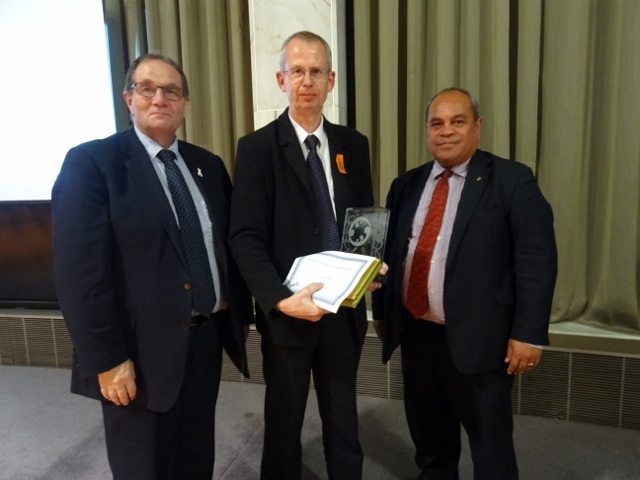
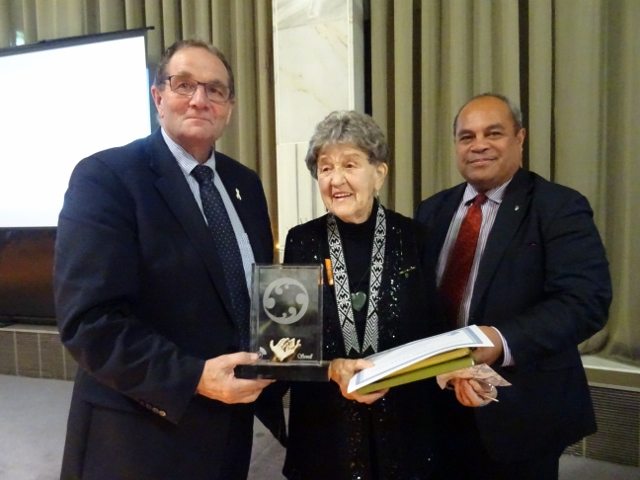
Church leaders and members of parliament joined with award winners and family members at the 2015 NZ Christian Network Unsung Heroes Awards ceremony at Parliament. The evening was hosted by Chester Borrows (National) and awards were co-presented by Chester Borrows and Su’a William Sio (Labour).
Awards were presented in two special categories (Theology & Arts, and Christian Unity) and the four regular categories (Secularism, Marriage & Family, Value of Life, and Missional Living).
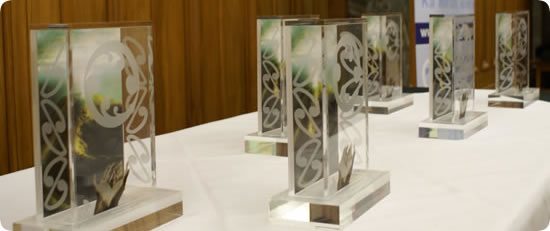
Unsung Heroes trophies artwork creation designed by artist Karen Sewell, Auckland.
The 2015 NZ Christian Network Unsung Heroes Awards go to…
Theology and the Arts (special award)
Bruce and Kathleen Nicholls
A truly amazing couple who have served in so many ways including, film, publishing, drama, funding, founding theological colleges and Bruce was even the founding director of the WEA Theology Commission!
Bruce and Kathleen were married 62 years ago, and began serving God in India two years later. Bruce has arts and theology degrees from Auckland, London, Princeton, and an honorary doctorate of divinity from Ashland, Ohio. Kathleen is an Associate of the London College of Music, and a Licentiate of Trinity College London in speech and drama.
They taught theology, English, speech, and communications at the Union Biblical Seminary in India from 1955 to 1973.
They pioneered a research community in New Delhi relating theology and communications in the context of Indian culture.
They founded a publishing company and made films for national TV.
Bruce arranged interest-free loans for small-scale industries. Kathleen took Christian dramas to the villages, cities and military camps of central India.
They have both authored and edited numerous books including Kathleen’s Asian Arts and the Christian Hope which was recognised at a World Book Fair, and the journal Bruce founded Evangelical Review of Theology. Bruce continues as the editor of the 50-volume Asia Bible Commentary series, written by Asian, Middle Eastern and South Pacific scholars.
Bruce was the co-founder of the Asia Theological Association in 1970, which now coordinates up to 250 theological colleges across Asia and the Middle East. He regularly travels internationally promoting these works.
Bruce was the founding director of the Theological Commission of what is now called the World Evangelical Alliance from 1975 – 1992, the world body which we are part of. Kathleen was a director of the International Christian Media Commission for the same body and Lausanne for 6 years from 1986.
Bruce was ordained in India by the Bishop of Delhi, and pastored a Hindi congregation for the Church of North India. His ordination is recognised in Anglican and Presbyterian churches in New Zealand.
They are inspirational, they’re even on Wikipedia, and they are our Unsung Heroes in Theology and the Arts.
Christian Unity (special award)
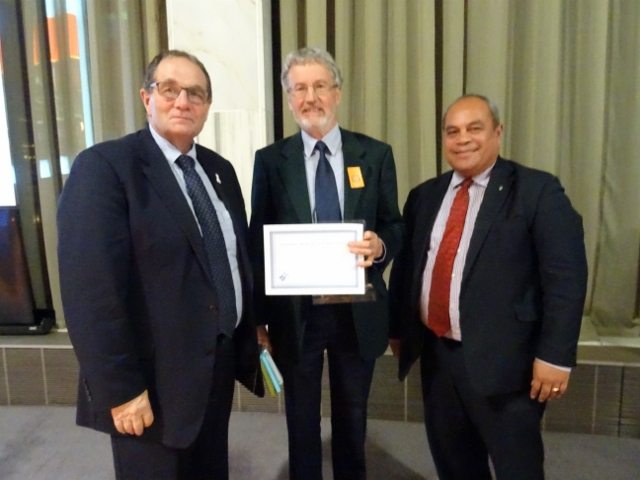
Richard Waugh
A man committed to Christian unity – chairman of the Auckland Church Leaders and National Church Leaders groups.
Richard Waugh is a man who is committed to Christian unity.
Since he began full-time ministry in the early 1980s he has always been involved in ministers associations and combined church events in the Manawatu, Henderson, and the Howick – Pakuranga area.
He chaired the Henderson Ministers Association from the early 1990s and later, when he moved to East Auckland, the Howick Ministers Association from the mid-1990s.
He was the founding chairman of the new Howick-Pakuranga Ministers Association with 45 churches in 1997. Since 1996 he has organised the annual combined churches Easter Sunrise service on Howick’s Stockade Hill.
In 1996 he helped launch ‘The Walk to Emmaus’ inter-church movement in New Zealand promoting three-day retreats for spiritual renewal.
He was a Founding Trustee of the Daystar ecumenical newspaper from 2001, and served on the Board of Management for several years, and was a Founding member of Vision Network of New Zealand (now New Zealand Christian Network) from 2002.
He speaks regularly at church conferences such as Congregational Union Annual Assembly, Baptist Church Planters Conference, Alpha Leaders Conference, and was a guest speaker at the annual NZ Police Remembrance Day Service.
In 2009 he helped establish the annual Stream Theological Symposium involving Wesleyan Methodist, Church of the Nazarene, and the Salvation Army.
Since 2009 he has chaired the Auckland Church Leaders Meeting and in early 2012 he was elected chairman of the National Church Leaders Meeting. He is now the longest serving church leader on NCLANZ!
He has been proactive in widening the membership of the group and helped prepare a strategy report and new directions for the meeting.
For the Bicentenary of Christianity in New Zealand he was appointed to the 2014 planning group and was involved in planning some of the key events culminating in national services in December 2014.
Secularism
Ron Hay
A secondary school English teacher before becoming an Anglican minister and vicar of Sumner-Redcliffs Parish in Christchurch before retiring early to devote time to writing. His passion is explaining faith matters in ways that make sense.
The Secularism award this year goes to a man who was a secondary school English teacher before becoming an Anglican minister. He was vicar of Sumner-Redcliffs Parish in Christchurch before retiring early to devote time to writing. His passion is explaining faith matters in ways that make sense.
He has contributed a number of articles on faith and public issues to the secular media, especially the Christchurch Press where he had a regular column for a time. He is a member of New Zealand Christian Network’s focus group on secularism.
His recent book titled Finding the Forgotten God: Credible Faith for a Secular Age, was published by DayStar Books, and sold 1500 copies in its first six months.
Last month it won the Ashton Wylie Literary award in the Mind Body Spirit category – a rare feat for a Christian book.
It is a book which explains Christian faith in a way that will be comprehensible to anyone who genuinely wants to know what the Christian faith is about.
The book explains why the Christian message is referred to as “good news” and deals with complex questions such as the problem of suffering, the challenges of other religions, the relation of science and faith, and the arguments of the “new atheists”.
There is also a chapter of personal stories of Kiwis who have come from non-faith to faith in adulthood.
Response to the book has been overwhelmingly positive from both believers and non-believers, leaders and grass-roots alike.
He now spends much of his time travelling and speaking about themes from the book in churches around the country.
He is NOT receiving one of the book prizes this evening, because he is the man who wrote it!
Marriage and Family
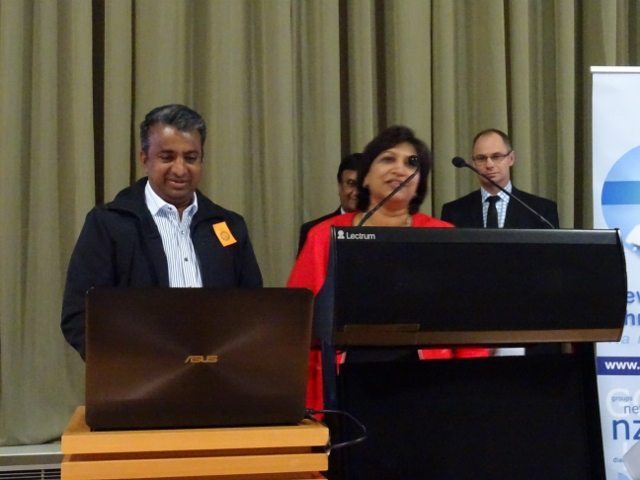
Cliff and Indranee Reddy, Te Whakaora Tangata Trust
They moved from South Africa 15 years ago and established the Te Whakaora Tangata Trust in 2010. Te Whakaora Tangata means life restoration for the people.
The Marriage and Family award goes to a couple who moved from South Africa 15 years ago and established the Te Whakaora Tangata Trust in 2010. Te Whakaora Tangata means life restoration for the people.
The Trust, based on Manurewa Marae, allows them and their nine staff to work with families in the Clendon community, an 80 percent Maori and 20 percent Pacific demographic, and is one of Auckland’s most disadvantaged communities, known for its cycles of domestic assault, drug abuse and gang violence.
They are able to develop trust with people in the community because, inspired by their faith and their own life experiences, they love people just as they are.
They don’t preach to people. They awaken a desire in people to want to move forward and break down the barriers that have been there for years.
Te Whakaora Tangata’s approach is about seeing the bigger picture, not just the individual.
There is no charge for their services, and they are generous with their time. Time spells love for many people.
They believe that money is not always the problem and that the government does not have all the answers but that the answers lie within the community.
Manurewa Marae manager Mary-Ann Harris from Ngapuhi says that the work these people do is transforming the lives of families in the community … They have a passion that is rare and special, and they share the marae’s values of addressing root causes of issues.
She says “They fit well into the marae because the marae is about holistic wellbeing for the community … Our belief is that if we can heal the family, and find the issues within, then that whole family can be healed and the individuals have a much stronger support unit,”
While their work is emotionally taxing they get fulfilment from seeing the change in people’s lives.
Cliff and Indranee Reddy
Value of Life
John Kleinsman
A man with decades of experience working in drug and alcohol rehabilitation and for IHC, lecturer in theology and ethics, member of a number of committees and author of a number of papers.
The 2015 Value of Life award goes to a man who worked in drug and alcohol rehabilitation before moving in 1988 to IHC where he held several roles including:
child and family support worker with responsibility for mainstreaming children with intellectual disabilities into pre-school centres
manager of vocational services for adults with intellectual disabilities
residential support services manager for people living in IHC Care
Branch Manager IHC Southland
In 1998 he became a lecturer in theology and ethics for Wellington Catholic Education and later The Catholic Institute, a position he still holds.
He was a researcher for The Catholic Bioethics Nathaniel Centre from 2001 writing regularly on a wide range of topics. In 2010 he became Director of the Centre, and in 2013 he also became the Director of Research and Advocacy for The Catholic Institute.
He is a member of the Families Commission Ethics Committee, the ACC Ethics Research Committee, and the Laura Fergusson Trust Advisory Committee. He also served as a member of the Central Region Health and Disability Research Ethics Committee from 2001 to 2009.
In 2013 he completed his PhD on the topic of the impact of assisted human reproductive technologies on society’s perception of responsible parenthood.
He has written papers and articles on numerous subjects including: euthanasia; the common good and bioethics; research ethics and the social media; and drug policies in schools.
He is heavily involved in the current euthanasia debate, through public lectures and debates, writing for newspapers; helping establishing the Care Alliance Trust, which was a key voice in the recent High Court Case; and providing an affidavit on behalf of the Crown in that Case.
He works closely with other life groups in New Zealand, Christian and secular, to promote respect for unborn life and to ensure that the intrinsic dignity of the human person is reflected in our laws surrounding abortion.
Missional Living
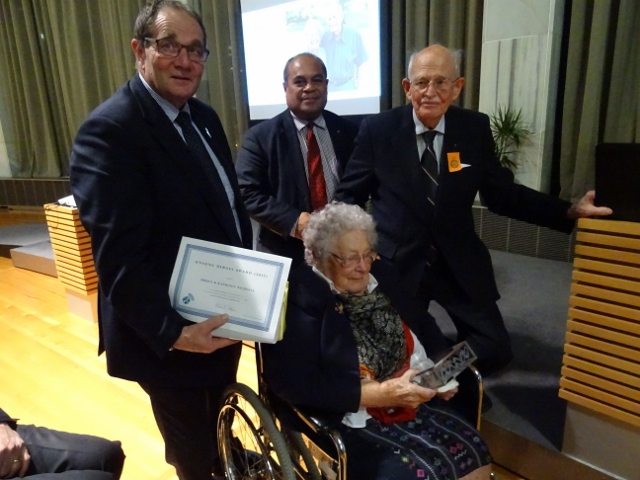
May Mackey
Retiring at the age of 95, May has worked with some of the country’s most high profile prisoners, and in units including maximum security for more than 30 years!
The Missional Living award goes to a woman who knows something of life’s pain. In 1960 she married Wally Chalmers, a police officer and Presbyterian Church member. They adopted two children but within three years Wally had been shot in an incident that led to the formation of the Armed Offenders Squad.
In 1968 she married Dave Mackey, from Tainui, an ex-United Maori Missions boy, who was farming in the Waikato. In 1982 they attended the induction of a Presbyterian Prison Chaplain at Mt Eden Prison and that was how she got started in prison ministry.
For over 30 years she has worked with some of the country’s most high profile prisoners, and in units including maximum security. For the last 20 years, she has made weekly visits to offenders at Auckland Prison and Auckland Region Women’s Corrections Facility.
She started visiting other facilities through the Kaiwhakamana programme which seeks to give Kaumatua greater access, and support, to Maori prisoners.
She says that she does not go to talk religion as there is no need to. She goes as a friend. The prisoners know… if they’ve got a need, they create the opportunity to talk.
She says what motivates her is the message of redemption which changed her own life. She says that with all due respect to the help the men get from psychologists, programmes, and so on, I know our message of redemption is the absolute. It’s the only answer.
This year at age 95 she made her final round at Paremoremo Prison. In her own words:
“I believe the input I make in providing an ear for them, and not judging them, and encouraging them that there can be a better future, can make a difference,” she says. “They are special to me and this is why I had to do a little swansong and visit everyone for one last time. My legs are getting tired!”