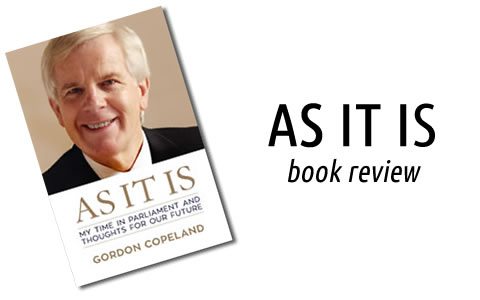
‘AS IT IS – My time in Parliament and Thoughts for our Future’
Drawing on his life experience and time as an MP Gordon Copeland, sets out a passionate vision for New Zealand’s future. In doing so he addresses a wide range of issues from fundamental social reform, the road to economic success for all rather than the few, a pathway to happiness in family life and even international affairs. All of these issues are dealt with in detail underpinned by the values of justice, peace, compassion and inclusiveness for all. This book is anything but “politics as usual”!
A review by former Cardinal Tom Williams can be found at the bottom of this post.
About the author
Gordon Copeland was a Member of Parliament for two terms between 2002 and 2008 and has maintained an active interest in politics for much of his life, an interest which has continued beyond his time in Parliament.
With qualifications in accounting and economics Gordon has had a varied career including senior executive positions in the NZ and International Oil Industry, Business Consultancy for Corporate and Government clients, financial administration for the Archdiocese of Wellington and, following his time in Parliament, Investment Management.
He has been married to Anne for more than 50 years, has five children, ten grandchildren and three great grandchildren.
He lives in Miramar, Wellington and his interests include church, sport – especially rugby – gardening and politics.
You can order the book through any bookstore by quoting the ISBN number, 0473334089, RRP $35.
However, the author is kindly offering NZCN readers special price of $28 per copy(including postage and handling in NZ only). Simply email gordon.copeland@xtra.co.nz with your delivery address and he will send you a copy along with your invoice.
Chapter Headings
How it all began
The Election Campaign 2002
Early days in Parliament
The Prostitution Reform Bill
The Euthanasia Bill
Working with Michael Cullen 2002-2005
Other Tax Matters
The Foreshore and Seabed
My Member’s Bills
Relationships and Civil Unions
Abortion and Related issues
The 2005 Elections and its Aftermath
Marriage (Gender Clarification) Amendment Bill and Same-sex Marriage
Easter Sunday Trading
The Parliamentary Prayer
The Partial Sale of State Owned Enterprises
I resign from United Future
Judeo-Christian Values
The Rise and Fall of the Kiwi Party
The Anti-Smacking Bill and Referendum
Housing Affordability
The Working Women’s Charter
Family Matters
Foreign Affairs and Trade
In all things Unity; the Maori Question.
Does Labour have a Future?
Epilogue
Review by Cardinal Thomas S. Williams ONZ
With Gordon Copeland’s withdrawal in 2007 the United Future Party lost a capable and creative MP. Gordon knew his resignation would likely bring his political career to an end since his chances of being elected for a third term in a new party were slight. But conscience dictated that he sacrifice a calling which he enjoyed and for which his more than six years in the House proved him well qualified.
Conscience is hardly prominent in most books by ex-parliamentarians. Their contents deal more with political strategies justified by their appeal to the voter. Moral issues are generally passed over, and conscience is rarely invoked. “As It Is” is markedly different. For Copeland conscience is paramount. The validity of arguments for or against any Bill he tested, not against the likelihood of gaining or losing electoral votes, but in the light of the common good of the nation and its people as determined by adherence to enduring principles and moral standards.
“As It Is” sets out with admirable clarity the legislative changes enacted during the 2002-2008 period. It treats such matters as taxation, the sale of State-owned enterprises, and the Foreshore and Seabed Bill. Given Copeland’s expertise in the areas of finance and commerce, his interventions in Select Committee hearings and debates in the House were cogent and compelling, even if disregarded for party political reasons.
That his stands and those of his fellow United Future MPs on social issues were not popular with some are not surprising, since traditional beliefs and values have been systematically subverted by the derision and hostility towards the whole Judeo-Christian ethic upon which civilisation has been based for the pass two Millennia. Relativism and permissiveness have been deliberately prompted, and morality reduced to purely subjective preference.
Copeland’s account of the passing of the Prostitution Reform Bill show how meaningless “conscience votes” have become in Parliament. Enough MPs ceded conscience to party pressure to ensure that in New Zealand street-walking is now as respectable as shop-walking. So, too, the definition of marriage has been widened to include all manner of relationships that are anything but marital. For most political parties, crucial issues such as aborting the unborn and physician assisted suicide, speciously termed “the woman’s right to choose” and “death with dignity”, are determined by public polling.
The sad story of the near demise of the United Future Party is revealed in one chapter. It was born in 2002 of a merger between the United Party with Peter Dunne as its sole MP and Future New Zealand, at that time without an MP. The merged Party contested the 2002 Elections and gained eight seats. Dunne who held the only electorate seat, unilaterally changed the Party’s stances after the 2005 Election, and so eventually silenced what had been well-argued opposition to over-liberal social legislation.
Equally enlightening is the chapter devoted to the Kiwi Party and the machinations of Brian Tamaki of Destiny Church which put paid to the Party’s potential.
Much else of value can be learned from Gordon Copeland’s 164-page book, not only from the pages devoted to his six years in Parliament, but also from his reflections in the concluding chapters on housing, family, foreign affairs trade and other controvertible topics.
Although but two terms as an MP, the lessons Copeland learned and shares in “As It Is” are well worth heeding by all interested in parliamentary processes and party positions.
NZ Christian Network is urging churches and individuals concerned about the possibility of euthanasia being legalised in New Zealand, to make submissions to the Health Select Committee before the due date 1 Feb 2016.
“There has been some very good work done by various groups on the issue. We are particularly impressed by and grateful for the work of the Care Alliance, which has produced a brochure to help people make submissions” – [Glyn Carpenter, NZ Christian Network]
The Care Allliance website contains all the information necessary to make a submission. This can be done online, or by email, or by traditional post.
“We are asking pastors and concerned individuals in churches to make sure the link to Care Alliance is circulated within churches” said Carpenter.
“But more than that … we have been informed by the chair of the select committee that if people are concerned about this issue, they MUST make a submission. Silence could be interpreted by MPs as people not caring.
Submissions can be as short as one sentence, or include as many points as people want to make. We’ve heard of one local church that finished its Sunday service early, handed out pens, paper, and envelopes, and in ten minutes, 130 submissions were written.
The important thing is for people to use their own words, and not to cut & paste someone else’s words.
We are also thankful to the Nathaniel Centre which produced the list of arguments below. People can use the list as a basis for making their own points in a submission.
[ENDS]
New Zealand Christian Network is a broad-spectrum network of churches and Christian leaders, with a Board of Reference that includes leaders from all the main denominations. It seeks to present a biblically orthodox position on issues, reflecting the views of the majority of Christians in New Zealand.
The week already began on a pessimistic note. On Monday, Frans Timmerman, vice president of the European Commission, confessed his personal fears of the European project being torpedoed by rising nationalism. He talked of a perfect storm gathering, with the refugee crisis following hard on the heels of the economic crisis.
And then came Friday 13th. Paris. Bloodshed. On the street, in a theatre, in a restaurant, at the football stadium. Chaos. Confusion. Fear. Anger. Grief.
The attack came as my wife and I were attending a European conference of Together for Europe in the south of the Netherlands. Delegates from nearly forty movements and organisations, Catholics, Orthodox and Protestant, came from many European countries, including France, for this annual event. Shocked and sobered, we reconvened for Saturday morning’s session, where Thomas Römer, of the YMCA in Munich, was to speak on the topic: Faith in the midst of today’s challenges and fears.
Thomas quoted Timmerman saying that if the politics of hope did not replace the politics of fear, the European project could disintegrate. And now this massacre was creating more fear, confusion and insecurity. IS had struck again: after Charlie Hebdo ten months ago, and the downing of the Russian airliner in the Sinai, now this.
Thomas pointed to the story of Jesus and the disciples caught in a storm on the Sea of Galilee. The wind and waves threatened. The disciples felt danger, fear and panic. And yet Jesus was sleeping. ‘Master, master, we’re going to drown!’ they cried, waking Jesus.
Hidden
Europe is in trouble. Waves of refugees are threatening to sink the ship, some say. And Jesus seems to be sleeping, Thomas said, before reminding us that Jesus was in the boat with the disciples, and is in the boat with us today. Luther, he said, spoke of God’s hidden grace, his hidden work and presence behind the scenes working out his purposes.
As he spoke, I recalled that my first weeklyword of this year (5 Jan) responded to the tragic reports in 2014 including Ukraine, Crimea, Syria, MH17, the bizarre fate of MH370 and more. What more tragedies awaited us in 2015? I had asked. Days later came the Charlie Hebdo massacre.
Like the disciples in the storm on Galilee, I wrote, we want to cry out to Jesus, ‘Don’t you care if we drown?’. Yet nobody could promise us that new year would be better than 2014, I admitted. ‘Fact is, we still live in a fallen world. Accidents and tragedies will continue to happen this year.’ Then I had told how Rembrandt’s painting of Jesus calming the storm had been a key image for my wife and I in making sense of that turbulent year.
In this scenario, Jesus spoke the words ‘Quiet! Be still!’ The wind obeyed and it was completely calm. Jesus never promised his disciples personal peace and prosperity. He did however promise to give them and us peace in the midst of storms, a peace the world doesn’t understand.
Thomas continued, contrasting the response of Jesus with our own inclination to fear and powerlessness, rage and aggression. Jesus creates peace through the word, not violence–which only spreads more fear. The word of Jesus can still the storm, the fear, the rage. He turned to the disciples and asked: Where is your faith?
Emptiness
We Europeans now face the test as to how we respond to this violence spilling over from the Middle East. And here is a key question: Where is your faith? Where do we draw resources from to respond in an opposite spirit? Does a secularised Europe have any real basis for faith in the core values stemming from the story which made Europe Europe in the first place? The headline in Saturday’s edition of the secular Dutch paper, NRC Handelsblad, written before the attack, read: We have lost our faith; and the emptiness is huge. What has come in the place of religion? the article asked. Populism fills the emptiness with fear for the norms and values of the foreigners. Fundamentalism claims to offer the alternative for the emptiness.
In another edition of the same paper, another writer suggests we should be more worried about the weakness of our faith in European core values than about the supposed strength of radical Islam. He echoed Angela Merkel’s concern voiced recently in Basel when she asked why more Europeans were not practising their faith rather than lamenting about Muslims practising their faith in Europe.
As we discussed and prayed in small groups in response to Thomas’ words, one person recalled the warning of a bishop from Iraq: ‘We Christians in the Middle East have been persecuted for centuries. This is normal for us. But I doubt if you Europeans are capable of responding in love and forgiveness to this sort of violence.’
There are some things which are basic in our Christian lives – things like prayer, Bible reading, worship, witness.
NZ Christian Network organised two major discussions recently – one on marriage and one on secularism, involving regional leaders, members of our focus discussion groups, theologians, and some national church leaders, And the common theme at the conclusion of these discussions is that we need to be praying more and we need to be reading our Bibles better.
So I was delighted when I followed up these discussions with Tim Bulkeley, former lecturer at Carey Baptist College and now roving Bible teacher and scholar, and Tim expressed a passionate interest in seeing something done about the Bible reading part of that equation.
Tim had (rather helpfully) already prepared a 5 minute video clip to introduce what he had in mind (see video link). It is similar to a course he has taught many times in New Zealand and continues to teach internationally.
The church I attend is running the introduction session in a couple of weeks time, and we will then be working with some other Bible lecturers to figure out how best to structure this for NZ churches and what would be the best delivery mechanisms.
If you are interested in staying informed, please leave your name and details on our office number (09) 525 0949
Pew Research Center’s 2014 Landscape Study on religion in America contains some interesting findings.
Among them, and relevant to NZ in the context of ongoing debates about same-sex marriage, is that “nearly all major religious groups have become significantly more accepting of homosexuality in recent years – even groups, such as evangelicals and Mormons, that traditionally have expressed strong opposition to same-sex relationships”.
The report says “changing attitudes about homosexuality are linked to the same generational forces helping to reshape religious identity and practice in the United States, with Millennials expressing far more acceptance of homosexuality than older adults do. Fully half of Millennials who identify as evangelical Protestants, for instance, now say homosexuality should be accepted by society”.
There is no reason to imagine that similar trends might not also be happening here in New Zealand. So what does this mean for us in New Zealand? How do we – how should we – engage on the issue?
One thing is for sure – Whatever our view of the ‘truth’ is on this matter, we should speak it with grace and love and gentleness and respect. If we fail to do that, then we will almost certainly be communicating something very different from the ‘truth’ we think we are.