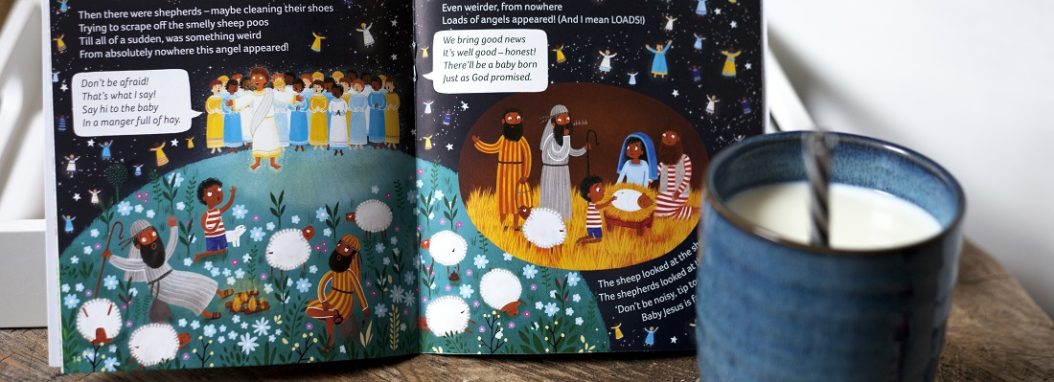
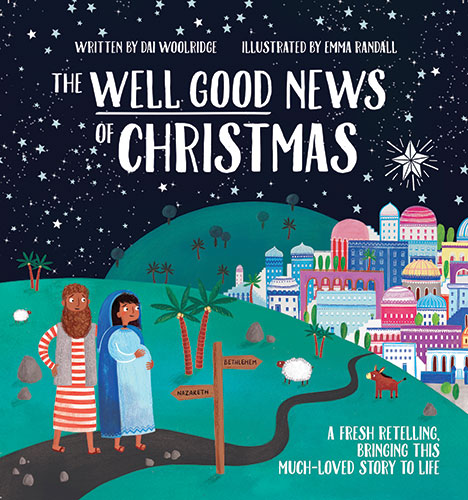
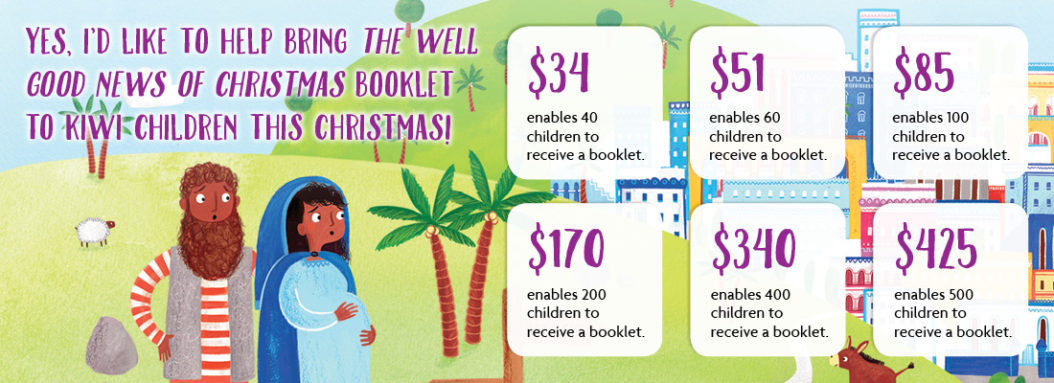
This Christmas Bible Society New Zealand, through the generosity of its supporters, is giving away 85,000 copies of The Well Good News of Christmas, a fun and colourful booklet for parents and grandparents to help them pass on the Bible story of Christmas.
Last year, this little book was a run-away success with 3,000 copies flying out the door equipping families to pass on the Bible story of Christmas. Following on its heels was The Super Cool Story of Jesus, with 84,000 copies given away to children around the country with the help of churches and families.
In publishing another 85,000 copies of The Well Good News of Christmas, Bible Society is hoping to reach the 36%* of Kiwi kids who have never seen, read or heard the story of Jesus’ birth. The book is part of Bible Society’s Pass It On campaign designed to encourage and equip parents, grandparents and caregivers to pass on their passion for the Bible to the next generation.
With The Well Good News of Christmas, people have a fantastic opportunity to share the good news of Christmas with the children in their communities using a brilliantly fun book. It’s a story that is still impacting and changing lives today.
Stephen Opie, BSNZ Programme Director.
Written by Welsh author Dai Woolridge, the story is aimed at four to eight-year-olds using child-friendly rhyming language.
And while The Well Good News of Christmas focuses on the events around Jesus’ birth, it also includes a little about creation, and Jesus’ life and ministry.
The Well Good News of Christmas
is being offered free to churches, BSNZ partner organisations and anyone who wants to share the Bible story of Christmas
Click here to order your copies or call us on 0800 424 253
Individuals can order up to five copies, while churches and organisations can order up to 250 copies
Learn more about how Bible society New Zealand makes the Bible accessible to everyone and encourage interaction with it
“Make every effort to keep the unity of the Spirit in the bond of peace”
– sohow are New Zealand churches going on that?
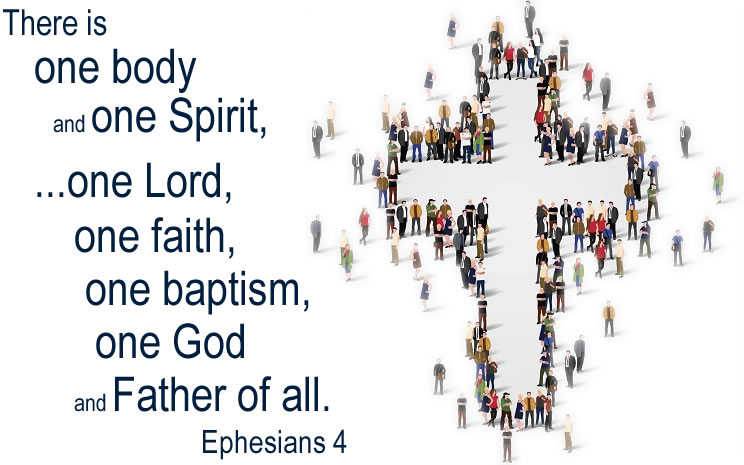
It is no secret that Jesus told his followers to “love another”, that he prayed that believers “all may be one”, and that he indicated such unity would be a great witness to a watching world. Also, Ephesians 4 reminds us that we all share the same Lord and are all part of the same worldwide spiritual body of Christ: “There is one body and one Spirit, …one Lord, one faith, one baptism, one God and Father of all”.
The principles of unity are clear enough. In reality, though, seeing and practising that unity is a lot more difficult. So the scriptures also say to us that we have to work hard at getting on well together. They also constantly teach us about humility and gentleness, forgiveness and reconciliation, respect and encouragement – attitudes and behaviours which reflect the mind of Christ and the fruit of the Holy Spirit. As it also says in Ephesians 4: “Be completely humble and gentle; be patient, bearing with one another in love”, and “Make every effort to keep the unity of the Spirit through the bond of peace”, and “Be kind and compassionate to one another, forgiving each other, just as in Christ, God forgave you”.
The main obstacle to Christian unity is not that we lack a biblical theology of unity, but our failure to live it out. Human nature is intrinsically self-centered. Even as Christian believers we do our own thing and don’t necessarily care too much about others.
So what are some of the obstacles to Christian unity in Aotearoa New Zealand today?
OUR OWN BUSYNESS
We are generally too busy coping with our own concerns and all the demands of our own ministries to be investing time and energy into relating to Christians beyond our immediate circles and context.
DENOMINATIONALISM
Our denominations tend to confine us as Christians into narrower boundaries. Too easily we idolise denominational distinctives, and make them more important than relating across the body of Christ. The church in New Zealand appears increasingly fragmented.
THEOLOGICAL DIFFERENCES
While most Christians would affirm the same basic tenets of faith, such as there is one triune God and Christ is Lord and Saviour and risen from the dead, and most would assent to the Apostles Creed, there are nevertheless some profound differences of belief and practice among Christians. Some may hold loosely to biblical orthodoxy, and many others may emphasise points of the faith that are secondary. The Church in New Zealand has various overlapping streams: liberal, traditional, liturgical, mainline, evangelical, charismatic and Pentecostal, and many people in each of those streams are not particularly eager to have much to do with those Christians who are in other streams, and regard them as suspect or defective in some way. There is some distrust between these different Christian streams of faith and practice.
TRIBALISM
Human beings are incurably tribal. We like to mix with people like us and do things our own way. That is why the dreams of Church union (which climaxed in the 1960’s plan for mergers to create a mega denomination) all came to nothing.
EXCLUSIVITY
Various attempts at creating national inter-church bodies in New Zealand have all struggled because, theologically and ecclesiastically, they failed to be sufficiently inclusive. The National Council of Churches and the Conference of Churches of Aotearoa New Zealand, for instance, did not include Pentecostals or smaller evangelical denominations, and the new National Council for Christian Unity includes just four denominations.
FUNDING
Denominations all agree unity is good, but are unwilling to give funding to support organisations working for Christian unity.
GEOGRAPHY
New Zealand is a long thin country and it is not easy to maintain relationality across the length of the whole nation.
CULTURAL DIFFERENCES
New Zealand is a mix of many different cultures and traditions and these add to the fragmentation of our Church. There are many churches in New Zealand which reflect migrant groups that, very understandably, prefer to worship together in their own way.
Unity is not just a matter of institutions and structures and mergers. It’s primarily an attitude of the heart and a work of the Holy Spirit. In Christ, all believers are called to unity, unity of spirit, which is something we are not always doing well. “Make every effort to keep the unity of the Spirit in the bond of peace” gives us what we need to do. How can we rise to that challenge?
Dr Stuart Lange, interim National Director, NZCN Adapted from reflections shared with the National Church Leader’s meeting, September 2018.
When an ambulance rushes through the streets with sirens blaring and lights blazing, ‘common decency’ stops all traffic to make room for this vehicle on an emergency errand.
Yet care and compassion have not always been the obvious response to suffering. Belief in karma, for example, hindered intervention in anyone’s suffering as simply postponing the suffering to a later life. Sickness signified human weakness in Greek and Roman societies. Seneca, the Roman philosopher, wrote: ‘We drown children who at birth are weakly and abnormal’. Romans often fled during epidemics, leaving the sick to die unattended.
The Hebrew scriptures, however, described many instances of God healing the sick, such as when Moses held up the serpent on a stick in the wilderness (Num. 21:9). They also contained guidelines for healthy living, and a promise to save Israel from the diseases afflicted on the Egyptians: “for I am the LORD who heals you” (Ex 15:26).
The teachings and actions of Jesus went even further, introducing a revolution in healthcare thinking. Love your enemies, he taught. His Good Samaritan story made care and compassion a universal concern, not just for those of familial, religious or national affinity.
Today, the cross is a symbol used on maps, signs and vehicles to signify hospitals and medical assistance of all forms. Yet the cross was a cruel Roman instrument of torture and death until the crucifixion of Jesus transformed it into a sign of healing and hope.
That was a turning point in the history of healthcare. Healing went hand in hand with the preaching of the gospel. Shipwrecked on the island of Malta, Paul healed many sick through prayer. The Maltese today date their conversion to Christianity from this event.
In their letters, both Peter and Paul stressed that God’s people should reflect God’s character by being hospitable, welcoming, especially to strangers; elders particularly should be known for their hospitality. Our words for ‘hospitality’, ‘hostel’, ‘hospice’ and ‘hotel’ all come from the same Latin word, hospitale which derives from hospes, host, he who gives hospitality.
In Matthew 25, Jesus listed the ‘works of mercy’: caring for the sick, clothing the naked, quenching the thirsty, feeding the hungry, housing the homeless and visiting the prisoners. This list has hugely influenced Christian work through the ages.
Dionysius, a bishop of the 3rd century, described how Christians ‘visited the sick without thought of their own peril,… drawing upon themselves their neighbours’ diseases and willingly taking over to their own persons the burden of the sufferings of those around them.’
Although some facilities seemed to have existed for wounded Roman soldiers, hospitals where the sick were treated and nursed were not institutionalised until after the Nicaean Ecumenical Council in 325. Delegates agreed to set up hospices in each cathedral city on their return.
Basil of Caesarea in Cappadocia (Turkey) is credited with building the first hospital (nosocomium) exclusively for caring for the sick, in 369. Others followed in Rome and Constantinople. Infirmaries became a regular part of monasteries as they spread throughout the former Roman empire. These were the world’s first voluntary charitable institutions.
The oldest operating hospital worldwide is the Hôtel-Dieu in Paris, founded by Bishop Landry in 651 AD. Built on the Île de la Cité, next to Notre-Dame, it was the only hospital in Paris up until the Renaissance.
Emperor Charlemagne sponsored the building of hospitals throughout the Holy Roman Empire. Later, during the Crusades, the Knights of St John were a military order appointed to defend and care for pilgrims in the Holy Land. They ran the 11th-century hospital in Jerusalem, and became known as the Hospitallers. After the Moslem reconquest of Jerusalem, they moved eventually to Malta, and became the Knights of Malta, setting up perhaps the most advanced hospital in the world, the Sacra Infermeria, where up to 914 patients of all faiths, Christian, Moslem and others were treated.
Christian charity inspired the development of both nursing and the care of the mentally disturbed. Augustinian nuns became the oldest nursing order of sisters in the 13th century, the term ‘sister’ still being used for female nurses.
After the Reformation, orders of deaconesses developed. One, founded by Thomas Fliedner in Kaiserswerth, Germany, inspired many others across Europe including Florence Nightingale, a young British Christian who visited Kaiserswerth before giving herself to care for the wounded in the Crimean War. On returning to London to a hero’s welcome, she founded a school of nursing at St Thomas Hospital.
Also appalled by the suffering on the battlefield, the Swiss Christian businessman Henri Dunant founded the Red Cross in 1864, and received the first Nobel Peace Prize in 1901.
The message of God’s universal love for humankind, expressed in Jesus, clearly has been the wellspring for the global spread of healthcare and hospitality which we so easily take for granted today.
The following article by Dr Chiara Bertoglio, first appears appeared on MercatoroNet and is republished here, under a Creative Commons licence.
Sixsmith and Paul Rowan Brian have published a very interesting piece in Public Discourse and MercatorNet identifying “apatheists” as the most dangerous enemies of believers today. Christians and people belonging to other major creeds are “theists”, that is, believers in a divine Being, a God, a Theos in Greek. A-theists are those who profess that there is no divine Being, and no supernatural entity. “Apatheists” is a brilliant neologism which describes the increasingly common stance of those who don’t care whether or not God exists.
In Western societies, apatheists make up a substantial part of the population. We are all familiar with people who seem to be perfectly indifferent to the greatest questions of humankind, to that primaeval call to philosophy which is an integral component of what it means to be human. People who are reluctant to be drawn into meaningful conversation about transcendent topics, and whose greatest contribution to the reasoning on first things is shoulder-shrugging.
I fully share the article’s thesis and viewpoint and am grateful to its author for articulating them clearly and compellingly. To this, I would add a further reflection, provoked both by this article and by my recent reading of a beautiful book by and about Dietrich von Hildebrand (My Battle Against Hitler). Hildebrand contrasts the concept of community with that of mass. Writing during the horrible years of Nazism (and when Bolshevism was proving itself equally destructive and dehumanizing), Hildebrand was careful to distinguish between the alienated masses, whose rationality and free will were seemingly obliterated by totalitarianism and the positive power of communitas – of communities such as family and church.
In most Western countries, the feeling of community is thinning at worrisome speed. Families are shrinking numerically, both as to the number of families and the number of their members. Many of them dissolve quickly, with new bonds multiplying up to the point that – as I once heard a child telling somebody in a train – one can have eight grandparents (!). When families become so fluid they evaporate, and the strength they should contribute to society is lost.
Most people don’t attend church; and – speaking from the viewpoint I know best – even among practising believers it is only infrequently that one knows the other members of the congregation by name, let alone anything meaningful about them and their lives. We pray side by side, but I frequently doubt whether we really pray “together”, much less if we pray “as one”.
One of the many advantages of thriving and flourishing communities is that they work as supporting forces when one is in need, but also as networks protecting and promoting shared values. I’m perfectly aware that “social control” may degenerate into bigotry, and may create a world of “don’ts” and “can’ts” which can suffocate the initiative which ought to flourish in a healthy society. But if a community is really sane, it will tolerate the proper amount of novelty, and even a salutary drop of folly, at the same time exercising a positive check on those disruptive forces which undermine the community’s wellbeing.
This is not an altogether original idea. The American sociologist Robert Putnam has documented the erosion of social capital in his famous book Bowling Alone. Americans were no longer joining community organisations and were less engaged in politics; they were no longer a nation of volunteers. He thought that the engine for the change was technology. Television, increasing commuting time and the internet were making people more and more individualistic. And socially disconnected individuals are unhappier, less healthy, poorer and more prone to crime. Civic disengagement, he found, is toxic for civil society.
Today’s society, both in the dilution of its social bonds, and in the modern principle that individuals have the right of defining not only their identity but their gender, how and when to end their lives, their right to parenthood and so on, makes it almost compulsory not to care about what the other is doing. I think that most people are deeply disturbed by, say, the selling of human beings which characterizes commercial surrogacy, or feel ill at ease with protocols promoting gender “transitioning” for children and teenagers; but it is politically incorrect to voice these feelings, it is socially dangerous, and it is best to confine oneself simply to an “apatheist” attitude.
We don’t feel that our fellow citizens belong to the same society as us; we don’t think that to promote erroneous values, wrong beliefs and dangerous practices is something which endangers our own lives, our own present and future wellbeing, and the society we are building for the generations to come.
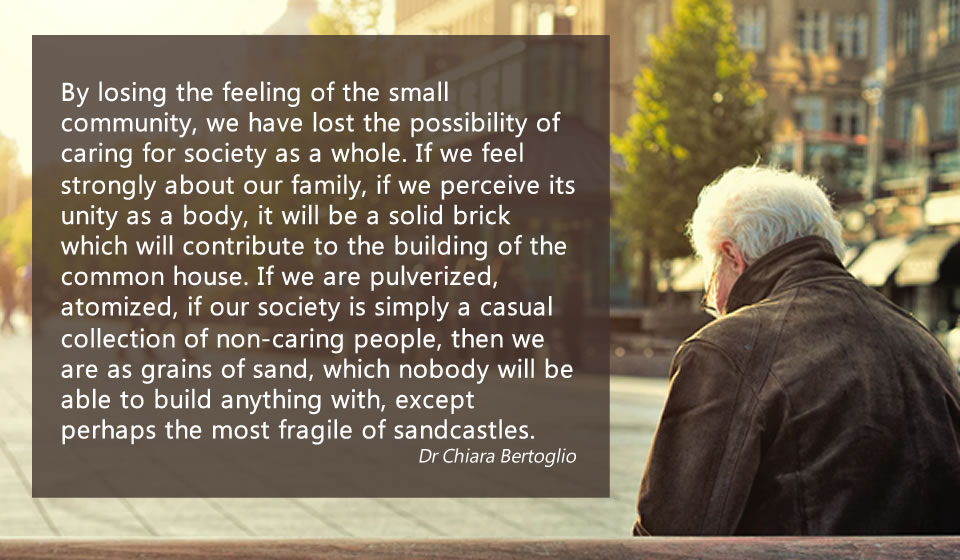
By losing the feeling of the small community, we have lost the possibility of caring for society as a whole. If we feel strongly about our family, if we perceive its unity as a body, it will be a solid brick which will contribute to the building of the common house. If we are pulverized, atomized, if our society is simply a casual collection of non-caring people, then we are as grains of sand, which nobody will be able to build anything with, except perhaps the most fragile of sandcastles.
We must learn to care again, to know our neighbours and to be concerned for them; to voice our worries for our society, to promote those values which are positive for making it healthy; we must make our social bonds solid, strong and powerful if we value communities as the habitat where humanity can flourish.
Dr Chiara Bertoglio is a musician and theologian moonlighting as a journalist. She writes from Italy. Visit her website.
The following article by Michael Cook, Editor of BioEdge, appeared in their 12 July 2018 newsletter and is republished here, with his permission.
Every year, about 1.5 million cases of euthanasia take place in the United States. Does this have a negative impact on healthcare workers? Sorry, about 1.5 million cases of cat and dog euthanasia take place. But the question is still relevant. Veterinarians, veterinary assistants and shelter workers experience great stress at having to put animals down.
The emotional connection between the work of human doctors and animal doctors is closer than you might think. Owners often react to a pet’s death with the intensity of grief which appears equivalent to the loss of a beloved relative.
So the moral stress which vets experience is relevant. Suicide amongst vets has been the topic of several studies. “Veterinarians are four times more likely than members of the general population and two times more likely than other health professionals to die by suicide,” according to a 2012 study in the journal of The American Association of Suicidology, Suicide and Life-Threatening Behaviour.
Why? Performing euthanasia day in, day out, also appears to make some vets less able to resist the temptation to commit suicide. The authors of the 2012 study found that “… all else being equal, veterinarians may be more likely than members of other professions to enact a lethal attempt when they desire suicide because their exposure to euthanasia has rendered them less fearful of death.”
Aren’t there lessons in these finding which are relevant to doctors who euthanize their patients? Sometimes doctors in Belgium or the Netherlands are quoted as saying that the death they helped was beautiful or peaceful. Could that be bravado masking their own nonchalance about human death?
How many times have we all heard the argument, “You wouldn’t let a dog suffer like this…” Its logic is that if the suffering of animals and humans is essentially the same, they both should be released from suffering in the same way. But if the animal-human parallel works for the patient, why not for the doctor? If we allow euthanasia, surely we can expect the same burn-out rates and the same suicide rates as veterinarians … at least the same. That should scare us all – especially the doctors who will be responsible.
Rev Stuart Lange, NZCN Interim National Director, presented our oral submission to the Justice Select Committee on the End of Life Choice Bill on 21 May, 2018. Maxim Institute was also among the list of nine submitters in the afternoon session and shared the link to the video of the session.
I recommend watching the video simply to gain an appreciation of how citizens and organisations can participate in the shape of the laws that govern our nation. The afternoon session was 2h 45 min long but you can use the guide below to find specific submissions.
Simply click on the video to play it, then drag the slider to the desired start time. Time and name of group or person making their submission
6:50 Motor Neurone Disease Association of New Zealand
21:50 End of Life Choice NZ
51:30 Cordon Copeland
1:03:00 Centre for Science and Citizenship Trust 1:22:00 NZ Christian Network 1:38:30 Maxim Institute
1:56:00 Remote New Zealand Mission Project (teleconference)
2:09:20 Conservative Party NZ
2:20:20 New Zealand Human Rights Commission (Paula Tesoriero – NZ Disability Rights Commissioner)