On both sides of the Tasman, in both public and social media, debate has been raging for several weeks about rugby star Israel Folau’s answer to the question,
…what was gods plan for gay people??
with
HELL… Unless they repent of their sins and turn to God.
Many commentators have expressed outrage, accusing Folau of hatred, bigotry, and homophobia. Others have been shocked by the intense anger, hostility and intolerance expressed towards Folau, and have worried about our society in relation to the freedom of religion and the freedom of speech.
Against that backdrop, some 21 reflections:
Note: these reflections do not necessarily reflect the views of the NZCN, or of all New Zealand churches, or of NZ Christians as a whole. This is an opinion piece.
1
Folau was not expressing hatred, but his belief based on the Bible
2
For most Christians, obeying the Bible is very important to them, because they see the Bible as the Word of God
3
It might have been better if Folau had answered something like “It is God’s plan that everyone should turn to God, and be forgiven and find new life through Christ”, and had left it at that
4
Repentance and hell are part of what the Bible teaches, but are not necessarily the best place to begin a conversation
5
God does not hate people. The Bible teaches that God loves human beings so much that he sent his only Son to die for us.
1 John 4:9 Romans 5:8 John 3:16
6
With regard to sexuality, the Bible teaches that we are created male and female, in God’s own image
7
The Bible teaches, and Jesus affirms, that God’s intention for human sexual relationships is loving faithful marriage between one man and one woman, and that all sexual relations outside of that context fall short of God’s intentions
8
The Bible does not quite say what Folau said, but he was correct in understanding that the Bible does not endorse homosexual relationships
9
The Bible does not single out homosexual relationships as the only sin, but as one sin among many others – and most sins mentioned in the Bible have nothing to do with sexual behaviour, but include such things as unbelief, blasphemy, idolatry, pride, drunkenness, temper, greed, injustice, and violence
Jesus did not explicitly mention homosexual behaviour, because everyone in Jewish society knew it was strictly forbidden in the Old Testament law. But in working among Gentiles, the apostle Paul addressed the issue several times, because homosexual behaviour was common in Graeco-Roman society
1 Corinthians 6:9-11 Romans 1:24-27
11
The Bible does not say anything about sexual orientation, but only about sexual behaviour, and sexual orientation in itself should not be regarded as sinful
12
Sexual fulfilment in marriage is one of God’s good gifts to humanity, but it is possible – and very common – for people of any age or orientation to live a life of celibate singleness, and some of them likewise see that as a calling and a gift from God
13
There is no biblical basis for cruelty, name-calling, prejudice, or hating anyone, and Christians who have done such things should repent of it
14
In general, Christians do not hate people with a gay lifestyle, but simply disagree with them on that
15
Christians are called to love everyone, but to love people we do not need unconditionally to accept everything they think, say, or do
Matthew 22:37-39 Galatians 6:10 1 John 4:11
16
To disagree with something as a matter of religious moral conscience is not the same as active discrimination
17
An ambivalence about same-sex relationships is not some unusual view of a tiny majority, but is held by a great many people and cultures around the world, and until a couple of decades ago it was mainstream in western societies too, and it remains mainstream in some cultural minorities who are very much part of New Zealand society
18
Some Christians in New Zealand see accepting gay relationships as reflecting biblical imperatives of love and justice, and thus put aside the specific Bible teachings about sexual morality – but that does not appear to be the majority view
19
Christians need to recognise the reality that the societal moves to normalise gay identity and relationships have become widely accepted, and are pervasively reinforced in public and social discourse, and that various anti-discriminatory measures are now enshrined in law
20
Christians should express their convictions wisely, sensitively, and respectfully, and with grace, in a way which reflects Christ and the Bible, and which avoids anything that can be misunderstood as “hate”
James 3:17 1 Peter 3:15-16 Colossians 4:6
21
Our society, media and law-makers need to be very careful that in New Zealand the cause of tolerance does not become dangerously intolerant, that freedom of religion and freedom of speech is not curtailed, and that the wider freedoms of society are not tragically diminished
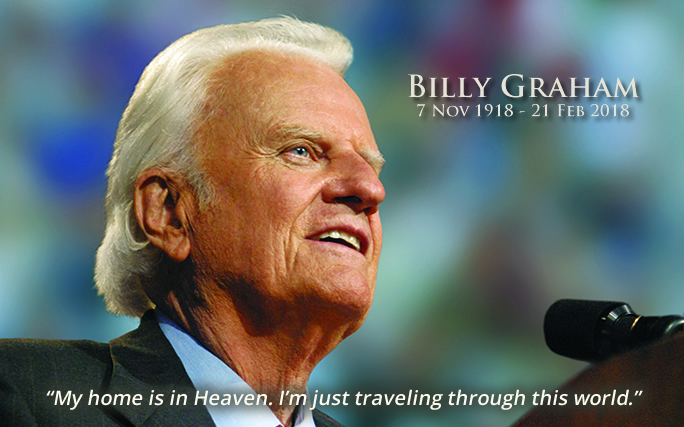
As news of Rev. Dr. Billy Graham’s passing at 99 years of age spread through the world today, the Christian community said goodbye to the one who helped defined the Christian message of the past few decades, more than any other. Bp Efraim Tendero, Secretary General of the World Evangelical Alliance (WEA), noted: “No one has more defined the essence of evangelical faith than Dr. Graham. He was God’s gift and instrument to the growth and development of today’s evangelical movement.”
He reportedly preached face to face to some 100 million people in his many public meetings since the middle of the past century. He gave focus and definition to what it meant to be born again in Christ and to what He calls us to in giving witness to the love and message of Jesus.
Rev. Dr. Billy Graham (c) BGEA.org
During his time, Dr. Graham was the voice of evangelicals, a community of Christians that grew from 90 million in the early 1960s to 600 million today. During his global travels, his prophetic and pastoral presence were trusted. His clear biblical message and deeply regarded leadership gave evangelicals a voice, an identity and clear vision. Not only did his preaching reach into millions of people, but his vision and energy translated into the lives of generations of leaders.
Throughout his life, he also had a deep interest in the world of the WEA. In 1968, at a time when the WEA needed added impetus he stepped in and provided resources for the relaunch and internationalization of the work.
WEA leaders were heavily engaged in the Lausanne Congress in 1974, where Graham and John Stott called 2,500 church leaders together in Lausanne, Switzerland, and there reshaped the evangelical witness, calling Christians to move away from just seeing the Gospel as an inward work of grace but to view ministry and calling to the world in all its need. The Lausanne Covenant became a theological and missional backdrop against which ministry was carried out. A legacy of enormous importance.
The week after the Congress ended, Dr. Graham took time to attend the WEA General Assembly nearby at Chateau d’Oex. Throughout his long ministry he continued to give much encouragement to the WEA and each of the national alliances to ensure that the results of his evangelistic efforts would be shepherded into the church, which the WEA is devoted to work with.
Living for almost a century, he had said, “I’ll preach until there is no breath left in my body. I was called by God, and until God tells me to retire, I cannot. Whatever strength I have, whatever time God lets me have, is going to be dedicated to doing the work of an evangelist, as long as I live.”
His ministry befits one who has been cited as one of the most liked persons of his generation. Avoiding political affiliation, his ministry drew together Christians from all communities. His humility, an earmark of his life, not only enabled people of all sides to join in common witness, but the clarity of his message never wavered. His faithfulness to the cross of Christ, its centrality in life and death, was an invitation for millions to accept the payment of sin and to live a Christ-centered life.
Dr. Graham’s passing leaves a vacuum that inevitably will be filled as the Spirit raises up new leadership for these coming generations.
NZ Christian Network is advising everyone who is concerned about euthanasia being legalised in New Zealand to make sure that they send a submission to the Justice Select Committee. This matter is now very time-sensitive: Submissions to the Select Committee have been extended and close at midnight Tuesday 6 March 2018.
This post runs through 5 ideas that help us situate the place of the church in society – which I think then helps us to critique and potentially adjust our engagement with society. Over the last few weeks I’ve been part of a conference with Christian Savings, Laidlaw College, and the Carey Centre for Lifelong Learning, where I talked around the idea that “something is different now” in terms of the relationship between church and society. In a previous post I looked at what the church will be like in 100 years – that was the first part of my talk, this post is the second part.
I’ve called the conference talk “something is different now” because our context is different to any other time in the history of the church in New Zealand. And while some of these changes might be unpleasing to us as the church – I think viewing the church through the lenses of these ideas can help with our engagement.
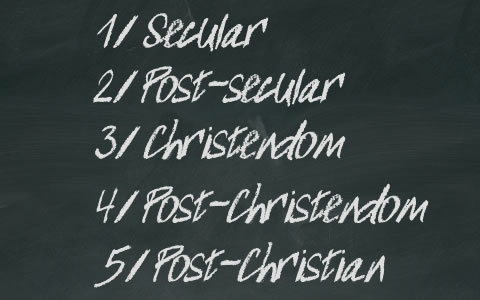
1. Secular
We sometimes talk about being in a “secular society”. And this is often said as if secular is bad or evil.
If you looked up a definition of ‘secular’, it simply means not concerned with religious or spiritual matters, so a secular society is a society not concerned with religious or spiritual matters.
Secularisation can refer to the historical process in which religion loses social and cultural significance. Sometimes this loss of significance can be accompanied with active disregard, but mostly in New Zealand I think the response is fairly passive.
The idea of ‘secular’ actually emerged from within Christian thought and culture. The most widespread contemporary understandings of the terms ‘religious’ and ‘secular’ were fashioned in the modern era, and encourage us to think in terms of separate, stable domains: the religious and the secular.[1]
We know life isn’t usually as clear-cut as binary or black-and-white grand frameworks, but we create them to aid our understanding.
What people mean by ‘secular’ is tied to their particular conceptualisation of ‘religion’… and vise-versa.
So religion and secularity are intertwined. I don’t think we need to lament about the secularisation of society – I think there’s a lot of good in it for the church.
Questions to ponder
If society in not concerned with religious or spiritual matters, have we, the church, fostered this?
Have we encouraged secularisation?
History and tradition
The church tradition I’m part of should flourish in a secular context: early Baptists were known as dissenters. I like to imagine them giving ‘the finger’ to the then current societal framework: no king or pope was going to tell them how to worship God!
This got them in trouble – because society was concerned with religious and spiritual matters – but in a way that some Christians thought needed reforming…
How does your own church tradition and expression fit within the idea of secularisation? Are there any stand out moments that still have an impact today?
Secularisation brought with it some angst toward religion – or at least an underlying negativity.
The next idea follows on:
2. Post-secular
I’m hearing this term more and more – it refers to a range of theories – (which you can look up online yourself if you’re interested…)
Not everyone is on board with this idea, some would say it’s just part of secularisation. I think it’s worth mentioning briefly here, because I think it brings (or will bring) a lot of freedom for the church:
The idea refers to a resurgence of religious beliefs or practices, and a new peaceful dialogue and coexistence with multiple expressions of faith and reason. (That’s quite an ask!)
The ideal is that religious people and secularist people shouldn’t exclude each other, but rather learn from each other and coexist tolerantly.
So in a post-secular society, religious and secular perspectives are on even ground, sharing equal importance. Fully secular societies may end up changing their value systems to accommodate this co-existence.
I’ve heard a scholar in the UK suggest New Zealand and Australia are showing the most signs of post-secularism of anywhere in the world…
Freedom
I do think we’re increasingly free to do whatever we want – as Christians and the church – so long as we’re not trying to control society with our religious ideology.
We are free to be the church,
to be radical disciples,
to be bringing forth transformation through our following of Jesus…
The ideas around secular and post-secular and my own personal experience, give me a sense of ease and neutrality: I am free to be Christian, and others are free to be Christian too if they see value in it.
Being Christian in this current context is a great thing – so long as we have an appreciation of others: that Christian spirituality is one option among many: our doctrine might not affirm that, but our engagement with reality must.
And we must not cloister ourselves away, but be gently contributing to many things – including in the public square.
3. Christendom
Academically the idea of Christendom gets a hard time – it’s either too simplistic, or can mean too many things (my colleagues at Carey don’t like me using the term, but I think on one level it’s very helpful).
I think it’s useful as a way of trying to illustrate there was once a period of time where certain things had influence, and now we’re in another time, where different things have influence.
So for me, you can’t have Christendom, without also considering post-Christendom (which is point 4).
Christendom can be described as a society where there are close ties between church leaders and secular leaders, where laws appear to be based on Christian principles, where Christianity provides a common language, and where most people are assumed to be Christian. Hugh McLeod[2]
I think New Zealand used to be a bit like that.
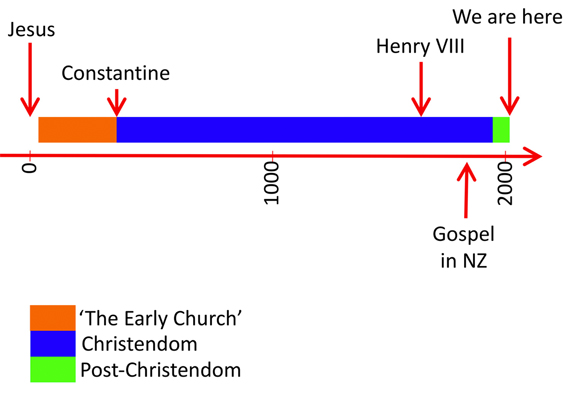
Here’s a really basic diagram – the last 2000 years:
Christendom can be defined as the period of time from about the 4th century (AD) until some time in the 20th century, so about 1600 years – which is why historians don’t like the term: so much happened over that time.
Constantine and his Christian conversion are said to have been the launch into this new paradigm called Christendom.
Christians were now free to gather in public spaces
The church began to be more formally organised
It is said that sitting in organized rows of seats in big rooms are also a product of Christendom
In Christendom-dominated-cultures the church had significant power in shaping the way of life. Some of this was good:for example, a lot of our systems of law and order are based on Christian principles. But some of it was bad: the church became a well-oiled religious institution. It lost some of its organic-ness and creativity.
Over time, due to things such as the abuse of power and control, and influences such as science and modernity, the church gradually crumbled in terms of its position and influence in society.
Christendom changed the church.
In some expressions of the faith, Christendom brought a church-building, institutional and power focus to the Christian-faith-community (church).
That’s not to say plenty of good things haven’t happened because of the church through this time – this is just a critique of some of the evolution of the church into what we have today.
The net effect…
A favourite quote on Christendom from a neighbouring pastor and academic, Mike Frost:
The net effect over the entire Christendom epoch was that Christianity moved from being a dynamic, revolutionary, social, and spiritual movement, to being a static religious institution with its attendant structures, priesthood, and sacraments.
And this leads us into idea number 4:
4. Post-Christendom
People who subscribe to the idea that our current period of time is very different to the paradigm of Christendom, have a desire and hope that in this new period, the church will again become a dynamic, revolutionary, social, and spiritual movement.
Baptists then and now
For Baptists – back in our history, Baptists have been known as ‘radical disciples’- there are some great stories from our origins.
As a movement of churches in New Zealand at the moment, words like ‘dynamic’ and ‘revolutionary’ aren’t used to describe us. In fact, we’ve been described as ‘stale, pale, and male’ and that we’ve run out of imagination!
That’s perhaps a bit harsh. If you’re not a New Zealand Baptist, how is your own church tradition/community being described at present?
What’s different about us now to when Christendom was in full swing?
Loss of coherence
Post-Christendom is the culture that emerges as the Christian faith loses coherence within a society that has been definitively shaped by the Christian story and as the institutions that have been developed to express Christian conviction decline in influence. Stewart Murray. [3]
Something is different now.
But I think we often operate as if Christendom still exists: As if the church still has influence like it once did. With an expectation that society will follow our moral code and listen to our… clanging cymbals?
Embrace, relax, fear not
However we define the changes that have formed the current context, I think we need to embrace the context as it is, relax within it, don’t fear it, and find new ways – which might actually be very old ways, to be the church and engage with society.
The final idea on my list is
5. Post-Christian
Here Christianity is described as a sub-culture. At the end of last century an English academic described Britain as post-Christian. He didn’t mean there is no Christian existence or expression, but rather that Christianity has become marginal.
In this post-Christian Britain, there are obviously still people like us that find Christianity a profound and vital influence in our lives, but we are situated outside the mainstream of social life, culture and influence. He described these Christians in post-Christian Britain as:
Like the early Christians in a pre-Christian, classical world, they became a ‘peculiar people’, anomalous in their primary beliefs, assumptions, values and norms, distinctive in important aspects of outlook and behaviour. They become a sub-culture. Gilbert, A. D.[4]
I think this sounds great! This is starting to sound a bit New Testament – a bit radical even!
A purpose of the church
If one of the purposes of the church is to realise the kingdom of God – or God’s transformative plan for the world – people will see the transformation in this sub-culture: in our lives, and families, and neighbourhoods – and they’ll want to know why – not because a church billboard said they should, but because my life, and your life has been transformed – and that is attractive.
These 5 ideas, or lenses
However we frame the changes in society – let’s try to be at peace with them, and find ways to be transformative within them. Let’s not expect the church to have any control over society, but imagine how we might express the love of God in ways that connect and engage with society.
Hope
Something is different now. But as far as I can tell, there is still no substitute for the present and future hope of salvation that the church has and does offer with its ideals of justice and selfless love.
I can imagine an amazing church existing in New Zealand in the year 2117. I expect it will look a lot different to many of our 2017 expressions.
[1] Troughton, G. (2016). Introduction in Sacred Histories in Secular New Zealand. Wellington, New Zealand: Victoria University Press. Page 12.
[2] McLeod, H. (2007). The religious crisis of the 1960s. Oxford, England: Oxford University Press.
[3] Murray, S. (2004). Post-Christendom: church and mission in a new world. Milton Keynes, England: Paternoster. Page 19.
[4] Gilbert, A. D. (1980). The making of post-Christian Britain: a history of the secularization of modern society. Harlow, England: Longman Group. Page ix.
Mike Crudge’s blog focusses on issues that in some way connect with communication, church, and society. These topics overlap with others such as theology and missiology, so if you’re interested in things like the mission of the church, being missional, or evangelism, you might find something of interest on it.
Mike currently lives in Auckland and is the Director of the Carey Centre for Lifelong Learning, which is part of Carey Baptist College, New Zealand’s Baptist theological college that has an ecumenical mix of students focusing on applied theology, pastoral leadership and mission training. Before that, he was a pastor at Oxford Terrace Baptist Church, Christchurch.
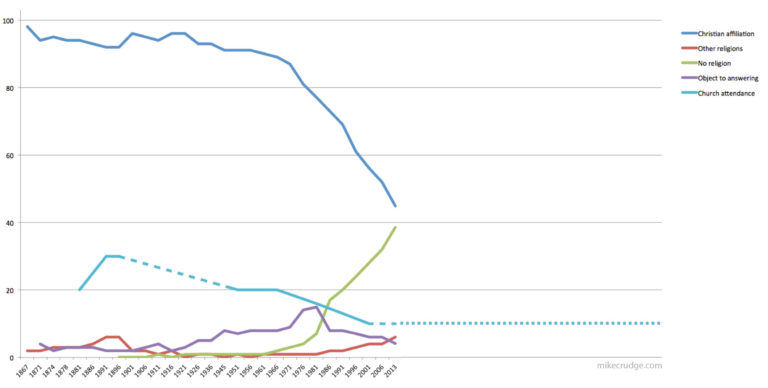
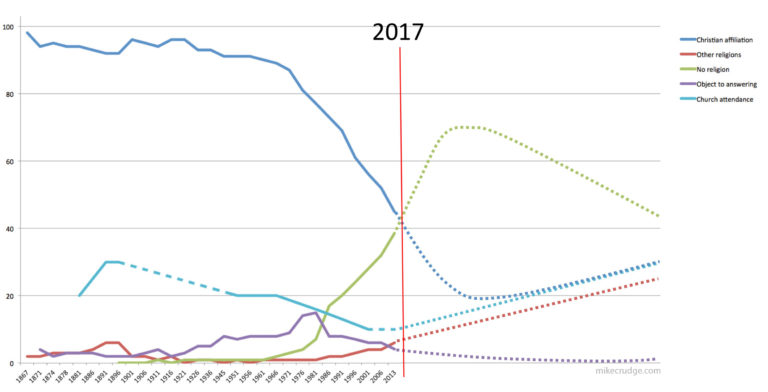
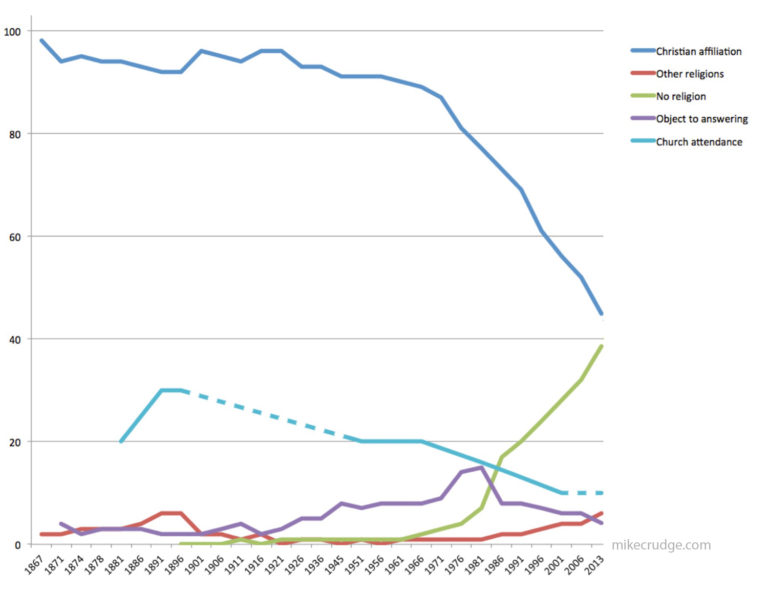
This graph shows the last 150 years of New Zealand census religion data and church attendance, plus my prediction for the next 100 years. Over the last few weeks I’ve been part of a conference with Christian Savings, Laidlaw College, and the Carey Centre for Lifelong Learning, where I talked around the idea that “something is different now” in terms of the relationship between church and society. This blog post is part of that talk. I debunk some of the hype around some census figures, and give two possible future scenarios for the church in New Zealand.
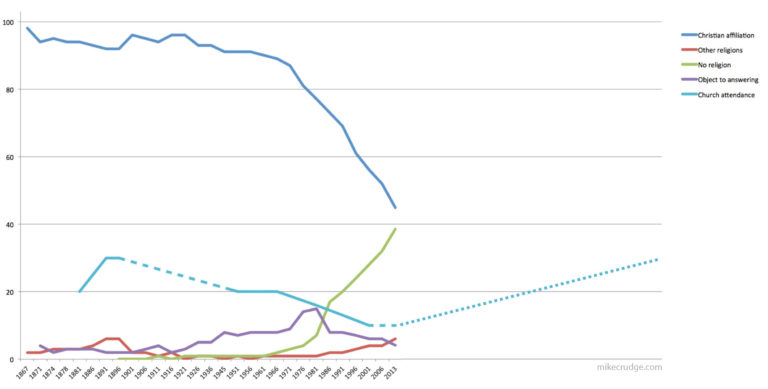
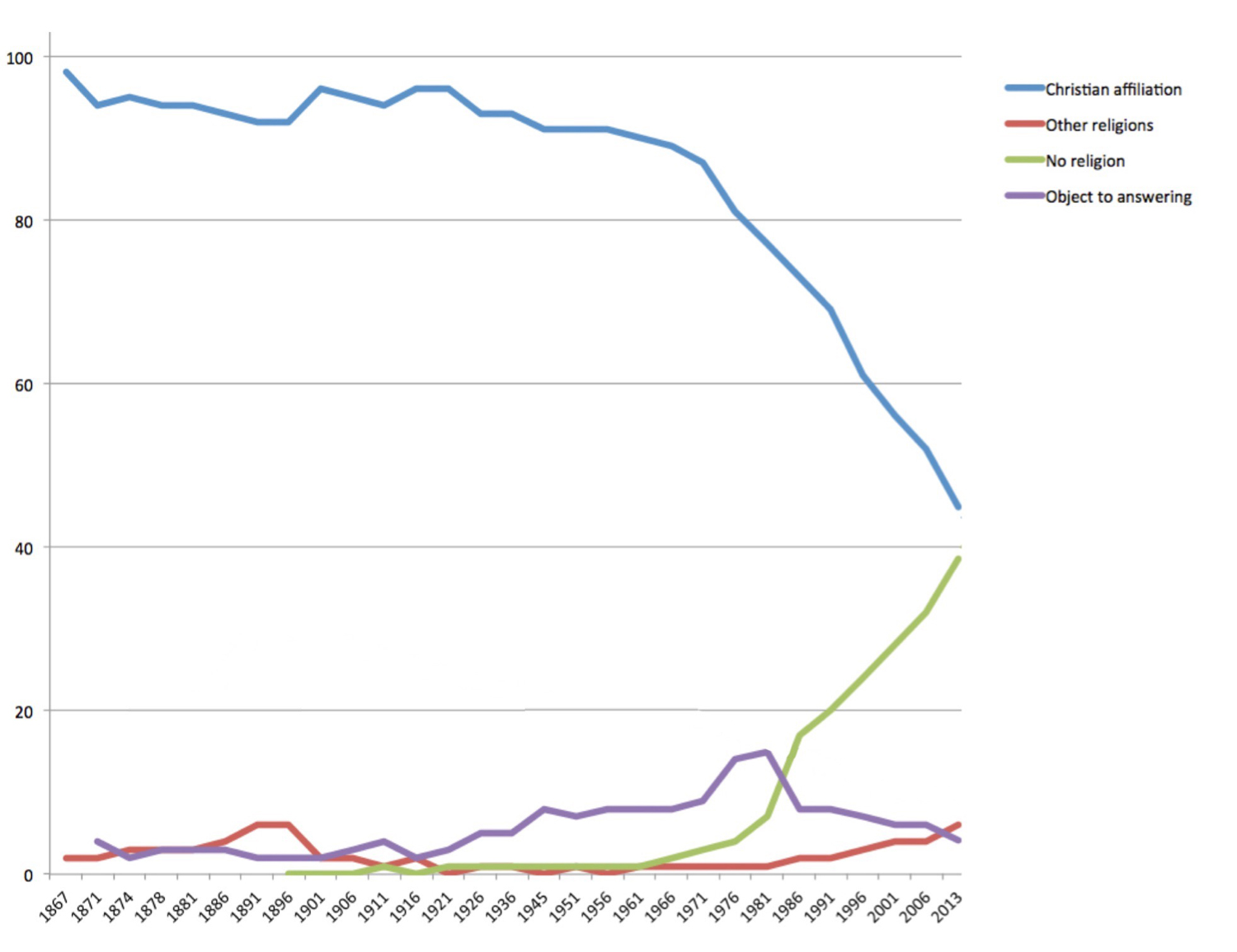
Looking at the census data in the graph below, the top line on the graph: Christian Affiliation – this is the line we hear sensational headlines about in the media when census results are released: about the church dying as this line on the graph plummets toward zero…
The vertical axis is percentage of adults, and horizontal axis is time from 1867 to 2013.
I don’t think we should believe the stories of doom! There is some bad news for the church, but I don’t think this is it.
I don’t think this downward line matters at all: what we’re seeing as this line falls is a correction in the data that will eventually match what the reality is.
As a comparison
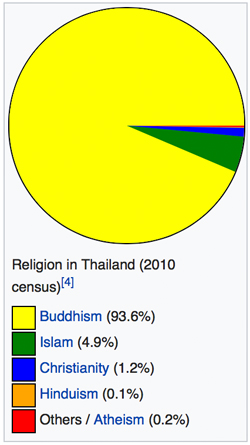
This pie-graph shows current religion in Thailand. The yellow shows 93% are Buddhist.
I first went to Thailand in 2001, the Kiwi friends I went to visit were working with Buddhist monks – teaching them English. Looking at this pie chart, you’d think nearly everyone in Thailand was Buddhist. They might be culturally Buddhist, but not practicing Buddhism – there’s a massive difference between a cultural identity, and the following of a religious faith. My friends told me they had discovered that for Thai people: “to be Thai, is to be Buddhist” – which doesn’t mean they are Buddhist.
150 years ago in New Zealand
Think about where the Pākehā colonizers came from 150 years ago: Christian Brittan. A culture that had centuries of Christian influence shaping it.
In the first New Zealand census in 1851, I think “to be a coloniser, was to be Christian.” 93.35% ticked the Christian box (interestingly, the same amount that are currently Buddhist in Thailand – it’ll be interesting to see the figures in Thailand in 150 years from now).
I think most followers of this blog would agree: that to claim affiliation to a cultural identity shaped by an historical religious framework – does not make you a follower of that religion.
A correction
What we have with the downward line on the census graph, are people deciding they no longer need to have a cultural Christian Affiliation, and they’re now happy and able to say “No Religion” – which is the increasing green line (I don’t think “No Religion” was even an option for a long time in the census.)
Eventually, the downward blue line will level out at roughly the amount of what I would describe as active-participating-followers-of-Jesus: the church. I don’t like to use the descriptor, but maybe the blue line will eventually represent actual Christians (I know – who am I to judge? – but I hope you see what I mean: the difference between participation compared to identity-only).
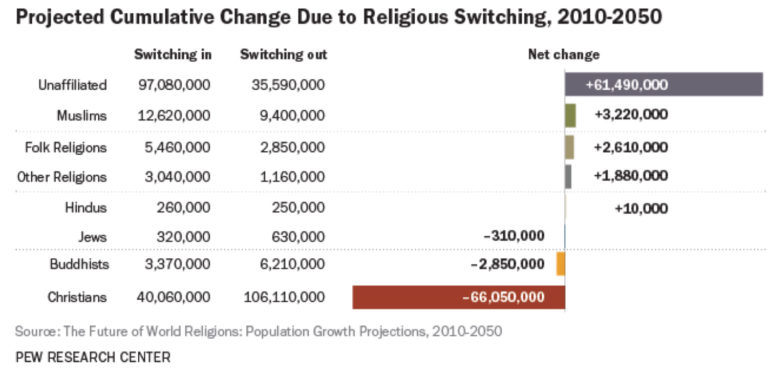
This plummeting line on the graph, what I’m calling a “correction” to reflect reality, Pew Research refer to as “Religious Switching”.
These are global figures projecting the change between 2010-2050
They are suggesting: Christians globally will drop by 66 million. Unaffiliated will grow by 61 million.
This doesn’t mean 66 million people will lose their faith, it just means they will be able to articulate a different cultural association – one that matches their reality: of no religion.
This data matches my predication with the blue line on our census graph: that it will eventually reflect actual Christians not cultural Christians.
Pew also have this chart:
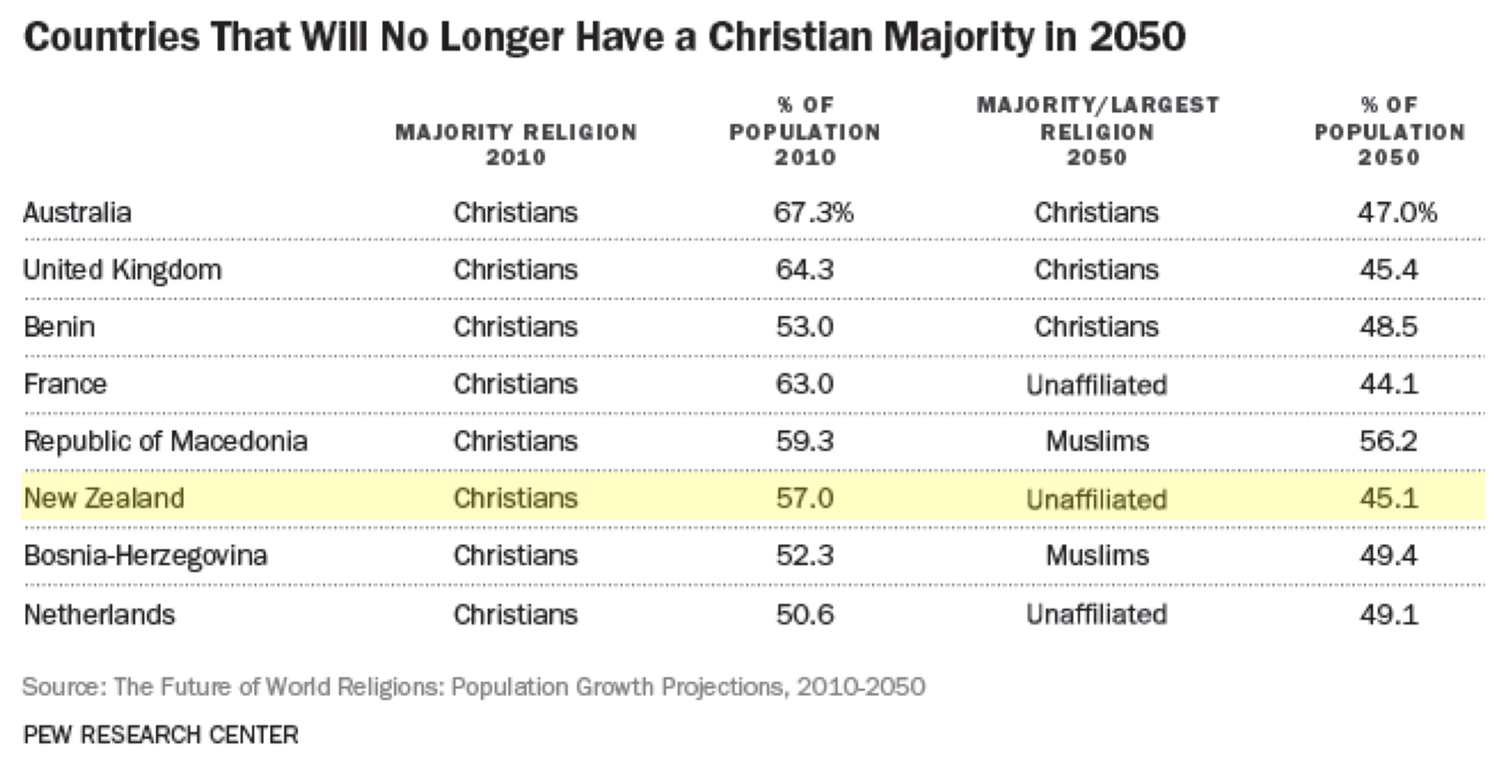
This chart is showing that New Zealand won’t have a Christian Majority in 2050 – they’re using Christian Affiliation figures – to suggest in 2010 57% of New Zealanders were Christian – that’s a cultural reference not a reality reference – the church was no where near that big in 2010.
If you hear media hype around this – that the church is dying – don’t believe it – it’s scare-mongering.
We don’t have a Christian majority now – what we have is a cultural identity with an historical Christian framework that is declining rapidly.
The actual church?
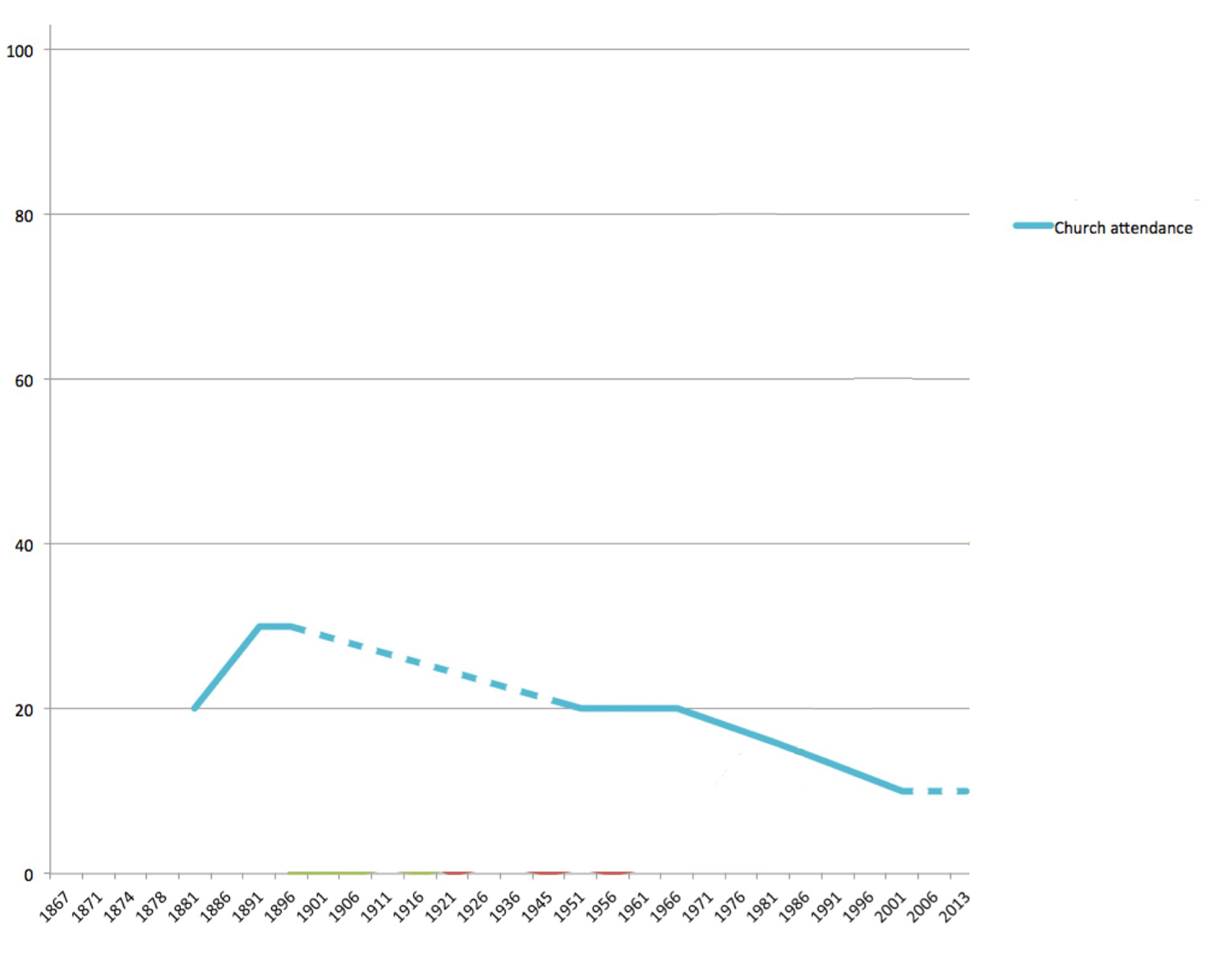
The data that is more significant, that might be a better indication of the church in New Zealand is this:
This is a rough graph of church attendance in New Zealand – across the same time period (percentage of adults on the vertical axis, time on the horizontal from 1867 to 2013)). The data is rough and incomplete – I talk more about this graph here in a post about when church attendance peaked in New Zealand… This line is an attempt to show regular church attendance of adults – as a percentage – by counting bums on seats at Sunday church services.
Assessing the state of the church by bums on seats is a pretty rough way to measure.
While you can be a follower of Jesus and not turn up regularly to church services – I do think regular participation in a local church community is a good indicator of “actual” Christians, rather than “cultural” Christians.
A new way to measure the church
As an aside: I’d be interested in coming up with a new way to measure how the church is going. What about this list forming some new measurement Key Performance Indicators (KPIs) of the church:
good news to the poor,
released captives,
sight recovery,
freedom from oppression,
proclaiming the Lord’s favour.
This list comes from Luke 4:18-19, the bit from the prophet Isaiah’s scroll that Jesus read out as a manifesto at the beginning of his Gospel ministry. That’s what Jesus set out to do. Could that be a way of defining what the church is to set out and do?
The reality is, it’s much easier to count bums on seats.
The 1890s peak
Looking at the graph above – from the data we have, church attendance peaked in the 1890s – at 30% of adults attending. I think that’s a much better indicator of the church than the census affiliation numbers at the same time. New Zealand church attendance then is lower than in Great Britain at the time, which may have been 40% or more.
The right thing at the right time
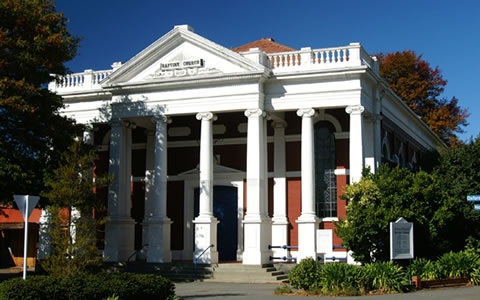
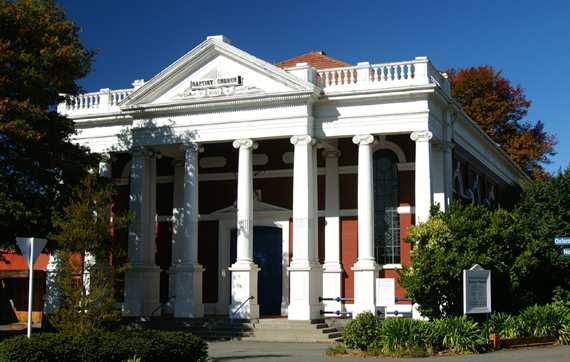
The photo below was the Oxford Terrace Baptist Church building in Christchurch, New Zealand. I was an assistant minister there for 6 years from 2009. This building was destroyed in the 2011 earthquakes and no longer exists.
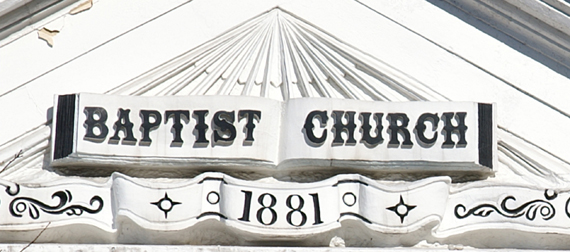
A close up of the top text:
This church building was built in 1881. They built that impressive building a decade before church attendance peaked in New Zealand. It was literally a case of “build it and they will come” – they couldn’t lose! There are stories of it being full to overflowing several times each Sunday for many decades.
I like to think they had their finger on the pulse as they sought to discern what was needed at that time and into the future. There will be similar stories throughout New Zealand. Those must have been exciting times for the church.
A strong minority
Current regular church attendance probably sits around the 10-15% mark. I think this is an indicator that 10-15% of New Zealanders are probably active, participating, followers of Jesus. Together we’re a strong minority.
In the graph below I’ve added the church attendance line to the census data:
What will the church look like in 100 years?
Now I want to predict 100 years into the future.
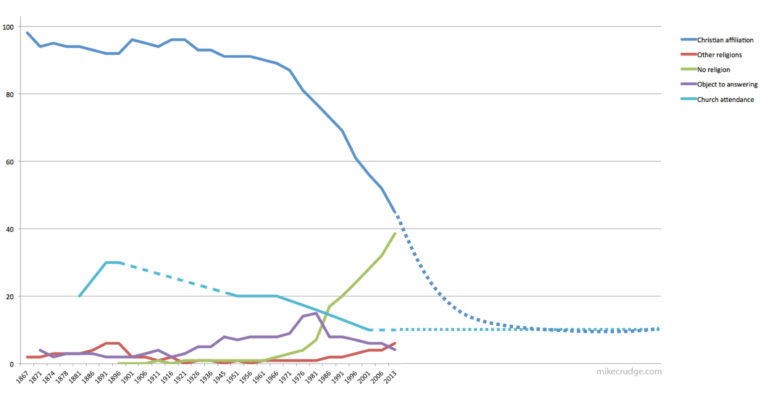
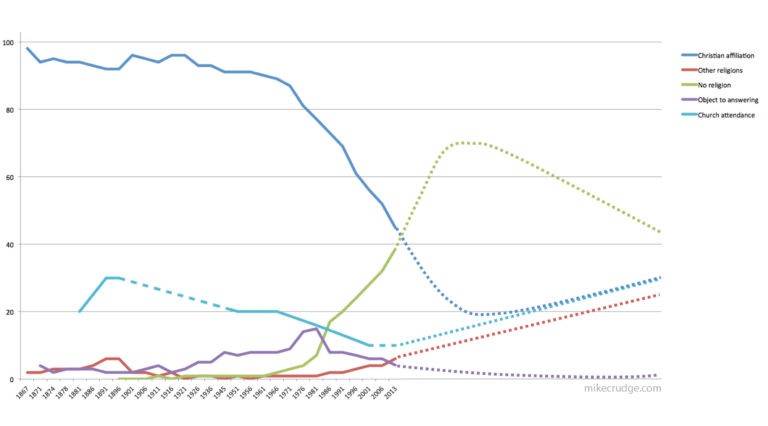
In the graph above I have added a church attendance line 100 years into the future that stays constant at 10% of the adult population. Imagine if the church stayed the same – we continued to be 10% of the population for the next 100 years.
This would actually mean the church grows significantly over the next 100 years, obviously as population increases, the size of the 10% increases too – so this is a pretty optimistic scenario: we stay the same percentage AND grow bigger.
As shown in the next graph, the Christian Affiliation line will correct itself and be in line with however we end up measuring the church. This is the so called Religious Switching of Pew Research:
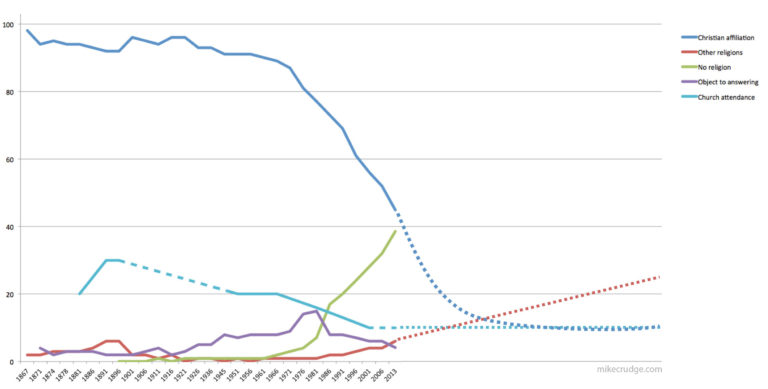
In this scenario I’m guessing Other Religions will continue to increase – mostly with immigration – as shown in the next picture. I’ve drawn this as linear, reaching 25% in 100 years – but it might end up being exponential and much higher depending on our immigration policy…
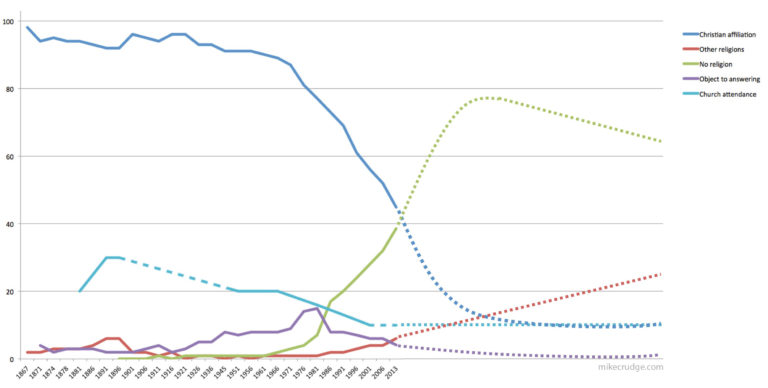
Object to Answer will dwindle – people will be happy to tick No Religion, and No Religion will peak and then diminish as Other Religions increase:
Do you think this is possible? Is this a realistic projection?
Could the church match the historical peak?
I’ve got one more scenario:
What if, over the next 100 years, the church grew back to its 30% peak – so in 100 years, 30% of New Zealanders were active followers of Jesus:
The other lines could end up looking like this:
Can you imagine that happening?
Imagine if in 100 years nearly a third of New Zealanders were active followers of Jesus.
Coming back to 2017 – I’m interested in the things the church needs to consider now as we plan the next 100 years:
What are your thoughts on all of this?
Imagining the church in 100 years is a way to introduce ideas that help us consider what to do now as we plan for the future. In a following blog post called 5 ideas that shape church and society engagement, I run through five ideas that I think help us situate the place of the church in society – five ideas that help us critique and potentially adjust our engagement – helping us get our finger on the pulse at this time as we plan for the future.
Mike Crudge’s blog focusses on issues that in some way connect with communication, church, and society. These topics overlap with others such as theology and missiology, so if you’re interested in things like the mission of the church, being missional, or evangelism, you might find something of interest on it.
Mike currently lives in Auckland and is the Director of the Carey Centre for Lifelong Learning, which is part of Carey Baptist College, New Zealand’s Baptist theological college that has an ecumenical mix of students focusing on applied theology, pastoral leadership and mission training. Before that, he was a pastor at Oxford Terrace Baptist Church, Christchurch.
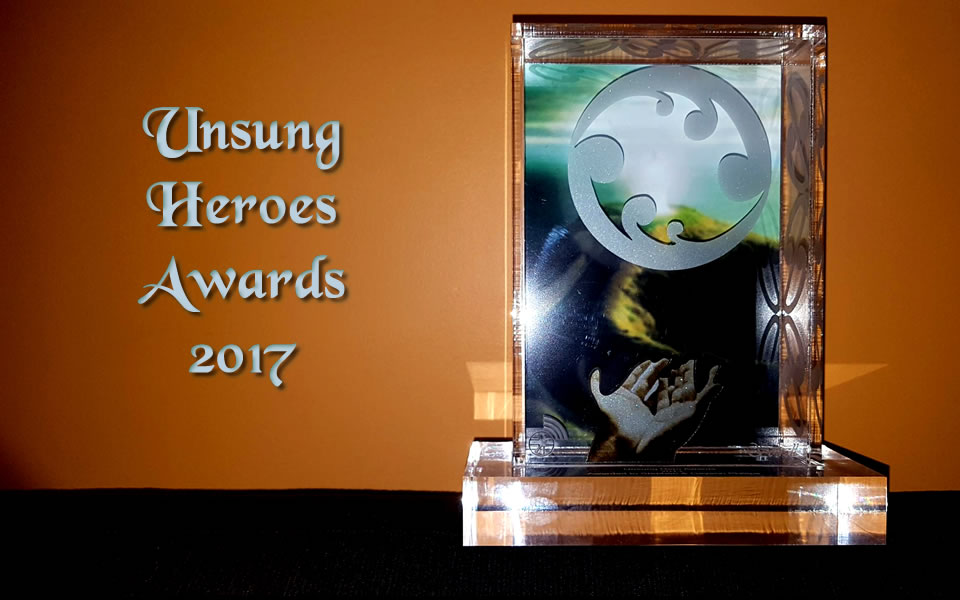
Shortly after the 2011 Christchurch earthquake, in recognition of the contribution of churches in providing hope and comfort as well as material assistance, NZ Christian Network’s board inaugurated a new award, known as the New Zealand Christian Network Unsung Heroes Awards.
The purpose of these awards is to honour the good work of individuals and groups which has gone largely unrecognised, to encourage others, and to give glory to God who inspired and empowered them.
In an age which has forgotten or never knew the significance of Christianity in our history, and which increasingly does not appreciate the importance of God in our country today, we are grateful for the privilege of being able to hold this event at Parliament and celebrate what God is doing in and through the lives of people. We are thankful also this year to Simon O’Connor MP, who hosted the event.
The awards are presented in categories related to New Zealand Christian Network’s key projects – Secularism, Value of Life, and Missional Living. This year we were pleased to also make two special awards for Working for Bi-cultural Understanding and Demonstrating a heart for Mission from within the Local Congregation.
This year’s recipients all received a trophy designed by Karen Sewell especially for our Unsung Heroes, a certificate, a copy of their citation and a gift card from Manna and NZ Christian Network.
Special categories for 2017
Bi-Cultural Understanding
Demonstrating a Heart for Mission
Key Focus categories for 2017
Secularism
Value of Life
Missional Living
Special Categories for 2017
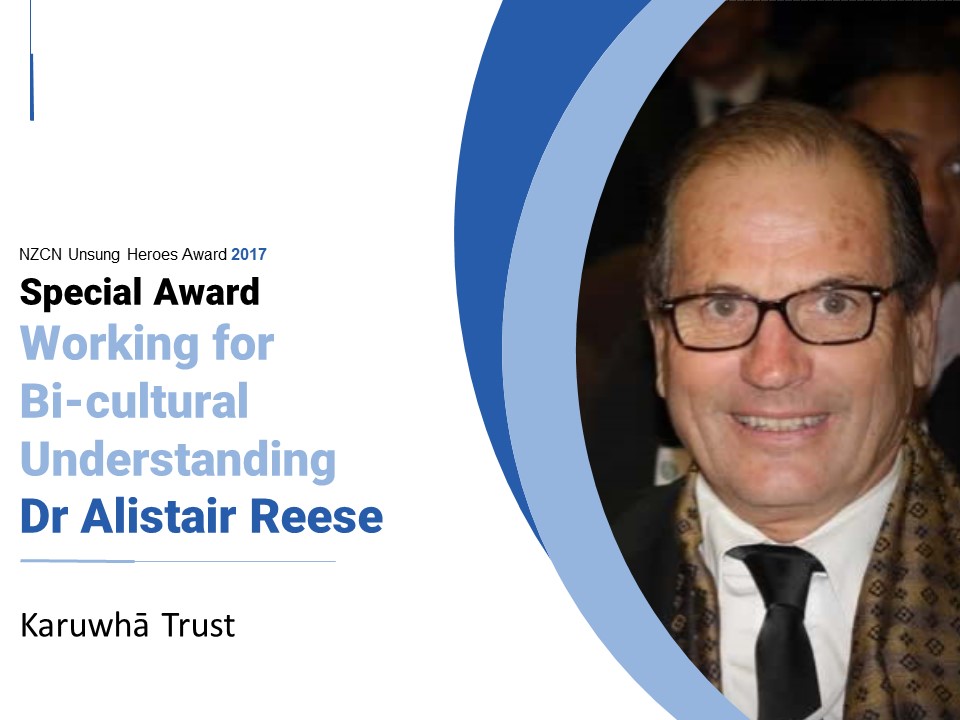
Working for Bi-cultural Understanding
For many years Alistair has been preoccupied with reconciliation in Aotearoa NZ, with a particular emphasis on Pākehā identity and how we can live in a colonised land. Much of his speaking and writing reflects on Te Tiriti/Treaty of Waitangi as a doorway to reconciliation.
He and his wife Jeannie live near Te Puke in the district of Tapuika/Waitaha on a farm in Paengaroa, Aotearoa New Zealand. He has postgraduate degrees in Theology, History and Tikanga Māori. His PhD in Public Theology was conferred by the University of Auckland in [2014]. Alistair is a Teaching Fellow at the University of Auckland and his research and speaking interests include post-colonialism, reconciliation and prohetism. Alistair is involved in local and national efforts to promote reconciliation between Māori and Pākehā and exploring understandings of what an indigenous form of Christianity might look like.
Dr Alistair is a Trustee for the Karuwhā Trust, a registered New Zealand charity that seeks to engage Aotearoa New Zealand in a conversation about identity and history. They do this by facilitating groups to Waitangi. By researching the stories about our shared history and not just the famous stories and running workshops speaking at conferences, hui, seminar or retreat. In asking the question about what this conversation looks like I was struck by Alistair’s response to Mike Hosking cynical view of the Waitangi event as masquerade waiting for trouble or to quote for it to “hit the fan”. I shall read it so that you can hear the heart and the flavour of conversation with Doctor Alistair Reese.
“Discussions both informal and formal were held in Waitangi meeting houses, hotels, marquees and over cups of coffee, fried bread and raw fish. The Constitution, water ownership, the flag, the Treaty itself and the Black Caps’ chances in the World Cup were discussed and debated. People participated in the powhiri at Te Ti Marae, the Dawn Service and the later church service at Te Whare Rūnanga – the nation’s marae on the Treaty grounds. They watched the navy band, the flag being raised and waka being launched. Some bought stuff from the craft markets, Māori bibles from the Bible Society, while others protested in close proximity to those doing bombs off the bridge. Add to this, buskers, Ardijah on the main stage, swimming, sleeping on the beach and political fora against the backdrop of a sparkling Bay of Islands, and a glimpse of our national day can be seen.
“Not a ‘masquerade’, and neither did whatever ‘hit the fan’, but it was a day of significance that provides an opportunity for our nation to commemorate, celebrate and also ponder how the Treaty relationship can be restored. This is a day of conversation that looks back, examines the present, and dreams about the Waitangi aspiration of unity or kotahitanga, spoken of 175 years ago by Lt. Governor Hobson in his famous words: He iwi tahi tātou! We are now one people! Not all the same – no – but all belonging to this land because of the Treaty’s invitation to be here and prosper here, together.”
Dr Reese, we honour you this evening for your service to the Kingdom of God…
Demonstrating a Heart for Mission from within the Local Congregation
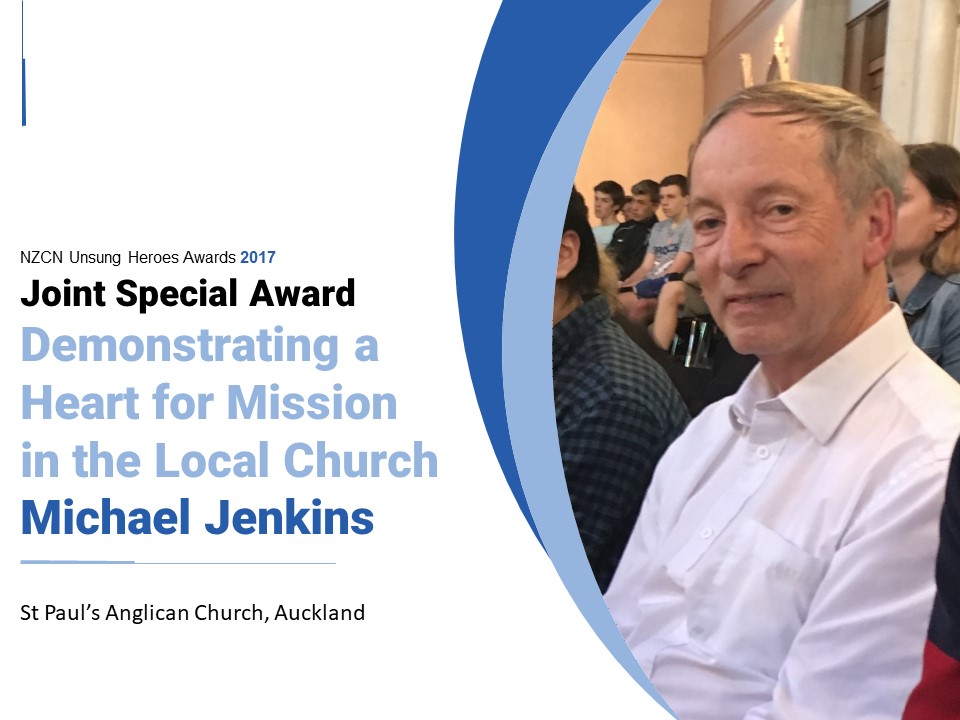
Michael Jenkins was brought up in a Christian home, with an awareness of his forebearers missional work, particularly amongst Maori. He became a Christian in his early teens, and was soon teaching the Bible in a local interdenominational Sunday School, and working with ‘at risk’ young Maori in Ponsonby.
For the last 25 years, he has ministered to young people and particularly International students at St Paul’s Anglican Church, Auckland City.
Michael has given free English coaching and keyboard tuition for many years to international students and has found this is a great way to engage with people, many of whom have had little experience of Christianity and eventually want to learn more by joining in Bible Study Groups.
He is a professional music teacher and has given many hours of free music tuition to promising students in organ, piano and keyboard. Every Saturday morning he sets up 20 keyboards he has purchased himself to give free keyboard lessons: these are open to all.
For decades, he held Friday night gospel services for mostly Asian international students, and immigrant families. He and his team of helpers have served those who came, also leading home groups and undertaking pastoral care. Over the years, they have seen many hundreds became Christians. Starbucks, opposite the church, is Michael’s unofficial headquarters where he has met with students helping them with assignments, and other needs.
Michael has played the organ and led Bible studies for a Korean church who meet in the St Pauls building. Michael has a home in Warkworth that is open to students and families, and he has often accommodated needy people in his home in the city. He is a man with a huge heart who has given a lot to generously serve many people over the years.
Please welcome Michael Jenkins…
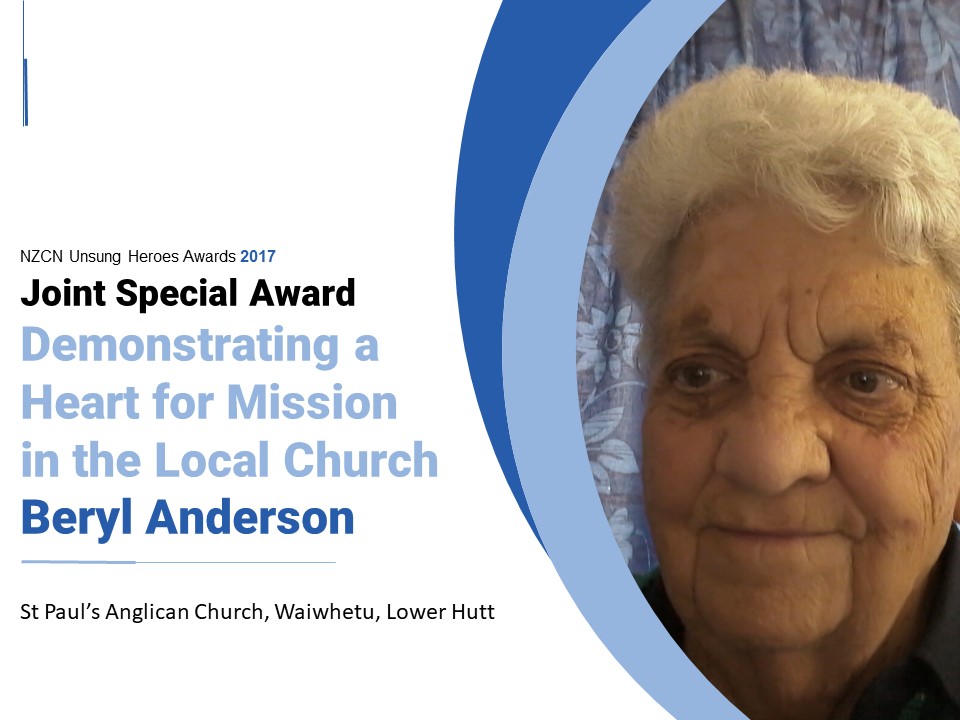
Beryl was born and grew up in Invercargill. She trained as a nurse and began a career of using this professional expertise alongside a pastoral heart to look after others. Early in her career, she served at the Leprosy Mission Hospital in Vanuatu. She married Doug when she returned to New Zealand and furthered her mission endeavours alongside her husband working with the Overseas Missionary Fellowship (OMF). Starting out in Singapore, they trained Christian workers from all over the world, and Beryl used her nursing and pastoral skills.
From there a move to Kuala Lumpur, saw Beryl running the Guest House. She trained as a Samaritan phone counsellor and started helping people in crisis.
On returning to New Zealand, Beryl provided pastoral care and support for families at St Paul’s Trinity Pacific Church in Christchurch, where Doug was the minister. And later at Knox Presbyterian Church, Lower Hutt. During this time she also:
Completed a degree in Women’s Studies and Chinese Studies,
Trained and served as a chaplain for the Inter-Church Trade and Industrial Mission
Worked as a volunteer for Refugee and Migrant Services
Initiated Knox’s free Christmas Dinner for more than 100 people from the community, which has continued every year
Wrote and published a book titled ‘Opportunity Knocks’, a compilation of stories of people’s struggles and successes when their lives were shattered by early retirement, restructuring, redundancy, bereavement, or medical misadventure.
In 1994, Beryl and Doug moved to Turkey, where Doug pastored a church. Beryl provided hospitality and support to many including migrants and refugees, she was a member of the Istanbul Women’s Conference, and worked amongst street kids where she was awarded a plaque for her services by the group ‘Friends of Street Children Work in Istanbul’.
Part of the citation on the award reads: “You have been a mother to us and the children. We will always remember you and our time together in Istanbul.” On their return to New Zealand, Beryl and Doug have settled at St Paul’s Anglican Church, Waiwhetu, Lower Hutt. Beryl is actively involved in the church’s pastoral care committee and in providing a voice for mission organisations, and leading prayer support for persecuted Christians overseas. She has been co-founder and co-leader of a support group for refugees and migrants, she volunteers at the local Citizens Advice Bureau, helps refugees and migrants to learn driving and obtain their driver licences, is ESOL-trained and helps teach English to refugees.
To quote the people who nominated Beryl: She is an inspirational role model of 24-7 Christian faith, including worship, witness, words, and action; someone who brings to mind Paul’s statement “Follow my example, as I follow the example of Christ.”
Please join me in welcoming Beryl Anderson to receive this award…
Key Focus Categories for 2016
Secularism
The scriptures are full of small enterprise, Zebedee, Philemon, Lydia, Paul and even our Lord to name a few. Most of the other names including those of the original apostles that are mentioned in the New Testament are those of working people. It is Greek thinking and non-biblical thinking which separated the church as sacred or spiritual, from business and employment as secular or of the flesh. God is moving to change this and make all of life, business included, the context for the Lord Jesus to be revealed through us.
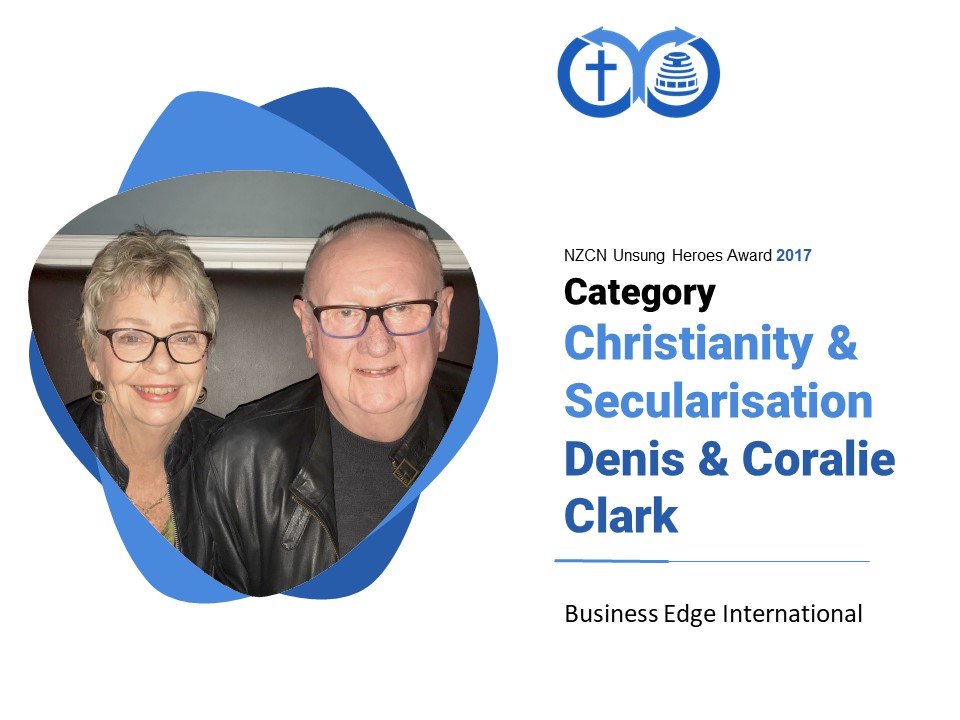
Denis and Coralie Clark are the Founders and CEO of Business Edge, a unique support business dedicated to empowering business people to become a positive force within their business, community, and nation from a Christian Worldview….!” The business world for them is a missional opportunity for the Kingdom of God.
The seeds of Business Edge began in 1989 in their experience of a business failure. In their own business experience, they have both received spiritual support and not received spiritual support. They have seen both business success, and failure. They know the joys and the grief. They have employed staff, borrowed, done the selling and the producing. They understand that as business people they exist not just for themselves but they are an integral part of the city and as Christians called to transform it.
In 2003 Denis and Coralie launched Business Edge believing that no one is more strategically positioned in a city or community than Christian believers operating in the marketplace. Business Edge, their assignment from God, is to see that you are encouraged, strengthened, equipped, and inspired to succeed in your business or work.
The vision statement of Business Edge is
“To be the business group of choice in our city and nation, unlocking all your potential for good and for God.”
Within the church family, Denis and Coralie found others who experienced a loneliness, lack of understanding and frustrations. So they gathered within their church community a business focused small group. They met, prayed, laughed, cried together and built meaningful relationships with folks who dealt with similar situations every day.
After 2 years when the group had become larger in size, they realised they needed to extend this “budding ministry” to more than a small group and more than just one church. Business people of faith all over the city were needing to be part of something that would encourage and recognize the “calling” that God had placed on their lives to be a beacon of light in the city by doing business God’s way.
Business Edge develops relationship groups, social events, business speakers, educational seminars and workshops, a bi-annual conference day with validated overseas speakers, resources like books, DVDs, CD’s, Pastoral contact, direct prayer within the business, email prayer requests and praise points daily etc.
Denis and Coralie are committed members of a local church. They have 3 married, adult children, and 7 grandchildren. I have the privilege of knowing them, I have attended a number of their events. They are just really good people with a heart for the Kingdom of God.
Denis and Coralie, we honour you this evening for faithful pioneering work encouraging Christian business owners in the mission to which God has called them…
Value of Life
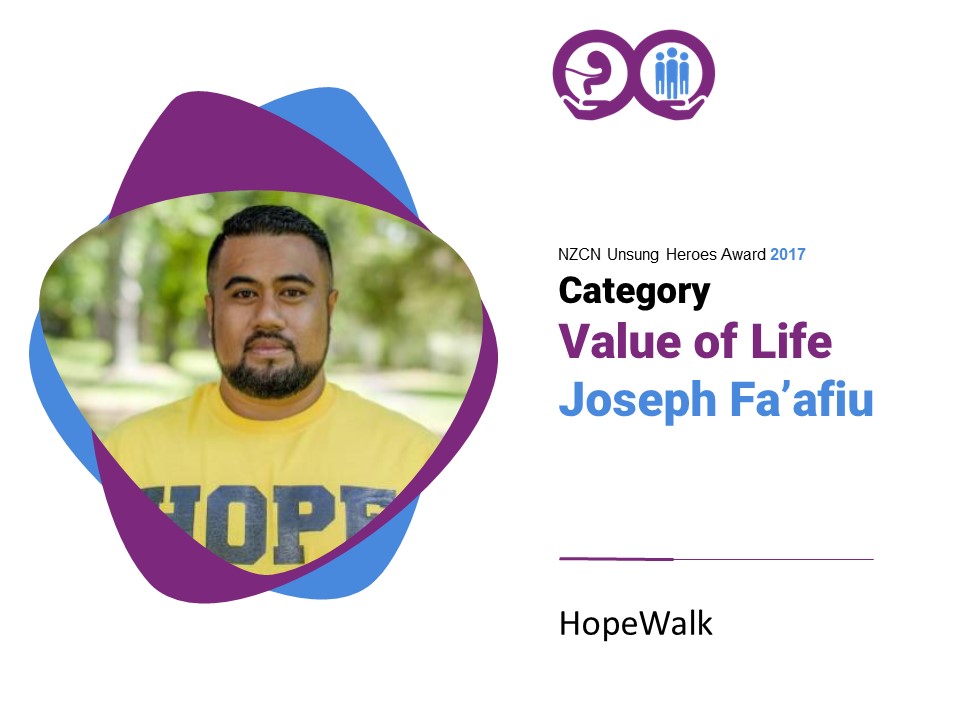
Joseph’s mission in life has many forms, but in its purest form is to make sure others become all they were born to be. Joseph wants to help them dream, to design what that might look like and to set about doing it. Joseph Fa’afiu is also a Leader and a Storyteller.
Joseph has served the South Auckland community and New Zealand as a nation for over 15 years in a range of areas from free story times in libraries and schools to working with at-risk youth. He is currently a Duffy Books In School role model.
In 2015 Joseph founded HopeWalka suicide awareness and prevention movement. They are a community action group which gives individuals, families and communities who have been affected by suicide a place to connect with others who have also lost loved ones to suicide.
HopeWalk was also birthed to highlight the existing organisations and agencies that provide suicide prevention, intervention and post-intervention support. Hopewalk organise and lead walks globally in NZ, Australia, USA, Canada and the South Pacific.
Joseph says, “This movement is about giving people a voice which they are told by society they can’t have because its taboo, an unspoken topic and so on. We need to break the shame, stigma and silence around suicide – it starts and ends with us. We need to remember that we are talking about people, not numbers on a piece of paper.”
In 2017 Joseph was acknowledged for his work by being the runner-up for the Maori/Pacific Ministry of Health Volunteer of the Year 2017 and recipient of a LifeKeepers Award for work in suicide prevention.
Joseph served on the Counties South PoIice Pacific Advisory Unit in 2016 and was also the recipient of a Kiwibank New Zealander of the year local hero medal two years in a row in 2017 and 2018 for his ongoing work in the community. In 2017 Joseph was awarded Sunpix Pacific Community Leader of the year.
Joseph was educated in Glen Innes and Lives in Mangere, South Auckland with his beautiful supportive wife Lydia and 5 sons. Joseph’s favourite quote is from the movie Gladiator “What you do in this life echoes in eternity”.
Joseph, we are privileged to honour you and Lydia in your service and ministry…
Missional Living
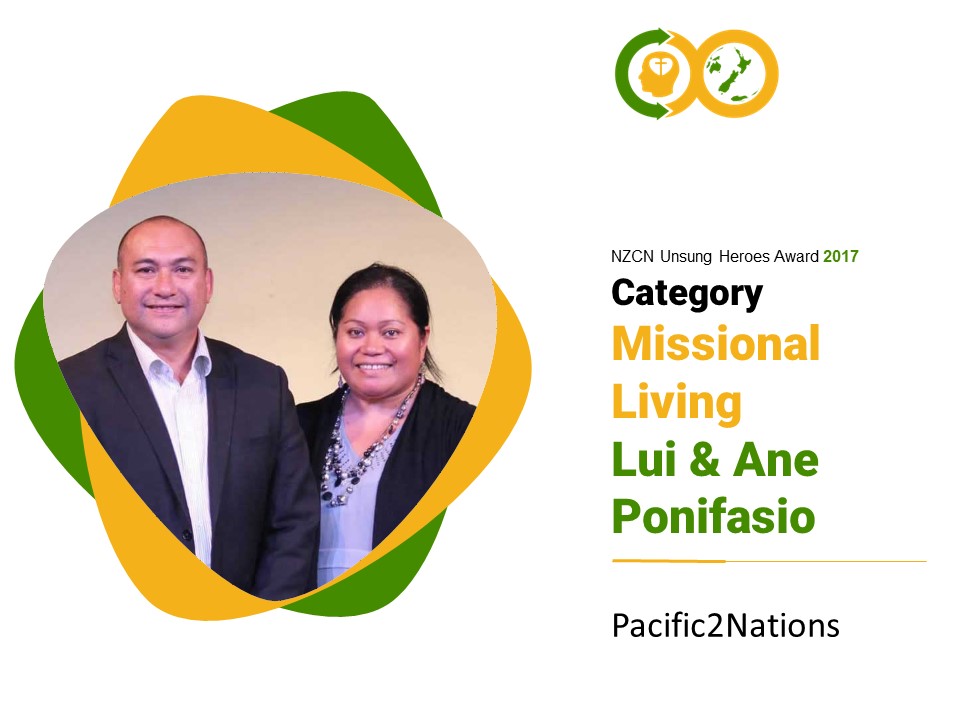
Lui and Ane Ponifasio: Lui – Pastor, entrepreneur and founder of Samoa MultiMedia Group and Radio Samoa, Chairman of Pacific2Nations, and the Senior Pastor for LifeChurch in South and West Auckland and internationally West Papua. Ps Ane – currently the Managing Director for Radio Samoa, Senior Pastor for LifeChurch South, West Auckland and West Papua.
LifeChurch is a flourishing church community, committed to seeing the gospel declared in this nation and internationally. Lui is one of the international leaders of the Pacific to the Nations Movement (P2N). Pacific to the Nations seeks to mobilise the Pacific people into missions from across New Zealand, Australia, the Pacific and beyond. Lui also has a significant leadership role in the Samoan Brethren Churches in New Zealand and Australia.
The genesis of the Pacific2Nations movement began several years before the first meeting was held, as the Holy Spirit started stirring the hearts of several Pacific ministers and leaders in Auckland and the Pacific Islands to mobilise Pacific people for global missions.
The first group of pastors and mission organisation leaders gathered in September 2012 to discuss how they could mobilise Pacific people for world missions. There has been a sense and evidence of sovereign connections taking place to achieve this vision. There was a recognition that Pacific peoples had taken Missions very seriously after they first received the Gospel through European Missionaries. Many went from Tahiti, Tonga, Samoa and the Cook Islands, and travelled west to Fiji, New Caledonia, Vanuatu, Solomon Islands and Papua New Guinea with the good news.
Many were martyred and died of sickness and disease, but when the news of someone losing their lives reached the country they had been sent from, then in many cases others quickly volunteered to take the place of those that had lost their lives. The Pacific2Nations movement wants to stir this legacy again in the hearts of Pacific Island peoples, especially the younger generation, so that a fresh wave of Pacific people may be sent into the nations of the world. This is principally a Church-centred thrust, but also has tremendous support and input from Missions Interlink and several member organisations that actively support the Pacific2Nations vision.
A wide variety of Churches are already involved, from all spectrums of the body of Christ, including Mainline, Evangelical and Pentecostal Churches. All of them recognize that the time is right to re-engage Polynesians, Micronesians and Melanesians in a new wave of Missions in its various forms. Leader of the Pacific2Nations Movement, Pastor Lui Ponifasio says, “We are not trying to recreate what our forefathers did in the 1800s and early 1900s, but we feel that they have handed over to us a strong legacy and a mandate to fulfil the heart of God by going to the nations, to unreached people groups as they did. This is our time.”
Pacific2Nations held its inaugural conference at the Vodafone Events Centre Auckland, on the 8th and 9th of November 2013. A second event was held in September 2015. Over 3000 people attended both events. In May 2017 Pacific2Nations was held in Sydney Australia. Similar mission events are planned for the USA and the Pacific Islands in 2017 and beyond. P2N500 is an initiative to reach 50 countries with the gospel in 2017. Over 500 missionaries will be sent from over 100 churches in short-term teams with an emphasis to reach unreached people groups.
A supporter of the P2Nation movement writes “I believe ‘The Pacifc2Nations’ is a (movement of people) – whereby ‘people’ can share resources in doing Christian mission together. It is in sharing resources and networking and connection that people can be encouraged to do mission. For the purpose of evangelising and discipling people towards the great commission.”
Lui and Ane, we acknowledge you for your vision and passion to mobilise the Pacific people into missions…





 What will the church look like in 100 years?