by NZ Christian Network | 19 Aug , 2013 | FOCUS, Marriage and Family, Media Releases, NZCN, Secularism
MEDIA RELEASE: With the amended marriage law coming into effect today, New Zealand Christian Network is asking MPs and others who advocated for the law change to respect the freedom of belief and conscience of those who hold different beliefs on this matter.
National Director Glyn Carpenter said, it would be a pity if those assurances are ignored and people are forced to participate against their consciences with ceremonies they do not agree with or face consequences.
“This affects far more people than just marriage celebrants. I have heard this week from people involved in service industries who are worried they may have to close their businesses if they do not provide services for marriage ceremonies they don’t agree with.
“Freedom of belief and conscience need to be taken very seriously, not just for ordained ministers, but for all people” said Carpenter.
[ENDS]

by Guest Author | 18 Aug , 2013 | FOCUS, Value of Life
ABC Religion and Ethics | 26 July, 2013
Hoisted on his own petard – that phrase has kept coming to mind as I’ve followed the announcement, explanation and implementation of the so-called “PNG Solution.”
In 2006, then-Shadow Minister for Foreign Affairs Kevin Rudd wrote an article for The Monthly entitled “Faith in Politics.” It was about the role of churches and individual Christians in politics. His purpose was to critique the “privatised, pietised and politically compliant Christianity” of the televangelists and to challenge “those who would seek today to traduce Christianity by turning it into the political handmaiden of the conservative political establishment.”
In this argument, Rudd nominated the important German theologian, church leader and martyr Dietrich Bonhoeffer as the proponent and exemplar of authentically Christian political engagement. “Bonhoeffer is, without doubt, the man I most admire in the history of the twentieth century,” he wrote, and I do not doubt him.
Rudd’s account of Bonhoeffer’s life, thought and ongoing relevance was informed and insightful. It still makes worthwhile reading. In particular, Rudd was able to crystallise a core principle to shape the engagement between Christians and the state – namely, “that Christianity, consistent with Bonhoeffer’s critique in the 30s, must always take the side of the marginalised, the vulnerable and the oppressed.” He went on to show how such a principle would guide Christians’ engagement with some specific political challenges. One example is worth quoting at length:
“Another great challenge of our age is asylum seekers. The biblical injunction to care for the stranger in our midst is clear. The parable of the Good Samaritan is but one of many which deal with the matter of how we should respond to a vulnerable stranger in our midst. That is why the government’s proposal to excise the Australian mainland from the entire Australian migration zone and to rely almost exclusively on the so-called Pacific Solution should be the cause of great ethical concern to all the Christian churches. We should never forget that the reason we have a UN convention on the protection of refugees is in large part because of the horror of the Holocaust, when the West (including Australia) turned its back on the Jewish people of Germany and the other occupied countries of Europe who sought asylum during the ’30s.”
But now Kevin Rudd is the Prime Minister in a government that has itself excised the Australian mainland from the Australian migration zone and adopted its very own “PNG Solution.” He leads a government whose policy on asylum seekers is inevitably “the cause of great ethical concern to all the Christian churches.”
Even if the so-called PNG Solution “worked” and refugees fleeing for their lives stopped arriving by boat in Australian waters seeking asylum, the “solution” is wrong. It is wrong morally and spiritually. It is wrong because it requires us to mistreat and harm a group of marginalised, vulnerable, oppressed people who have arrived asking us for help.
It also a poor way to treat those who have not yet taken to the boats. There is nothing wrong with wanting to give desperate people in war torn countries a better option than risking ocean voyages in crowded, inadequate vessels – quite the contrary. But the PNG Solution does not do that. It merely tries to remove the last – admittedly bad – option they have left.
In his 2006 essay, Rudd reflected on how Bonhoeffer might have responded to complex contemporary issues such as “militant Islamism,” “international terrorism” and asylum seekers. He wrote, “Bonhoeffer’s voice, speaking to us through the ages, would ask this simple, truth-based question: what is causing this phenomenon? He would also caution against inflammatory rhetoric that seeks to gain political advantage, rather than respond substantively and find a way forward.”
So what is causing this phenomenon? More to the point, why isn’t the political debate about those causes – war, poverty, racism – and how Australia can best involve itself in international efforts to address them?
Conveying the truth over the lies in this political maelstrom has become one of the most complicated challenges for us as Christians. With both major political parties – each led by a practicing Christian – trumpeting policies with language such as “waves of boats”, “flood of migrants,” “orderly migration” and “sovereign borders,” it is difficult to remember that at the heart of this “wicked problem” are the extraordinary lives of very ordinary men, women and children seeking asylum.
The uncomplicated truth – indeed, the unheard truth – is this: Our borders are not under threat. It is not illegal to seek asylum. There is no such thing as an orderly queue. We are not being overrun by asylum seekers on leaky boats. There is no “refugee emergency” or “crisis” in Australia. The reality is around 45 million people worldwide are displaced because of conflict, famine and persecution. This is the truth that Prime Minister Rudd has turned his back on and that Opposition Leader Tony Abbott wilfully disregards in this awful debate. In their desire to secure more votes in the upcoming election, Labor and the Coalition are engaging in what must be one of the hardest and most retributory round of policies we have seen in this country since the White Australia program.
Under Labor’s latest scheme, all asylum seekers arriving by boat will now be processed in offshore detention centres – most likely Nauru and Manus Island. Those whose applications are successful – and we know that just over 90% of those who arrive by boat are confirmed as refugees – will not be resettled in Australia. Instead, they will remain in Papua New Guinea, a nation with entrenched poverty, high levels of violent crime, poor healthcare and education and high unemployment.
Of course, this isn’t just about the utter inadequacy of a developing nation to provide a safe and secure future for a miniscule number of the world’s refugees. This is also about the fundamental abrogation of our commitment to human rights here in Australia. There are around 17,000 asylum seekers and refugees living in poverty in Australian communities who have been denied the right to work. There are a further 10,000 asylum seekers in detention centres, including 1700 children.
In 2006, Kevin Rudd was right about the clear implication of the biblical injunction to care for the stranger in our midst. He was right to draw lessons from the Good Samaritan to guide our response to the vulnerable stranger. He could have added the command of Jesus to treat others as you would want to be treated. He could have pointed to the Christian conviction that every human being is made in the image of God; that they have a dignity and significance as human beings that commands our respect and care, and that requires that we do not harm them. It requires that we honour them, extend hospitality to them and, indeed, love them. And against all these measures, his PNG Solution is just wrong. Indeed, against Kevin Rudd’s own measures of right and wrong, his PNG Solution is just wrong.
What would Bonhoeffer do about asylum seekers, Mr Rudd? You know as well as I do that it wouldn’t be this.
Andrew Dutney is the President of the National Assembly of the Uniting Church in Australia, and teaches Systematic Theology at Flinders University.
by Guest Author | 18 Aug , 2013 | Church, FOCUS, Missional Living
by Richard Sterns
The Christian message is in trouble. From a public relations point of view, our brand is hurting. Non-Christians find us to be hypocritical, judgmental, arrogant, and constantly telling other people how to live. Our own young people are leaving the church in surprising numbers. Christian influence in American culture is probably at an all-time low.
For Christians who believe that the gospel of Jesus Christ is the solution to the poverty, pain, and brokenness in our world, this is very bad news. The question is, what can we do about it?
During my career as a CEO, I have led companies that were on the rise as well as on the decline. There was a time in the early ‘80s when the electronic gaming industry hit a rough patch. Sales were down, and my shareholders wanted to see a turnaround. Times were tough.
In this situation, a leader has two basic options. You can retreat to your “core competencies.” That is, you focus on what you do best, and stick to it while riding out the storm. You batten down the hatches. This is what a bank might do during a market crash, focus on the core business of collecting deposits and making loans and avoid the fancy market speculation that can produce big payoffs as well as losses.
The other strategy is to take some risks, get aggressive, and step into what might be unfamiliar territory. You use the difficult situation to find an edge when the market changes. This is what a technology giant might do when new, nimble startups fundamentally change the nature of the industry.
I believe this is what the church needs to do today.
For the last century, Christians have largely focused on the first strategy. We have sought to clarify our doctrines and purify our congregations. We stuck to the basics of the faith: believe and be baptized, and you’ll go to heaven.
That strategy had its moment and saw its share of successes. When the basic truths of Christianity were being questioned—but Christianity was still widely accepted and followed—it was important to stick to our core beliefs. However, there are times when that strategy is no longer effective.
Today, Christianity is not only questioned but even disliked. The situation is fundamentally changing, and we need to look outward, not inward. It isn’t good enough to ride out the storm if the wind and waves are likely to break the ship to pieces.
Having travelled to dozens of countries, I have seen the church succeed wildly when it takes the gospel message boldly into new arenas, but it requires us to be willing to break out of our ghetto. It means we will have to engage in the messy reality of our world.
I’ve seen Christians earn a fresh hearing for the gospel as they worked alongside Muslims and Buddhists providing a day care for the children of prostitutes. In Africa I’ve seen Christians and Muslims learn to respect each other’s faith as they work to stop the AIDS crisis. I have seen Christians working on behalf of the poor but doing so alongside governments accused of human rights abuses. What I get to see in the arena of international development, the church must also do in the arenas of culture, politics, business, art, science and entertainment.
In each situation, Christians must earn the right to offer the whole gospel—one that moves from belief to action—as the solution to the brokenness and pain in our world.
The fact is, we have to get into the messiness of the world—and get messy ourselves—if we’re going to impact it. Instead of judging those outside the church, we must engage them. We have to risk offending other Christians who want to stick to our “core competencies” and avoid the grey areas in the world.
In 1 Corinthians 5, the Apostle Paul advises the church not to associate with immoral people, but he offers this clarification. “I wrote to you in my letter not to associate with sexually immoral people—not at all meaning the people of this world who are immoral, or the greedy and swindlers, or idolaters. In that case you would have to leave this world.” I think Paul is saying that while we are to be holy ourselves, we must also live with and love all the swindlers and misfits in our world.
We can no longer bar our doors and close our windows seeking a refuge from the turmoil outside. We can’t expect people to come to us looking for salvation. We have to find new ways, outside the walls of the church, to demonstrate to a hurting world the good news of the gospel. We need to show people a different and authentic faith. And we have to be willing to make mistakes, get dirty, and take risks. The times are changing, and we need a new strategy.
Originally published at qideas.org
Richard Stearns is president of World Vision US and author of Unfinished: Believing is Only the Beginning. Follow Rich on Twitter (@RichStearns) and Facebook.
by Guest Author | 18 Aug , 2013 | FOCUS, Value of Life
By Nicole Pryor
View original article on stuff.co.nz
A report into child abuse in New Zealand has revealed the areas with the highest reported rates.
Child Poverty Action Group’s research, released at the organisation’s annual general meeting this evening, examined Child Youth and Family (CYF) data from 2008-2012.
Based on reporting of child abuse at CYF site offices, Papakura, Auckland, and Whakatane had the highest recorded rates.
The site office with the lowest rate was Wellington, found the report.
Papakura, with the highest rate of children as victims of substantiated claims of abuse, was 0.040%.
The Far North, with the tenth-highest proportion, had a rate slightly over half that, at 0.022%.
“The ten sites…show support for the proposition that child abuse is associated with deprivation,” said the report.
“Two areas with high rates of poverty – Whangarei and Far North – are at the bottom end of this group; while the presence of Taupo and Rotorua appears to reflect high rates of deprivation in surrounding rural areas.”
Westgate was the only site in Auckland in the top ten not in South Auckland.
Broken down into types of child abuse over the same time period, sexual abuse accounted for the smallest proportion, at 6.7% of cases.
Emotional abuse was the most common form, at 54.6% on average.
Sexual abuse and neglect was relatively constant during the period, but the number of emotional and physical abuse cases had risen.
CPAG said this could reflect an increase in the number of police and family violence referrals, or the impact of the Ministry of Social Development’s ‘It’s not OK’ campaign.
Though violent child abuse cases resulting in death attracted the most public attention, they accounted for a tiny fraction of child abuse cases, said the report.
Across the country, Maori children were abused at a rate far higher than expected, given their proportion in the population of children.
Raw data showed nationally Maori children were more than twice as likely to suffer abuse as Europeans.
The data pointed to the strong link between socioeconomic deprivation and ethnicity as an explanation.
TOP TEN HIGHEST RATES OF CHILD ABUSE
- Papakura
- Whakatane
- Clendon
- Taupo
- Otahuhu
- Manurewa
- Rotorua
- Westgate
- Whangarei
- Far North
© Fairfax NZ News
by Guest Author | 18 Aug , 2013 | FOCUS, Secularism, WEA
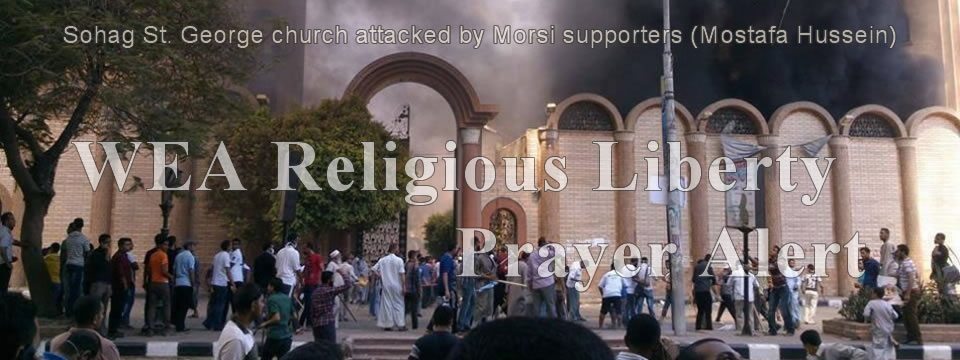
WEA Religious Liberty Prayer Alert
15th August, 2013
If one member suffers, all suffer together
1 Corinthians12:26
In yesterday’s sudden eruption of violence scores of churches, Christian-owned businesses and homes came under attack in Egypt.
The violence was a reaction to the government’s crackdown on 2 camps in Cairo, established to call for the reinstatement of President Mohamed Morsi.
Media reports state that 27 church buildings and at least 30 Christian-owned homes were attacked in the violence unleashed by pro-Morsi supporters. The government, however, reported attacks on only 7 churches.
According to the Egyptian Health Ministry, 235 people were killed and more than 1000 injured in the clashes. However, estimates of the casualties vary widely with some reports even stating that the death toll could be around 1000.
Since President Morsi was ousted, extreme Islamists have targeted the country’s Christians, stating that they hold them partly responsible.
Only last week, a 10-year-old Christian girl was shot dead on the way home from her Bible class.
Prayer points:
- Pray that there would be no more outbreaks of violence;
- Pray for God’s protection over all Christians in Egypt;
- Pray for God’s healing mercy upon all those injured in the attacks;
- Pray that the LORD would comfort families mourning the loss of loved ones.
by Guest Author | 8 Aug , 2013 | FOCUS, Secularism
We Can Defend Our Liberties
John Stonestreet, August 2, 2013
Karl Marx said that history repeats itself, first as tragedy, then as farce. And for once, I agree with him.
After World War II, our nation found itself in a dangerous Cold War with the Soviets. But while America eventually prevailed, not everything done in the name of freedom was kosher.
For a time, Senator Joseph McCarthy and the House Un-American Activities Committee wreaked havoc on free speech and destroyed a lot of reputations—remember the Hollywood Ten?
Modern liberals have made freedom of speech a cornerstone of their movement, and rightly so, ever since.
Tragically, the old impulse to control what people believe and say—or crush them politically—is still alive and well. But farcically, it is those who say they value tolerance over everything who are doing a lot of the persecuting.
Orson Scott Card, an award-winning writer of fantasy and science fiction, is their latest target. Card, a Mormon, has publicly stated that society should oppose gay marriage and even homosexual conduct—a pretty mainstream position just a few years ago.
Well, earlier this year, when he was selected to write for a new Superman comic series, homosexual activists tried to blacklist him—on National Public Radio, no less! Now Card’s science-fiction book, “Ender’s Game,” is being released as a major film this fall, and the thought police are at it again.
A gay activist group organized a boycott of “Ender’s Game,” even though all sides agree the movie has nothing to do with any social issue. The goal of these neo-McCarthy-ites is to punish Card, plain and simple, to make him unemployable, and to hurt any company that transgresses their definition of political correctness.
Surprisingly enough, The New York Times is calling them on it. The Times says that the boycott is really “closer to blacklisting,” adding, “This isn’t about stopping the dissemination of antigay sentiments; it’s about isolating Mr. Card and shaming his business partners, thus cutting into their profits. If Mr. Card belongs in quarantine, who’s next?”
Good question, New York Times.
Well, who’s next was my friend and Summit Ministries colleague, Mike Adams. A popular professor at the University of North Carolina at Wilmington, Mike writes extensively and powerfully about speech codes on college campuses. Mike has more than 5,000 Facebook friends. Facebook ought to be sending him flowers and a card every week, because followings like his keep their social media platform in business.
But recently, Mike offered an argument against same-sex “marriage.” It was not angry or sarcastic, but some folks complained. So Mike was informed by Facebook that his account had been suspended for twelve hours for “violating community standards.”
Well shockingly, there are a few Facebook pages still live and active entitled “Kill George Zimmerman.” These are some community standards!
And earlier this month, Facebook blocked fans of Christian actor Kirk Cameron from posting comments about his upcoming movie, “Unstoppable.” Incredibly, Facebook deemed the content of the website “abusive and unsafe.”
Cameron didn’t take this lying down—and neither should we. The actor informed more than half a million of his Facebook fans and received more than 24,000 “likes” and 5,000 comments in about an hour. Facebook rescinded the ban, and eventually stated that they had made a technical mistake. Well, take that for what you will, but at the very least, the flood of comments no doubt helped them discover the “mistake.” “This is a real victory,”
Cameron said. “If we work together, we do have a voice.”
Friends, as you can see, the pressure on free speech is building. But as you can also see, if we stand up for our rights, we can preserve them. However, the old maxim, “use it or lose it,” applies. Let’s stand for our right to free speech and freedom of religion and do so calmly, winsomely, persistently, and—when appropriate—humorously. After all, attacks on free speech are no laughing matter, but they can certainly seem rather farcical!
Next Steps
As John has pointed out, each and every one of us must do our part to keep free speech free. First, stay vigilant. If you become aware of someone being blacklisted or harassed because their view is politically incorrect, speak out using your social networks.
Second, share this commentary on Facebook or Twitter with others. It will take considerable effort from everyone to halt today’s attack on free speech; and it can be done.
Gather more information on Daily BreakPoint by visiting www.breakpoint.org