Life is filled with coincidences. My children still delight in asking me to recount many of the events that have transpired in my life. Be they key or incidental; it makes no difference. They find them exciting and so do I.
“For I know the plans I have for you,” declares the Lord, “plans to prosper you and not to harm you, plans to give you hope and a future.” ~ Jeremiah 29:11 (NIV)
When I was a preschooler, I met a man from New Zealand. He had brought his family to Canada and worked at the same engineering firm as my father for a number of months. Given their similar stages in life, my dad’s boss suggested our families socialise. I have a few vague memories of their time with us.
Years later, there was a knock on the door; I opened it. “Jelly-tot Bob!” I squealed. “Little-one,” he replied, “you remember me!” Somehow the memory of this happy man was deeply etched in me. Bob stayed with us for a few days and showed us pictures of his family back in New Zealand. I was hooked by the time I saw the second photo.
I was away on a French exchange, during my final year of high school, when my parents sold our house in Calgary. They rang and said, “Bob has invited us to visit his family in New Zealand later this year. If you can get a job and save up enough money for your flights, we’ll pay your living costs while we’re there.”
Bob collected us from the Auckland International Airport mid-October ’84. After a brief tour of the city, he took us to his house in the Waitakere Ranges, where we stayed with his family for the next six months.
“Welcome to my home… My house: my rules.”
Apparently, when Dad first met Bob, he identified him as one of “those Christians” who naturally spoke about the love of his life. Being a determined atheist, Dad took Bob aside and advised, “My house: my rules.” Bob respected Dad’s wishes – and waited patiently for the day the tables would be turned.
Bob proved to be a very ‘connected’ and forward thinking man. Not only was he the founder of Inspirational Tapes, the NZ distributor for ‘Everyday with Jesus’ and exercised Christian hospitality by taking in numerous people from all walks of life, but he was part of a group of men who initiated many innovative Christian trusts – including one that operated a campground in Pauanui, Coromandel. Bob arranged for me to work at The Glade as a volunteer for the summer, alongside his daughter. There I met many wonderful people, realised the extent of my situation, the truth of the Gospel and gave my life to Christ.
One of those key people was Viv, a missionary on furlough from the slums of Manila. He too had previously been on the receiving end of Bob and Prue’s hospitality and he advised me to tell my parents about my decision and ask Bob to baptize me in one of his ponds when I returned to Auckland.
Before returning to Canada, God told me he would bring me back to NZ in two years. I felt homesick as I passed through the gates of the departure lounge…
“When I was a child, I spoke and thought and reasoned as a child. But when I grew up, I put away childish things.” ~ 1 Corinthians 13:11 (NLT)
Upon our return to Canada, Dad pointed out that I was 18 and that it was time I grew up. My sister and I rented a basement suite in a house mid-way between the university and technology institute, where I studied architecture. I also found a Bible believing church with a supportive congregation and fantastic youth group to help establish me in my faith.
A recession hit Western Canada as I graduated, but that didn’t concern me because a still, small voice reminded me that two years were up… “I’m preparing the way for you to return to New Zealand.”
A letter from an architectural practice arrived in the mail so, I rang and asked how they heard about me. “Someone showed me an ad in an architectural magazine. It has your name, age, address, qualifications and says you want to work in New Zealand.” I was offered a job and moved to New Zealand two weeks later… I didn’t place the ad.
Coincidences happens when our lives coincides with God’s plans. In other words, coincidence is a God-incidence
Take another look at 1 Corinthians 13:11. Even as an unbeliever my father would have agreed whole-heartedly with the text, but this is how I read it:
When I was a child, I spoke and thought and reasoned as a child. I believed everything my father said and did… and suffered the consequences of an abused childhood… because I existed under his domination.
But when I grew up, I put away childish things. I saw reality and took hold of life under God’s authority and protection. Most importantly, because I grew up I forgave my father of his sins against me… just as My Father (God) forgives me of mine against Him (Matthew 6:12).
Coincidence?
I’d love to hear about some of your “coincidences”. Please, post them below. Your faith will grow and you will inspire others. And share my story with others if you feel it may encourage them.
Blessings,
Gayann
Gayann and her husband, Stephen, have provided web design and email communication support to NZCN since 2006. She has home schooled their two children for the past nine years, but was ‘made redundant’ at the start of 2013. Since then, she has taken a more active role with NZCN.
Historian Jaroslav Pelikan began his insightful book, Jesus Through the Centuries: His Place in the History of Culture, with these provocative words: “Regardless of what anyone may personally think or believe about him, Jesus of Nazareth has been the dominant figure in the history of Western culture for almost twenty centuries.” The question that immediately confronts the competent historian, of course, is why: why did a penniless, itinerant rabbi from a backwater district of the Roman Empire, executed in disgrace, exert such a powerful influence on Western civilization?
Reza Aslan’s best-selling book, Zealot: The Life and Times of Jesus of Nazareth, belongs to that genre of works devoted to unearthing the “real historical Jesus.” Like countless authors before him, Aslan claims to have discovered a radically different Jesus from the personality portrayed in the gospels and preached by the church for two millennia. Like his predecessors, he assumes, without any hard evidence, that the Christian community conspired to reinvent Jesus in order to meet pressing social needs. Like them, Aslan delivers an account that fails, with staggering ineptitude, to answer the question that haunts all honest minds about the legacy of the Nazarene.
In Aslan’s retelling, Jesus made no claims to divinity, nor did he interpret his life and death as the crowning act of God’s redemptive mission on earth. Rather, he writes, Jesus was “a zealous revolutionary, swept up, as all Jews of the era were, in the religious and political turmoil of first-century Palestine.” In short, Jesus was a freedom-fighter advocating violence to remove the boot of Roman rule from the neck of his fellow Jews.
Jaroslav Pelikan’s book is worth revisiting in the midst of this latest debate. He reminds us that in each age of history, scholars as well as laymen depict Jesus in ways that endorse their own cultural biases and agendas. In the Renaissance, Jesus was “the Universal Man,” the figure who inspired the humanistic revolt against traditional and medieval beliefs. In the Age of Enlightenment, Jesus was “the Teacher of Common Sense,” a moral reformer opposed to the superstition and spiritual tyranny of organized religion. Thomas Jefferson, for example, required just three evenings at the White House to bang out his own version of the life of Jesus, “abstracting what is really his from the rubbish in which it is buried.” The discarded trash included just about everything Jesus said about God, eternal life, and the coming judgment.
The habit of reinterpreting the life of Jesus to support professional and partisan agendas picked up steam in the turbulent twentieth century. In the throes of the First World War, American ministers and theologians invoked his name to convert the war into a holy crusade. “This conflict is indeed a crusade. The greatest in history — the holiest,” intoned Randolph McKim from his pulpit in Washingon, D.C. “Yes, it is Christ, the King of Righteousness, who calls us to grapple in deadly strife with this unholy and blasphemous power.”
Scholars and ministers took the opposite line in the 1930s, however, having repented of their faith-based militarism. In their historical revision, Jesus was “the Prince of Peace” who endorsed utopian disarmament schemes and rejected war under any circumstances. The portrait of Jesus as Divine Diplomat was trotted out even as Nazi Germany launched its blitzkrieg throughout Europe. As late as 1941, with most of Europe under Nazi control, Rev. John Haynes Holmes spoke for many when he argued for complete disarmament: “Can anyone read Jesus’ gospel, and study his life in fulfillment of that gospel, without seeing love is a weapon more potent than the sword?” Their twenty-first-century descendants, such as Duke University’s Stanley Hauerwas, promote the same pacifist messiah, confident that Jesus categorically rejects the “war on terror” as an immoral foreign policy.
By the 1960s, leftist theologians were touting Jesus as “the Marxist Messiah.” In their “liberation theology,” Jesus championed the cause of the poor against their capitalist oppressors. As such, he endorsed violent revolution against Western-backed dictatorships, the nationalization of industry, and the collectivization of private property. “I think liberation theology’s understanding of Jesus is part of a wider 20th-century appreciation of the historical Jesus and his ministry,” says Fordham University’s Michael Lee.
Zealot likewise fits the temper of our times neatly — too neatly. Aslan’s controversial Fox News interview, about whether his Islamic background allows him to write an objective historical account of Jesus, obscures the real problem: the hubris of the professional provocateur.
Aslan has advanced his career — he is a professor of creative writing, not a historian — with self-serving criticism of the “demonization” of Islam under the Bush administration. Having fled Iran in 1979 for the United States, he interprets the 9/11 attacks as a clarion call to Muslims in the Middle East to overthrow oppressive regimes. Thus, the Arab Spring is seen as the happy fruit of that horrific event: an unequivocal march toward political freedom. “Across the board,” he told Mother Jones, “what has happened is that the regimes in the region now understand that they can no longer just ignore the will of the people.” (Aslan has less to say about the pernicious influence of radical Islamist jihad in directing the “will of the people” in Egypt, Syria, Libya and beyond.)
Thus, we encounter Jesus the Zealot for Political Liberation: the embodiment of the revolutionary motif so congenial to Aslan’s frame of mind. The problem, of course, is that textual and historical evidence to the contrary — not to mention a good dose of common sense — must be thrown overboard to support the storyline.
Jesus’ counsel to his followers, for example, about whether to submit to Roman rule — “give to Caesar what belongs to Caesar, and give to God what belongs to God” — takes on a subversive meaning. Evading the plain rendering of the Greek text in the gospels, Aslan claims that Jesus forcefully denounced the oppressive political authority of Rome, embodied in its tax system. The telling fact that none of Jesus’ disciples interpreted his words as a rallying cry for rebellion is not permitted to intrude into this fantasy narrative.
We are informed that the early Christians, desperate to avoid the persecuting wrath of Rome, sought to soften the militant themes embedded in Jesus’ message. As Aslan writes: “Thus began the long process of transforming Jesus from a revolutionary Jewish nationalist into a peaceful spiritual leader with no interest in any earthly matter.” We are asked to believe in a vast conspiracy of distortion, sustained over centuries, supported by false documents, countenanced and hushed up by church leaders.
Sound familiar? Dan Brown, author of The Da Vinci Code, at least had the decency to tell us that his work was fiction. The preaching of the early church, the collective testimony of Christian martyrs, the Christian moral code that challenged much of Roman cultural and political life — all of this lays waste to the notion that the primitive church was more concerned about its social status than its fidelity to the life and teachings of Jesus.
Aslan insists that his aim is to “purge the scriptures of their literary and theological flourishes and forge a more accurate picture of the Jesus of history.” What has been purged in this latest treatment of the life of Jesus, however, are not the flourishes, but the existential, redemptive core of the faith he founded. Other religions, including Islam, may be able to dispense with the miraculous and retain their essential meaning. Not the religion of Jesus. “The Christian story is precisely the story of one grand miracle,” writes C.S. Lewis, “that what is beyond all space and time, what is uncreated, eternal, came into nature, into human nature, descended into His own universe, and rose again, bringing nature up with Him.”
No account of the historical Jesus better explains his extraordinary and enduring influence over the human story than this one.
Joseph Loconte, PhD, is an associate professor of history at the King’s College in New York City and the author of The Searchers: A Quest for Faith in the Valley of Doubt (Thomas Nelson).
It’s been a while since I went to a hair dresser. I still remember what it was like. It’s not actually something I miss. My stereotype of hairdressers are people who talk a lot all day with many different people. They have their ear to the ground, their finger on the pulse, and are probably happy to give their opinion about anything (I say that all positively).
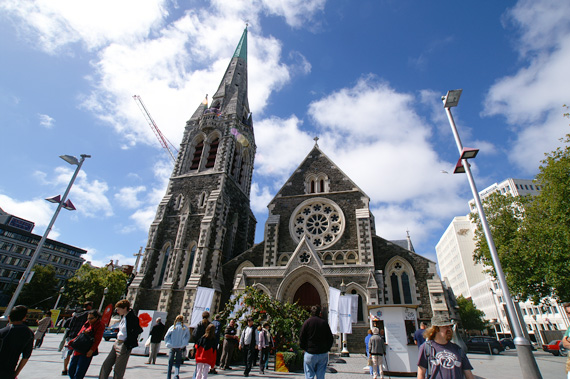
Christchurch Cathedral before the 22 February, 20111 earthquakes
For my doctoral research I interviewed some people who were not what I defined as being Christianised. I wanted to gain their perception of the Christian church in New Zealand. One of these people was a 30-year-old male hairdresser working in the inner city who was born and grew up in Christchurch. He had some fascinating thoughts about the Anglican cathedral which was a central icon in the inner city. This is part of his story:
This conversation was before the 22 February 2011 earthquakes which destroyed both of the cathedrals in Christchurch.
I invited the people I interviewed to choose where we met and I offered to buy them a drink at a cafe or pub. This hairdresser, lets call him Dave (not his real name), chose a cafe on the edge of the square in the centre of the city, where we met one Tuesday at lunchtime. We sat at a table by a window and the view was similar to that in the photo above.
We were well into the interview, perhaps 40 minutes had passed, and we’d been talking about things to do with society and church. I looked out the window and the thought of asking him about the magnificent symbol of Christendom sitting only meters away from us crossed my mind:
Mike “Looking out here, does the cathedral being in the Square mean anything to you?”
Dave“Um, yeah, I actually thought about that, I think it’s a beautiful building, it’s historical… because we’re New Zealand, we are part of Europe, um, all these countries that churches were, um, originally founded, because they that’s um, English-style architecture…”
Mike “People probably go there on a Sunday”
Dave“Oh it’s a church?! I thought it was just-”
Mike “What would you think of people that went there?…”
Dave“That’s a hard one but I should have an answer for that, I should probably think about that before I answer… if it is a church, I don’t know if it is an active church?”
Mike “yeah, yeah it is”
Dave“People do go there? And it’s probably something you’d see in an old English- with choir boys and big long gowns-
Mike“Yeah, I think they do have a choir”
Dave“And their slick back haircuts and suit and ties…”
I love this conversation. I think it says so much about so many things to do with the church in New Zealand:
the way a part of the church presents itself,
the way something as historically iconic as an Anglican cathedral can appear to be so removed from the essence of Christian-faith-community,
the difference between how I as a churched person see a cathedral and how someone not familiar with church sees it.
Christianity has not been in New Zealand for long: nearly 200 years.
When New Zealand was being colonised, there were two church sponsored settlements, one by the Presbyterian (Scottish) church in Otago in 1843, and the other by the Anglican (English) church who founded Christchurch as a settlement in 1851.
I lived in several New Zealand cities before moving to Christchurch at the end of 2008. When I arrived here I found the historical Anglican influence in Christchurch very noticeable compared to the other major New Zealand cities – for example, the number of Anglican church buildings in the original city limits (the “Four Aves”) compared to the number of “dissenter” churches.
This post isn’t supposed to be a critique of the Anglican church or the city of Christchurch – I like them both! What I hope it does is provide an example of how two people in the same city, both in their 30′s, view a nice old building in the centre of town:
I think of it as the seat of the Anglican bishop for this region, and a place where people who consider themselves part of the Anglican communion in this city can gather for worship. I have also experienced the building as a space used like a town hall, where public meetings and concerts occurred.
Davevalued the building’s architecture including its historical connection back to Europe, and appeared to see the building as having no current religious significance.
When I said I love this conversation, I acknowledge that it isn’t particularly positive for the public impression of the expression of Christian spirituality – that was occurring from the Anglican cathedral before the earthquakes.
What I love is how succinctly it gives a snap-shot of one person’s reality concerning that big old building in the square.
I suspect Dave is not alone with his views and understanding.
Four (?) generations into New Zealand’s most Anglican city and even the bricks and mortar of this institution have lost their meaning [for some – for many?]
What would your hairdresser think? (Lets call this The Hairdresser Test)
One of NZ Christian Network’s objectives is to help NZ Christians understand and respond to secularism. The following article is relevant and hopefully might stimulate some local initiatives.
How UK Christians Can Respond to Secularism?
Instead of separating from our local government, churches in my hometown partnered with it. Danny Webster | 19 August, 2013
It is supposedly the place where King Canute stood and futilely ordered the sea to retreat. It’s certainly the place King Henry V set sail from to reach the Battle of Agincourt. The gate through which the troops marched stands in a forgotten corner of the city. It is the place where the Titanic set sail. On that fateful voyage, 549 people from this city lost their lives.
Illustrious history mixed with patches of ignominy. Sacked by the French in the 14th century, walls restored and strengthened, never again breached. Struck by the plague soon after and again, 300 years later. A city defined by fears of invasion as well as the prospect of prosperity brought through its docks. Its proximity to the sea and other countries both a virtue and a threat.
It’s also where I grew up. Several years ago, the leaders of Southampton, on the south coast of England 70 miles out of London, adopted a vision statement: Southampton would be a city that is “good to grow up in and good to grow old in.” A few years before, Eugene Peterson had used similar language to interpret Zechariah’s ancient words: “Old men and old women will come back to Jerusalem, sit on benches on the streets and spin tales, move around safely with their canes—a good city to grow old in. And boys and girls will fill the public parks, laughing and playing—a good city to grow up in.”
Praying on the City Walls
Around the time the City Council was unintentionally borrowing from the Old Testament, I stood on the city walls. Every other Wednesday night at midnight, a small group of us met here to pray. We looked out over the developments rising from land reclaimed from the sea. We looked down to see revellers staggering from bar to bar, and the homeless man shrunk beneath a park bench. On one occasion, a larger group gathered—too many for our regular perch—so we moved in front of the main city gate. There we knelt. And we prayed. We prayed for our families, for our friends, but most of all, for our city.
Five years ago I left Southampton, a place that will in some way always be home. My parents remain; my sister and her family too. My nephew Josiah, born a few weeks ago, entered this world in the same hospital ward I did nearly 30 years ago. It is a city I love, and a city in difficult times. But Southampton is also a city with churches committed to helping it prosper once again.
In 1925, the Methodist Central Hall was built in the center of Southampton. On the scaffolding stretching across the half-finished structure hung a sign calling for workers. But it wasn’t a call for carpenters and masons; it was a call for workers to carry out the work of the church: “Workers wanted with grace, grit, and gumption.” For a food bank, a clothing bank, a poor man’s lawyer, maternity care, Boys’ Brigade, Girls’ Brigade. It is not a new thing for the church to serve the city. It is just something it has on occasion forgot.
If the church really has good news, then it needs to make a difference to those who need it most. And Southampton, like communities across the United Kingdom, is in need. One London Borough produced a graph showing their declining income against the rising cost of adult and child social care. By 2022, they will afford nothing else. That means no libraries, no youth clubs, no pot holes filled, no bins collected. The funding crisis for local government in the UK is very real, urgent, and will get worse before it gets worse
About the time I was praying on the walls of the city, the Council was also reforming the governance of several schools. They invited bids from businesses, universities, and charities to take over running the schools. In a fit of outrageous desire to serve the city, my church, New Community Southampton, threw its hat into the ring. Four schools being merged into two, in two different but similarly deprived parts of the city, contracted out as part of the government’s academies program for 125 years. And they chose us.
It nearly brought the City Council down, I sat above the chamber as it tabled a vote of no confidence in the elected leader, then passed only because of a renegade councillor voting against her party. Billy Kennedy, senior leader of New Community Church, Southampton, signed on the dotted line. By doing so, he took responsibility for the schools for over a century to come. In the years since, the church has built relationships with the local government, and improving exam results have demonstrated credibility. In Southampton, and throughout the UK, local churches are becoming the preferred partners for local government.
Christians Creating Jobs
In the light of the budget cuts faced by the council—£25 million to go this year, and again the next, and the next; 300 jobs going this year alone—the council asked for churches’ help. And that little bit of grammar matters. It was the churches together, not one in competition or isolation from others, from across the city, all committed to seeing Southampton become a place that more reflects the kingdom of God. A place that is good to grow up in, and a place good to grow old in.
Southampton has prospered from its position as a trading port, bringing employment to many. This summer, Ford will close its assembly plant on the edge of the city. In 1910 Ford opened its first UK dealership in the city, with a manufacturing plant following in 1939. For generations the factory has provided work. One employee commented on the closure: “My dad worked here in 1972 for 25 years. I’ve worked here for 25 years. I’m not sure what I’ll do.”
The City Council leader met with the churches who wanted to help address unemployment. They could help with youth unemployment, they were told. They could help with youth clubs, childcare, and the shortfall of families willing to foster and adopt in the city. From across the city, 400 people from churches of every stripe met to hear the challenges and consider what they could do. They prayed and then got practical.
Christian businessmen and women started to ask what they can do to create jobs. There is the scandal of private fostering companies making money out of the lack of families able to provide a home for some of the city’s most vulnerable children. Because the local council cannot find enough families for children in care they pay private companies, at a very inflated rate, to find these places. The city needs 40 more families, and the churches have committed to find them—at last count 39 families from churches in the city have stepped up and applied to become carers. If they make it they’ll save the city £1.2 million by doing away with the need for private foster agencies.
Council budget cuts will mean all the youth workers employed by the city will lose their jobs, and children’s centres are under threat. An audit of churches discovered that between them there were 17 paid youth workers across the city and 37 mother and toddler groups. The church has resources and opportunities to serve both their own members and the communities around them.
Welcomed, Not Excluded
For many years, UK Christians have worried about the tide of secularism. They have worried that their beliefs are being squeezed out of public life. We have also had the call for Christians to run for office, take up positions of influence, and be a bulwark against this tide. And like Canute was mocked for his failure to roll back the waves, they have been judged for not doing enough to protect Christian values. From the sidelines, we have worried that our beliefs are being marginalised.
Southampton is just one example of churches across the UK bucking this trend. Behind the scenes and beyond the glare of newspaper headlines, churches are working for the good of their communities. And when they seek to work with local authorities, they are not turned away because of their beliefs but often welcomed as key partners. When church leaders met with Southampton City Council to discuss the issues facing the city, across the table from them sat the Head of Strategy for children’s services, the Head of Parenting, and the lead councillor, all Christians, along with a couple of others. At the time when the city needs the most help, the church is there to respond. To respond as congregations of believers and respond as individual Christians committed to finding ways to resolve some of the communities’ most intractable problems.
Christians are not excluded, they are welcomed. And when relationships are built, when credibility is established, when fears are dispelled and suspicions counted void, the church is there to serve the people of Southampton. When political tides turn, when programs are cut, when funding dries up, the church is committed to make it a city that is good to grow up in, and good to grow old in.
Danny Webster works for the UK Evangelical Alliance on political issues and helping Christians engage in public life. He tweets @danny_webster and writes on an eclectic range of issues, from relationships and church culture to politics and theology, on his blog, Broken Cameras & Gustav Klimt.
Danny’s essay won the This is our City essay contest run by Christianity Today
I wrote an article in one of the national newspapers a couple of weeks ago in praise of Lucinda Creighton and afterwards received an email that gave me pause for reflection. It was short and not so sweet. My correspondent didn’t like my views, and indeed seemed to like Lucinda’s even less. But what intrigued me was the graphic image at the core of the communication – of a teenage Down Syndrome girl who has been raped. People like Lucinda Creighton and myself, he declared, were standing in the way of her receiving an abortion.
The email didn’t change my mind about abortion, but it put me thinking about the way liberals have managed to win this debate, and will go on to win many more. I was briefly tempted to write back to this man (my correspondent was male) and ask him for the name of the teenage girl he referred to. In the end I decided against this course, feeling that it might give him a perverse kind of encouragement.
But of course there was no teenager with Down Syndrome. The girl had no name because she did not exist. It stuck me then that at least half of the argumentation put forward by the ‘pro-choice’ lobby is similarly lacking in any reality, being purely hypothetical. I can think of no other issue in respect of which the debate could take place in such abstract, dissociated terms. Imagine a debate about motor transport, for example, being conducted in this way: it would take just one or two instances of people being killed by motor vehicles to ensure that mechanically-propelled vehicles were banned for all time.
In the past 30 years, there has been a handful of real-life public controversies in which the issue of abortion was critical in the life of an actual woman – the X and C cases, for example, and more recently the Savita Halappanavar case. And yet, the pro-choice, building on this handful of cases, and augmenting its arguments with a series of creative hypotheses has, in effect, changed Ireland from being a nation inflexibly opposed to abortion to a society on the cusp of giving the nod to one of the most liberal abortion regimes in the world.
The debate of the past nine months confirms that this is going to happen, and there is no point in sticking our heads in the sand. Given the conditions in which these ‘debates’ occur, this is inevitable and cannot be prevented. For one thing, the ‘debates’ are almost invariably hosted by ‘liberal’ journalists, and, for another, the skewed dynamics of the ‘debates’ ensure that these are really dramas in which traditionalist forces are pitted against liberals in a manner than ensures only the liberal argument can win. Hence, it is not so much a question as testing both sides of an argument as dramatising the victory of ‘truth’ over ‘error’. If the present media culture is permitted to continue, abortion will eventually be introduced into Ireland. It is only a matter of time.
But those taking up the other side of the argument must take some responsibility also. Because of its outlook, ideology and tactics, the pro-life side has done much to deliver victory into the hands of its opponents, most notoriously in its promotion of the 1983 constitutional amendment, which had the effect of overriding a perfectly adequate anti-abortion law with a measure that in effect placed the rights of mother and child in diametric opposition, leaving the decision in complex cases to be decided by the courts. Once you redefine the relationship of mother and child outside its natural symbiosis, identifying the two parties as competing entities, the child has a diminishing chance of survival. Hence, that amendment unwittingly delivered the unborn child into a new dispensation of individualised rights, in which the balance of advantage – by virtue of ideology and the media’s capacity to manipulate public sympathies – would most likely be overwhelmingly on the side of the mother. Each successive case has resulted in a further erosion of the legal situation, which has now been formalised in the Protection of Life in Pregnancy Bill.
At the heart of this debate has been the recurring theme that pregnancy is always by definition an imposition on a woman, unless she chooses to define things otherwise.
Once this idea is accepted, abortion on demand becomes merely a matter of time, because the very bedrock of the culture becomes contaminated with a quite different understanding of human nature and purpose than was understood hitherto. Rarely is it pointed out that it is not in the nature of mothers to be opposed to their children, unborn of otherwise. On the contrary, the very idea of motherhood, and indeed fatherhood, is centred on providing for the needs of the child even at the expense of the parent’s personal well-being or even ‘rights’. Most parents, for example, would think nothing of risking their lives to rescue one of their children from a burning motor vehicle. And yet liberals use as a central bulwark of their debating tactics the idea that no woman should ever be expected to incur any risk by virtue of being pregnant.
Life is risk, and most people accept this. The number of people who are unwilling to run such risks for their children are miniscule, and yet the outlook of this tiny notional minority is used to effect the most fundamental changes in our understandings about the very nature and structure of human beings.
Another major failing on the pro-life side has been its attitude to the position of fathers in relation to unborn children. Irish Catholicism is by its nature mother-centred, and has therefore, unbeknownst to itself, been supplying a harmony to the feminist rhetoric emanating from the ‘pro-choice’ side. There is no point banging on, in different contexts, about ‘family values’, if you neglect to emphasis this aspect where it is most vital. The only person I heard alluding to fathers during the recent discussion was the (now former) Fine Gael TD Peter Mathews.
And there is an even more fundamental difficulty in as far as the Catholic contribution to these discussion is concerned. In recent times, Irish Catholicism has been asserting itself in the public domain almost exclusively in the context of battles to prevent the social drift of Irish society from taking a different direction to Catholic moral teaching. The word ‘abortion’ has become almost a synonym for ‘Catholic’, provoking public demonstrations characterised by extremist statements and intense rage. Meanwhile, the insistent and growing pressure in our culture to remove Christian thinking from the mainstream of education and culture attracts virtually no opposition from within the Catholic Church – apart from an occasional and timid resistance which might easily be construed as the straightforward protection of territory.
It is a problem that Catholic contributions to these debates rarely penetrate to the heart of the Christian teaching involved. Thus, the ‘traditional’ argument is easily dismissed as arising from simplistic positions, usually expressed in the form of unadorned and unsubtle rules – for example, that ‘all human life is sacred’, or that ‘marriage is between a man and a woman’. Such is the construction of the debate-drama that the reiteration of such reductionist rules serves merely to confirm that the interest of Christianity in this context is to oppose the impetus of modern society, rather than, for example, to make clear why Christians have come to think as they do. In the kind of public discourse we have arrived at, the telegrammatic expression of such values acquires precisely the texture and context which those on the other side of the argument rejoice in.
The Bible has to be read rationally as I have suggested and in the totality of its teaching, says Tallon. Photo / Getty Images
Originally published on nzherald.com on Wednesday Aug 7, 2013
Strange how some people are so fearful of religion. Nowadays it’s everywhere. A week or so back London officials banned the use of the phrase “in sickness and in health” in civil registry wedding vows as “too religious”.
Then, here, it was prayers in schools – to expunge these we would have to drop the National Anthem. And every day I hear passionate prayers from the most irreligious – all it takes is a finger caught in a door. Now it is the Bible in schools.
Why the fuss? Herald on Sunday columnist Paul Little asserts that religion amounts to “an intellectual transit lounge where the shackles of reason are thrown off and replaced with the loose fitting robes of superstition”. David Hines, “Rationalist”, is stuck in a time warp, still choking on Crusades and Inquisitions. Both are caricatures that fall little short of bigotry.
If rationalism means, as my dictionary states, “reliance on reason as the best guide for belief and action” then I am a Christian rationalist. And so are many of my Christian colleagues and friends. Indeed I would expand “reason” to read “reason and evidence”.
I am an orthodox Christian because of reason and evidence. I see no “shackles” piled up outside the door of my church each Sunday.
Does it not occur to these gentlemen, and so many others like them, that the institution that gave us modern empirical science is actually rather likely to engage with the mind?
Now in fairness I think we should be allowed to inspect Rationalist websites. What does one find? No end of bigotry, abuse and hatred of all things religious.
There is an issue about Crusades and Inquisitions and it’s this: People in the church have always distinguished between the church political and the church pious.
Of course the church political has lost its way from time to time. Look at any regime where accountability has been mislaid. But also time and again the church pious has pulled it back to its roots and reformed its practice. What are those roots? They are the Bible.
The Bible has to be read rationally as I have suggested and in the totality of its teaching. That core teaching lies at the heart of our institutions of democracy, freedom and justice, our understanding of the inviolability of human dignity, our very understanding of “the Western way of life”. Any denial of this is just modern-day medieval book burning.
So why would it not be taught in schools? If we want facts, data, evidence, archaeology – then all that can be provided. It forms part of my daily study.
And here’s the rub. All this data is actually substantial and requires a great deal of study to critically assimilate. I find people are simply unaware of the sheer quantity that is available.
Can we find the teachers who can teach this? That remains a challenge. I’m sure that in practice there are good examples and poor examples and, like all teaching, it requires excellent training.
It would be futile to attempt to remove religious terms from secular discourse. Here are some rather clumsy but illustrative few paragraphs:
There’s a fly in the ointment. It’s a sign of the times that politically correct busybodies, who are a complete law unto themselves, try to force us to set our house in order. Faith is the scapegoat. Religion, we are told, is the root of all evil, a thorn in the flesh for society which is wallowing in the mire of medieval beliefs. We need the patience of Job. How can we hold our peace? The PC powers that be, self-professed salt of the earth, have seen the light and seek to redeem us lost sheep from the howling wilderness of faith and bring us safe and sound back to sterile secularism. At the eleventh hour they hope to rescue us by the skin of our teeth.
Of course each of these phrases were introduced to the English language from the Bible.
Point made? Our historical religion lies doggedly at the heart of all our culture – our language, our institutions, even our science. Seems like there’s plenty to teach in schools.
Dr Jeff Tallon is a physicist specialising in superconductivity.